This article was translated from Japanese using AI. Read the Japanese original
In Zusetsu tokei no rekishi, Takashi Arisawa uses illustrations to trace how people have told the time, from sundials to mechanical clocks, pocket watches and wristwatches. The first half follows the changing forms of portable timepieces. The second turns to the people and industries that made them in Switzerland, Germany and Japan. The published table of contents and library descriptions provide a guide to the book and to objects that illuminate its themes. 1 2 3
From pocket watches to wristwatches#
The first three of the book’s nine chapters cover the beginnings of mechanical clocks and the development of the pocket watch. Chapter 4 shifts the focus to the wristwatch. Chapters 5 and 6 follow its wider adoption and subsequent changes. The Osaka Municipal Library notes that mechanical timepieces have also been prized as ornaments. Arisawa’s illustrations allow the reader to follow these changes in the shapes of the dials and cases. 2 3
The Laurel wristwatch of 1913 illustrates this transition. According to the Seiko Museum Ginza, Seikosha developed the wristwatch using movement and exterior components shared with a small pocket watch of the same name. The way people wore the watch changed, but the maker drew on the techniques it already used for pocket watches. 4
The history of watchmaking as an industry#
Chapter 7 deals with the recovery of Swiss watchmaking. Chapters 8 and 9 tell the industrial histories of Germany and Japan respectively. This geographical approach places changes in wristwatch design and mechanisms in the context of manufacturing centres and their industries. 2
Swatch Group’s corporate history, for instance, describes the Swatch introduced in 1983 as a watch of just 51 components assembled on an automated line. In Germany, the watch museum in Glashütte (in Japanese) traces the history of local watchmaking since 1845 through objects and records relating to its makers and firms. Both sources give readers ways to explore the industrial history in the second half of the book. 5 6
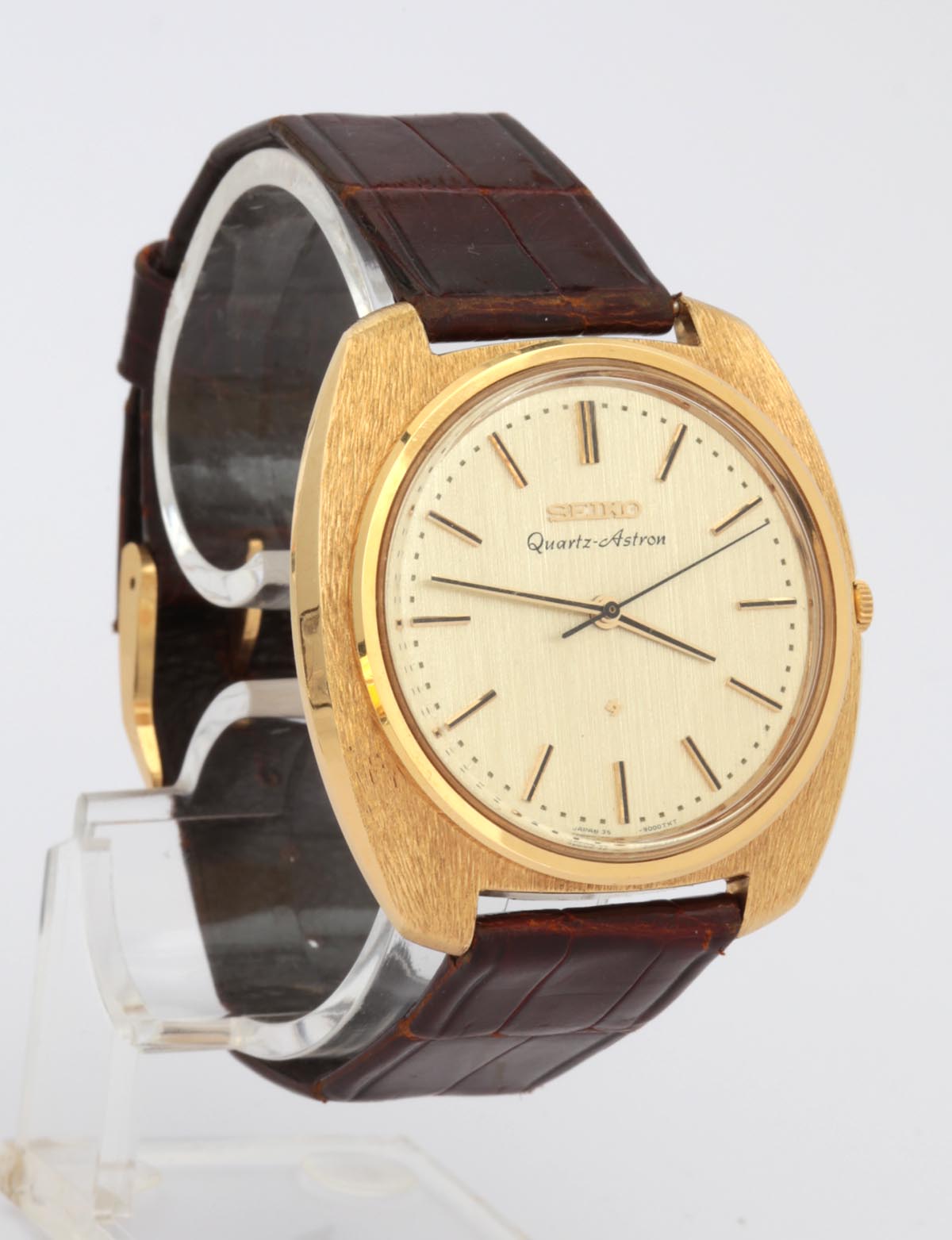
Seiko Quartz Astron, 1969. German Clock Museum, Furtwangen, inventory no. 2012-047. Photograph by Deutsches-uhrenmuseum, via Wikimedia Commons, licensed under CC BY-SA 4.0. Image unmodified.

The launch of the Quartz Astron 35SQ on 25 December 1969 marked another milestone in Japanese watchmaking. To fit a quartz timebase into a wristwatch, Seiko progressively miniaturised the technology, moving from equipment for broadcasting stations to pocket-watch and wristwatch prototypes. 7
Starting points for research on timekeeping in Japan#
The chapter on Japan also offers a starting point for studying timekeeping before industrial manufacture. When asked how people told the time during and before the Edo period, the Okazaki City Central Library directed a reader to the section on timekeeping in Japan before the wadokei, on page 90. Its reference response mentions water clocks (rōkoku) in that section. The book closes with a brief chronology of horology on pages 104–105 and a bibliography on page 106. 2 8
Arisawa had been deputy editor of a watch magazine. From 2004, before the book appeared, he helped plan, report and edit material for publications including temps and Udedokei-ō. Descriptions of the book mention craftspeople who carry on traditional techniques and watch museums in different regions, alongside a survey of timepieces from early examples to modern mechanical complications. 1 2
Bibliographic details and library holdings#
| Item | Details |
|---|---|
| Title and author | Zusetsu tokei no rekishi, by Takashi Arisawa |
| Publication | Kawade Shobō Shinsha, Fukurō no Hon series, January 2006 |
| Release date | 24 January 2006, according to the publisher |
| Language and format | Japanese, printed book, 111 pages, 22 cm (National Diet Library catalogue) |
| ISBN | 978-4-309-76073-5 (ISBN-10 4-309-76073-2) |
| Call number | National Diet Library, DL456-H7 |
The publisher lists 112 pages, while the National Diet Library and CiNii Books record 111. Libraries holding the book can be found through NDL Search and CiNii Books. 1 2 9
References#
- Kawade Shobō Shinsha, “Zusetsu tokei no rekishi”. Publication date, ISBN and biography of the author.
- National Institute of Informatics, CiNii Books, “Zusetsu tokei no rekishi”. Bibliographic information, end matter, contents and description from the BOOK database.
- Osaka Municipal Library, “Zusetsu tokei no rekishi”. Summary in the library catalogue.
- Seiko Museum Ginza, “The birth and development of the wristwatch up to the 1960s”, section on the transition from pocket watches to wristwatches.
- Swatch Group, “Swatch Group History”, entry for 1983.
- German Watch Museum Glashütte, “Welcome to the time experience!”. Introduction to the permanent exhibition.
- The Seiko Museum Ginza, “The birth of the quartz timepiece”. Miniaturisation and the launch date of the 35SQ.
- Okazaki City Central Library, “How did people tell the time during and before the Edo period?”. Reference enquiry recorded on 16 June 2017, source 2.
- National Diet Library Search, “Zusetsu tokei no rekishi (Fukurō no Hon)”. Bibliographic ID 000008066404, Japanese National Bibliography number 20974548.
Web sources checked on 20 November 2026.