This article was translated from Japanese using AI. Read the Japanese original
In L’Art de conduire et de régler les pendules et les montres, Ferdinand Berthoud explains how someone who has bought a clock or watch can choose a time reference, set the hands, and judge how much the timepiece gains or loses. Published in Paris in 1759, the book identifies its readers in its subtitle: people with no knowledge of horology. Berthoud’s aim was to help owners understand how their timepieces worked and get the best performance from them. Manufacturing techniques receive only the attention this requires. 1 2
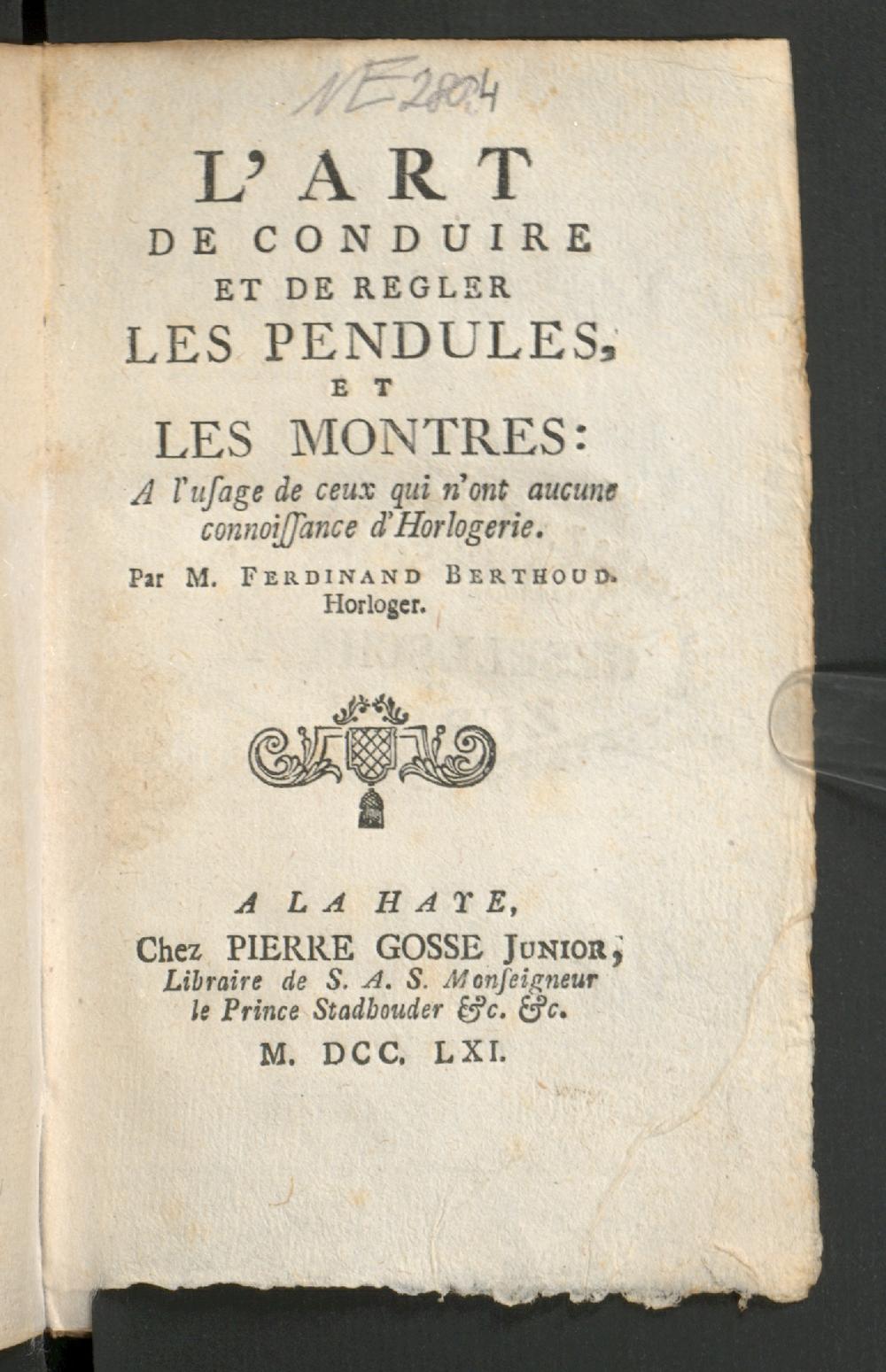
Figure 1. Title page of the 1761 Hague edition. Author: Ferdinand Berthoud. Collection and image: Zentralbibliothek Zürich, NE 2804. Source: digitised copy on e-rara. Public domain (rights statement for this copy, Public Domain Mark 1.0). Image reproduced unmodified.
Bibliographic details and editions#
| Item | Details |
|---|---|
| Author | Ferdinand Berthoud (1727–1807) |
| Original title | L’Art de conduire et de régler les pendules et les montres, à l’usage de ceux qui n’ont aucune connoissance d’horlogerie |
| First edition | Paris, the author and Michel Lambert, 1759 |
| Edition discussed here | The Hague, Pierre Gosse Junior, 1761 |
| Language | French |
| Physical description of the 1761 edition | XII preliminary pages, 107 pages of text, one unnumbered blank page, IV folding plates, 14 cm (duodecimo) |
| Holding institution and identifiers | Zentralbibliothek Zürich, NE 2804, DOI 10.3931/e-rara-51821 |
Sowerby’s catalogue of books formerly owned by Thomas Jefferson describes the 1759 Paris volume as the first edition and records 48 leaves and four numbered copperplates by P. P. Choffard. The discussion that follows uses the 1761 copy in the Zentralbibliothek Zürich. Its pagination belongs to that edition alone. 1 2
Is a clock that agrees with the sun always right?#
Berthoud opens his preface with a common expectation: once a clock has been set and is wound every day, it ought to keep correct time indefinitely. He distinguishes changes in the rate of the timepiece from discrepancies that arise when the sun is used as the reference. Understanding why winding alone is insufficient begins with understanding the time standard. 1 (preface, pp. iii–x)
Section I distinguishes apparent time from mean time. Apparent solar time takes noon at the instant the sun crosses the meridian. Mean time is a uniform measure that smooths out the variations in apparent solar time. The difference is the equation of time. A changing discrepancy between noon by the sun and noon by the clock is therefore no proof of a faulty movement. 1 (pp. 1–6)
Section XI turns this distinction into a practical observation. In the example for 6 October, apparent solar time is 12 minutes ahead of mean time. At the instant of the sun’s meridian passage, the reader should set the clock to 11:48 mean time. At later observations, the reader uses the equation of time for the date to determine how much the clock has gained or lost, rather than resetting the hands to noon whenever the sun crosses the meridian. 1 (pp. 52–60)
Berthoud thus makes choosing a standard of comparison part of the owner’s task. He also explains how an equation clock can display apparent solar time: the underlying movement runs uniformly while a separate minute hand receives the correction for the sun’s unequal motion. 1 (pp. 30–31)
Understanding the movement and its regulation#
Gear train, pendulum and balance#
Sections II and III distinguish the source of power, the train of gears that transmits it, and the oscillating component that regulates their motion. A falling weight powers a weight-driven clock, and the pendulum sets its beat. A portable timepiece cannot use a pendulum. A mainspring provides power, while the balance and its spring regulate the rate. The balance is a wheel that turns alternately in each direction. The fine balance spring restores it towards its equilibrium position. 1 (pp. 7–27)
The 1761 edition gives a numerical example. A 72-tooth wheel driving a six-leaf pinion gives a ratio of 12 to 1. A 60-tooth wheel driving a second six-leaf pinion gives 10 to 1, for a total ratio of 120 to 1. If one turn of a 30-tooth escape wheel corresponds to 60 beats of the pendulum, 120 turns correspond to 7,200 beats. At one beat per half-second, these occupy an hour, during which the first wheel turns once. 1 (pp. 14–17)
A constant rate and a variable rate#
Section VI distinguishes a timepiece that needs regulating from one whose rate varies. A watch that gains two minutes every day gains four minutes in two days and 24 minutes in twelve days. The error grows in proportion to the elapsed time: its rate is steady and can be corrected by regulation. A watch that gains one day and loses the next has a problem that a simple adjustment cannot remedy. 1 (pp. 37–38)
Section VII advises comparing a watch against the same good pendulum clock throughout. First hang the watch up for 24 hours, noting the difference every few hours. Then compare it again while actually carrying it, to see whether position or movement affects its rate. Changing the reference clock or sundial between observations risks attributing a difference between the references to the watch being tested. 1 (pp. 39–42)
Section IX describes regulating a watch by changing the effective length of its balance spring. Lengthening the active portion slows the oscillations, while shortening it speeds them up. A diagram of the rosette regulator shows how the pointer, gear, rack and pins on either side of the spring work together. The effect of one graduation varies from watch to watch, so Berthoud advises comparing the known gain or loss with the result after adjusting it. 1 (pp. 44–49)
The roles of owner and watchmaker#
Before discussing regulation, Section V lists factors that affect performance: temperature, changes in driving force, friction, the condition of the oil, air resistance, shocks and position. Its figures for daily rate and other measures express what Berthoud expected of the timepieces of his day. Modern certification standards serve a different purpose. 1 (pp. 33–36)
Section XIII, on buying a timepiece, explains why fine finishing alone cannot establish performance. Beautiful components may still be poorly designed. Sound principles and sound workmanship must go together. Berthoud criticises extreme miniaturisation and needless complexity, and stresses the maker’s knowledge and trustworthiness. These are the views of an author who also made and sold timepieces. 1 (pp. 69–77)
Section XIV treats repair and cleaning after purchase as part of ownership. Moisture can rust steel, and dust mixed with oil can cause wear. Berthoud advises entrusting the work to someone able to assess the entire movement as well as clean it. Section XV summarises the main points. As the preface explains, this arrangement also serves readers who skip the rest of the book. The advice documents eighteenth-century practice and should be understood in the context of the timepieces for which it was written. 1 (preface, p. ix, and pp. 78–87)
The author’s purpose and later additions#
In his preface, Berthoud explains that too much scientific detail would make the book long and abstract. He reserves the more specialised explanations for his Essai sur l’horlogerie. He thus assigned different purposes to the short guide for owners and the technical treatise on principles. 1 (p. x)
The contents changed in later editions. The table of contents of the 1811 Paris edition published by Courcier covers ordinary timepieces and also lists sections on determining longitude with astronomical clocks, transporting them overland and drawing a meridian for mean time. 3
| Year | Edition or record examined |
|---|---|
| 1759 | Paris first edition, described in Sowerby’s catalogue |
| 1761 | The Hague, Pierre Gosse Junior. The Zürich copy is available online |
| 1811 | Paris, Courcier. The contents list includes sections on astronomical clocks |
As a historical source, Berthoud’s book connects a timepiece’s accuracy to the reference used for comparison, its position in use, its regulation and its maintenance. Its central question emerges from a simple distinction: a clock can agree with a reference at a single instant, but does it continue to run at a uniform rate? 1
Primary sources and scope#
This account is based principally on the preface, table of contents and Sections I–III, V–IX, XI and XIII–XV of the 1761 edition. The 1759 edition was examined through its bibliographic record. For the 1811 edition, the publication details and contents list were consulted; its treatment of longitude is beyond the scope of this account. 1–3
References#
- Ferdinand Berthoud, L’Art de conduire et de régler les pendules, et les montres, The Hague, Pierre Gosse Junior, 1761. Zentralbibliothek Zürich, NE 2804. Preface, pp. iii–x, table of contents, pp. xi–xii, and the pages cited above. Digitised copy and catalogue record on e-rara, DOI. Accessed 13 November 2026.
- E. Millicent Sowerby, Catalogue of the Library of Thomas Jefferson, vol. I, p. 535, no. 1186. Catalogue record, Thomas Jefferson’s Libraries. Description of the 1759 first edition. Accessed 13 November 2026.
- Ferdinand Berthoud, L’Art de conduire et de régler les pendules et les montres, Paris, Courcier, 1811. Publication details and table of contents. Index of the facsimile on Wikisource. Accessed 13 November 2026.