This article was translated from Japanese using AI. Read the Japanese original
In Entretiens sur l’horlogerie à l’usage de la marine, Louis Berthoud explains what a maker of precision marine timekeepers should check before trusting an instrument’s accuracy. Published in 1812, its twelve dialogues set down the essentials of construction, adjustment and testing for four pupils whom he had already taught in person. Besides devising mechanisms, the watchmaker had to isolate sources of error and establish whether an instrument would maintain its rate over time. 1 (title page, pp. 1–2, 11–20)
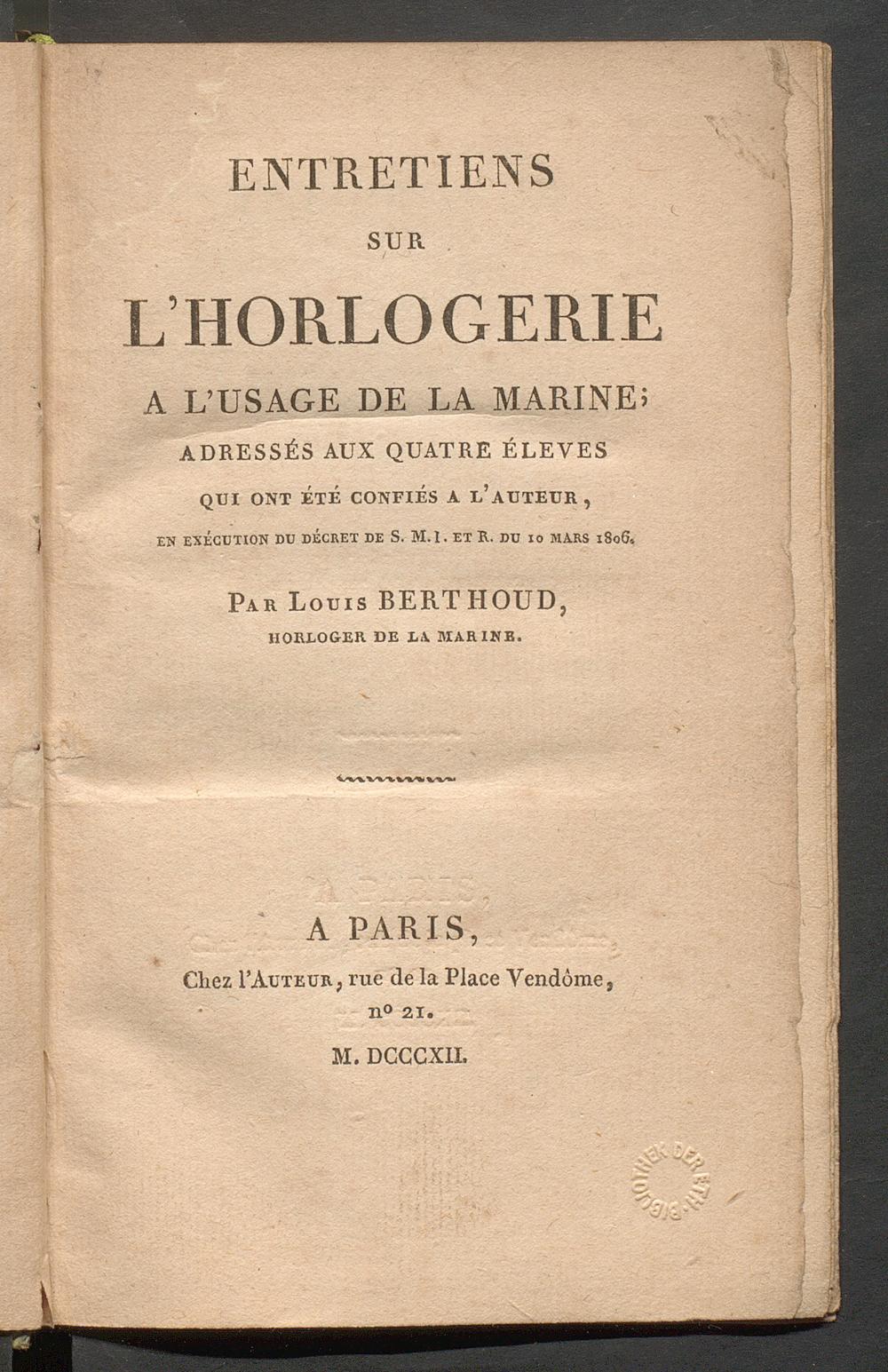
Figure 1. The title page of the 1812 edition mentions the four pupils and the imperial decree of 10 March 1806. Author, Louis Berthoud. Copy and image courtesy of ETH-Bibliothek Zürich, Rar 2053. Copy on e-rara. Public domain (rights statement for this copy, Public Domain Mark 1.0). Image reproduced as supplied.
The book and its intended readers#
| Item | Description |
|---|---|
| Author | Louis Berthoud |
| Original title | Entretiens sur l’horlogerie à l’usage de la marine; adressés aux quatre élèves qui ont été confiés à l’auteur |
| Publication | Paris, published by the author, 1812 |
| Printer | P. Didot l’aîné |
| Language | French |
| Physical description | The ETH catalogue records one preliminary leaf, 127 pages and one blank leaf, 17 cm |
| Copy consulted | ETH-Bibliothek Zürich, Rar 2053 |
| Identifier | DOI 10.3931/e-rara-14882 |
The subtitle identifies the readers as the four pupils entrusted to Berthoud under an imperial decree of 10 March 1806. In the preface he explains that he had passed on orally the experience of more than twenty-five years of making marine timekeepers. He now wished to set down a summary. His other commitments and his health, he adds, precluded an extensive systematic treatise. 1 (title page, pp. 1–2)
In the second dialogue Louis directs his pupils to another author, Ferdinand Berthoud. He recommends Ferdinand’s essay on horology and treatise on marine clocks, along with writings by Pierre Le Roy and others. To study British makers, he urges the pupils to examine their actual instruments. His own advice connects this literature with experience at the bench. 1 (pp. 21–29)
The first dialogue explains the absence of plates. The pupils had the timekeepers they had made before them and had entered the dimensions in their own notes. Berthoud considered that new drawings would be of little use without detailed dimensions. 1 (pp. 11–12)
How long will a good rate last?#
In the sixth dialogue, Berthoud describes faults that could affect trials even when a part appeared well finished. A pupil remade a balance composed of different metals. The new balance looked much like the first but gave different results. Initial accuracy was insufficient evidence, Berthoud concluded. The question was whether it lasted. A balance oscillates back and forth to determine the period of the timekeeper. Its appearance alone tells little about its performance. 1 (pp. 49–53)
The seventh dialogue extends the argument to the wheel train, pivots and friction. A thinner pivot may reduce resistance initially, yet defeat its purpose if wear causes irregular motion a few years later. Berthoud would accept a known loss of force to secure a sound finish on both the pivot and its hole. The objective was friction that remained stable in service. 1 (pp. 54–58)
The jewelled bearings discussed in the tenth dialogue illustrate the same point. In these bearings, a pivot runs in a hole drilled in a hard stone. Berthoud admired their use in British watches. But however bright the outside of a jewel, a bore with sides out of parallel, irregular edges or a chip could damage the pivot. The condition of the contact surface mattered more than the value of the material. 1 (pp. 79–82)
Testing isochronism and temperature compensation#
The eighth dialogue concerns the isochronism of the balance spring. This fine spring draws the balance back towards its rest position. Isochronism means that the period of oscillation stays nearly constant as the amplitude changes. Berthoud stresses its importance, while allowing for other causes of error, including increased friction and changes in the oil. 1 (pp. 59–66)
In the ninth dialogue, a hypothetical example shows how a fault in isochronism can mask a fault in temperature compensation, or vice versa. Even with correct compensation, a change in temperature can alter amplitude. If the spring is not isochronous, the rate then changes. Rate is the amount of time gained or lost over a given interval. Attributing the entire change to temperature compensation could spoil a sound adjustment. Conversely, working on the spring alone would miss the cause if the compensation were at fault. 1 (pp. 67–70)
Berthoud therefore tests them separately first. Once the accuracy has improved, he combines the adjustments, estimating their influence on each other, then tests isochronism again. His pupils learn to separate several causes capable of producing the same observed gain or loss. 1 (p. 70)
Berthoud describes using cylindrical balance springs even when that meant making room inside a portable watch. He also mentions a conical spring he made in 1793. Each coil of the cone has a different radius, he explains, so the coils can clear one another even with little vertical spacing. The difficulty of forming the spring and obtaining suitable steel prevented him from using the design consistently. His account shows how materials and workmanship constrained the choice of a theoretically desirable shape. 1 (pp. 76–78)
From positional trials to astronomical observations#
The twelfth dialogue examines positional error, or the difference in rate between orientations of a portable watch. Friction, a manufacturing defect or imperfect isochronism may go unnoticed in a single horizontal position and become apparent in another. Berthoud also explains the need for small instruments that could be carried on land surveys and coastal expeditions alongside the larger clocks used aboard ship. 1 (pp. 87–90)
The reference instrument itself required checking. Berthoud describes verifying the reference pendulum clock by observing the Sun or a star as it crossed the local meridian. A meridian transit occurs when a celestial body crosses the north–south plane through the observer, furnishing a means of determining the time. Near the end of the text he describes trials in which a pendulum clock spent several days at each of a series of temperatures. The comparison clock stayed at a constant temperature and was checked by astronomical observation. Comparison between two clocks alone cannot establish how much error belongs to the reference clock. 1 (pp. 91–95)
An appendix gives daily rates and observations for timekeeper No. 14 on the d’Entrecasteaux expedition. The book closes with a table and discussion by de Rossel concerning a different instrument, No. 111. These records connect the workshop lessons with experience at sea. The figures concern individual instruments and do not establish a guaranteed accuracy for all Berthoud’s work. 1 (pp. 97–127)
Later uses of the book and how to consult it#
The present-day firm Ferdinand Berthoud refers to the book in its account of Naissance d’une Montre 3, a project to pass on handcraft skills. The connection it draws between Berthoud’s teaching of four pupils and its own project is the manufacturer’s interpretation of that history. 2
The original French edition is available on e-rara as page images and machine-readable text. Early spellings and OCR errors make it important to check precise terms and figures against the images. The Hachette BnF catalogue lists a reprint of the same title dated 1 May 2017. The original and the reprint are separate editions. The 127 pages recorded for the 1812 copy cannot be assumed to be the page count of the modern paperback. 1 3
This article draws chiefly on the title page and preface of the 1812 edition, the first, second, sixth through tenth and twelfth dialogues, and the arrangement of the appendix and closing material. The technical discussion follows Berthoud’s reasoning in these passages.
Where to find the reprint#
Hachette Livre BnF published its French paperback reprint on 1 May 2017 (ISBN 9782013083454). Its format and specifications differ from those of the original. The quality of the reproduction has not been assessed here. Purchase terms are available on the linked page.
View the reprint on Amazon (advertisement)As an Amazon Associate, My Horology Notebook earns from qualifying purchases.
References#
- Louis Berthoud, Entretiens sur l’horlogerie à l’usage de la marine, Paris, chez l’auteur, 1812. ETH-Bibliothek Zürich, Rar 2053. Digitised copy and catalogue entry on e-rara. See the title page and especially pp. 1–29, 49–82 and 87–127. Accessed 13 November 2026.
2. Chronométrie Ferdinand Berthoud, Naissance d’une Montre 3. Manufacturer’s account of its project to pass on watchmaking skills, in particular the passage referring to the book. Accessed 13 November 2026.
3. Hachette BnF, Savoirs et Traditions, publisher’s catalogue, p. 212. Entry under the same title, dated 1 May 2017. Accessed 13 November 2026.