This article was translated from Japanese using AI. Read the Japanese original
Clocks and Watches: The Collection of the Worshipful Company of Clockmakers is an English-language illustrated catalogue by Cecil Clutton and George Daniels of the timepieces held by the Worshipful Company of Clockmakers in London. Published in 1975, it places the collection in the context of the Company’s and its museum’s history, while documenting the individual objects themselves. 1 2
Reading about horological history often raises a question beyond who invented what. Where is the object that a particular account describes, and how has it been documented? This collection catalogue offers a starting point. Guildhall Library also lists it as a source for research into the Company’s timepieces. 3
Bibliographic details#
| Field | Details |
|---|---|
| Original title | Clocks and Watches: The Collection of the Worshipful Company of Clockmakers |
| Authors | Cecil Clutton and George Daniels |
| Publisher | Sotheby Parke Bernet Publications |
| Place and year of first publication | London, 1975 |
| Language | English |
| Extent | xx preliminary pages and 123 pages of text. Includes an index. |
| ISBN | 0-85667-019-7 |
| Identifiers | Library of Congress Control Number 76379159, Open Library OL4950986M |
The bibliographic details were checked against a library-derived record in Open Library and the holdings catalogue of the Wessex Branch of the British Horological Institute. The Roman numeral xx denotes 20 preliminary pages, counted separately from the 123 pages of text. 1 4
What the catalogue covers#
Richard Watkins, who compiled an annotated bibliography of horological publications, describes a short history of the Company and the museum followed by descriptions of selected objects from the collection. The catalogue includes photographs, although the objects vary in the amount of illustration they receive. 2
The German horological society Deutsche Gesellschaft für Chronometrie describes the book as a catalogue of 692 objects, including pocket watches, longcase clocks, table clocks and clock or watch keys. Its scope thus extends well beyond portable timepieces to other forms of clock and their accessories. 5
The catalogue is particularly useful for looking up a named timepiece and comparing an account of it with the description of the object itself. A beginner studying the workings of a mechanism would need a technical textbook. A researcher looking for the Company’s documentary holdings would turn to a different catalogue by John Bromley, also listed by Guildhall Library. 2 3
How the collection took shape#
The Worshipful Company of Clockmakers began collecting material in 1814, when it established a library to bring together important books on horology. In 1815 Benjamin Lewis Vulliamy acquired three horological objects at the sale of Alexander Cumming’s effects and donated them to the library. Further gifts of objects followed. In 1816 the idea was put forward that collecting the work of early clockmakers could document the history of their profession. 6
Books and timepieces thus came into the collection together. Written sources describe earlier makers’ work, and the objects preserve tangible examples of it. The 1975 catalogue can be read as a record of the individual timepieces assembled in this way. 3 6
The Company’s library and museum collections opened to the public at Guildhall in 1873. The timepieces were still there when the book appeared. Watkins identifies it as the new catalogue following G. H. Baillie’s catalogue of 1949. 2 6
Distinguishing the titles#
The subtitle and ISBN help distinguish this book from works with similar titles.
| Publication | Subject and use |
|---|---|
| Clocks and Watches (1975), the book discussed here | The collection of timepieces held by the Clockmakers’ Company |
| Watches, by Clutton and Daniels | A separate work on the technical and decorative history of portable timepieces |
| The Clockmakers’ Library (1977), by Bromley | A separate catalogue for locating books and manuscripts in the Company’s library |
Watkins lists Clocks and Watches and Watches as separate, consecutive entries, R682 and R683. Guildhall Library likewise distinguishes the catalogue of timepieces from catalogues of the library and its records. 2 3
Watkins also records a 1980 publication date and identifies 1975 as the year of first publication. This article uses the 1975 edition as its bibliographic reference. Whether the text changed in 1980 or a Japanese translation exists has not been verified. 1 2
The museum today#
The collection of timepieces moved to the Science Museum in London in 2015. The Company’s library and archives remain at Guildhall Library. The Clockmakers’ Museum is housed within the Science Museum, and the Company describes it as an independent museum. 6
The Science Museum’s current guide lists more than 600 watches, 90 clocks and 30 marine chronometers, among other objects. Marine chronometers are precision timekeepers used to maintain a reference time at sea. The guide also highlights John Harrison’s H5 and a longcase clock by Thomas Tompion designed to run for a long period between windings. 7
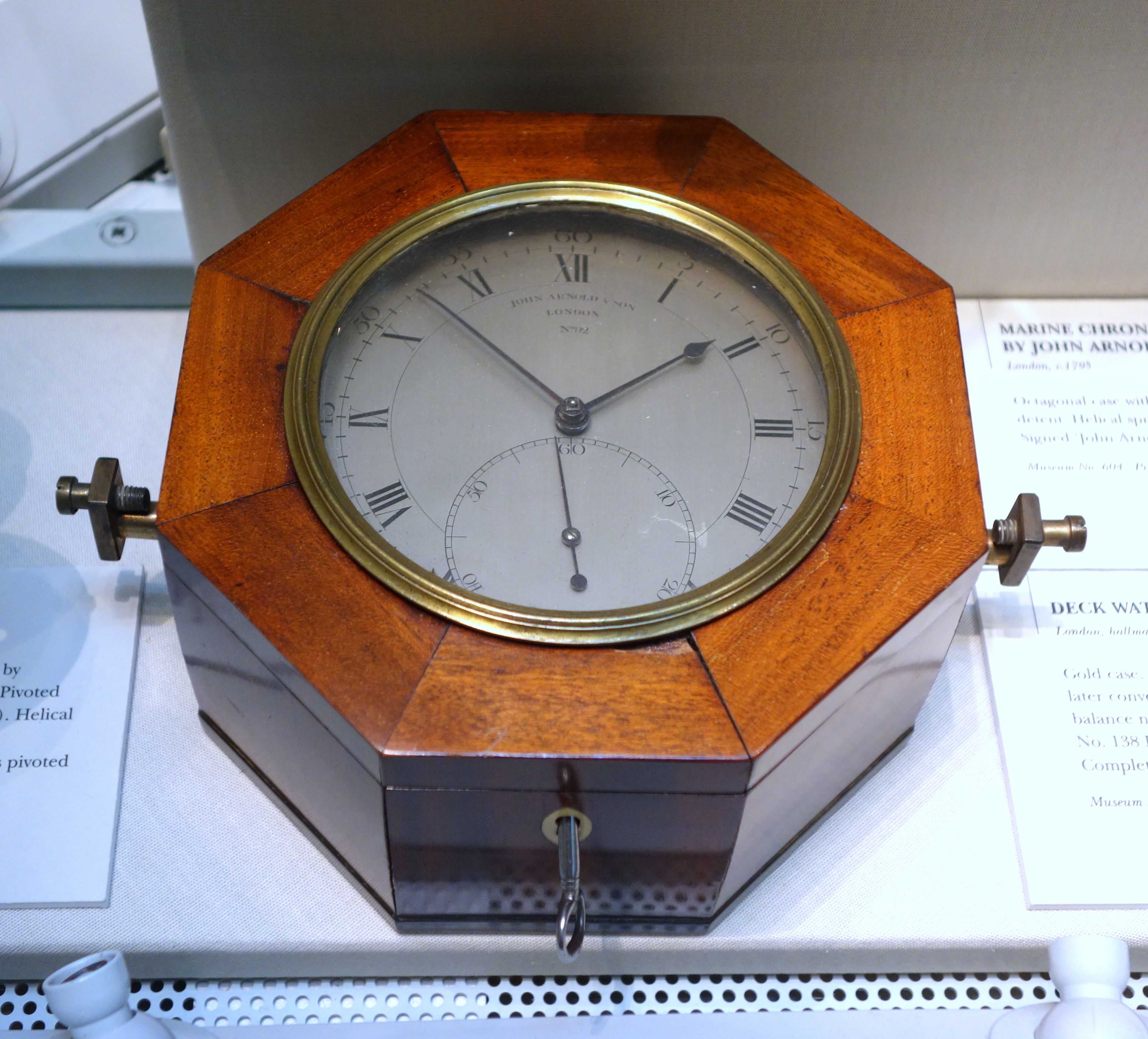
Figure 1. Marine chronometer by John Arnold & Son, London, about 1795, on display at the Clockmakers’ Museum. The photograph shows an example from the surviving collection and was taken independently of the book’s illustrations. Photograph by Daderot. Wikimedia Commons file page. Released under CC0 1.0 Universal. Image unaltered.

The display also includes the Space Traveller II, which Daniels made in the early 1980s, after the catalogue appeared in 1975. 7
Where to consult the book and what was checked#
Guildhall Library lists the book in its research guide, and the Wessex Branch of the British Horological Institute lists a copy in its members’ library. The Internet Archive has a record for a digitized copy. The record is public, but access to the text is restricted. 1 3 4
The sources checked for this article include library-derived bibliographic records, a description in a specialist horological bibliography, a horological society’s entry describing its copy, and official information from the Company and the museum. The book’s complete text and table of contents were not examined. This account therefore does not summarize the individual object descriptions, details of the photographs or textual differences between editions.
Where to buy#
The listing below is for the 1975 English-language hardback published by Sotheby Parke Bernet Publications (ISBN 9780856670190). The listing gives the terms for individual offers, including second-hand copies.
View the collection catalogue Clocks and Watches on Amazon (advertisement)As an Amazon Associate, My Horology Notebook earns from qualifying purchases. Please check the listing for current prices, availability and delivery terms.
References#
- Open Library, Clocks and watches (OL4950986M), bibliographic and MARC-derived information on the 1975 edition. Internet Archive, clockswatchescol0000wors, bibliographic record and access status. Accessed 22 October 2026.
2. Richard Watkins, Mechanical Watches: An Annotated Bibliography of Publications since 1800, Fourth Edition, Volume 1, 2023, entry R682, printed pp. 164–165. The separate work Watches is R683. Accessed 22 October 2026.
3. City of London, Clocks and clockmakers, updated 26 January 2023, Guildhall Library holdings. Accessed 22 October 2026.
4. Wessex Branch, British Horological Institute, Branch Library and holdings catalogue dated 31 January 2021. Accessed 22 October 2026.
5. Deutsche Gesellschaft für Chronometrie, DGC Freiverkauf, item 6287. Bibliographic description of the copy and the types of object covered. Accessed 22 October 2026.
6. The Worshipful Company of Clockmakers, Museum & Archive, on the origins of the collection and the locations of its different holdings. Accessed 22 October 2026.
7. Science Museum, The Clockmakers’ Museum, guide to the current collection and displays. Accessed 22 October 2026.