This article was translated from Japanese using AI. Read the Japanese original
Edmund Beckett Denison’s Clocks and Locks is an illustrated technical work from 1857 covering pendulum clocks, turret clocks, watches and locks. Its main example is the Great Clock at Westminster, which Denison helped design. How can a clock strike the hour without disturbing the pendulum’s beat when wind presses against its heavy hands? The book follows the project from the action of the gears and pendulum to the layout of the tower and checks against Greenwich time.1 4
Figure 1. Title page of the 1857 edition. Written by Edmund Beckett Denison. The compositor is unknown. Source: digitised copy at the National Library of Scotland. The original is in the public domain. It was published in 1857 and Denison died in 1905. Under the library’s rights policy, CC0 1.0 applies to the digital reproduction where rights arise. One page of the PDF was converted to JPEG and resized, with no cropping or additions.
The edition and how it came about#
| Item | Details |
|---|---|
| Title on the title page | Clocks and Locks. From the “Encyclopædia Britannica.” Second Edition; with a Full Account of the Great Clock at Westminster |
| Author | Edmund Beckett Denison (1816–1905), later Lord Grimthorpe. A barrister who helped design the Great Clock at Westminster. |
| Edition discussed | Edinburgh, Adam and Charles Black, 1857. The title page calls it the second edition. |
| Language and structure | English. Part I, “Clocks”, Part II, “Locks”, and additions. The printed text runs from pp. 1 to 236. |
| Digitised copy | National Library of Scotland reproduction, PDF identifier 140915072. Page references below use printed page numbers. |
According to the 1857 preface, Part I expands articles on clocks and watches and on transit instruments from the eighth edition of the Encyclopædia Britannica, reissued in 1855 as the pamphlet Clock and Watch Work. Denison also regards the clock section as the third stage in a line that began in 1850 with an introductory work on clockmaking under another title. “Second Edition” on the title page counts from the 1855 pamphlet, while Denison’s account of his work begins in 1850.1 2 8
Part II draws on the locks article in volume 13 of the same encyclopaedia. Denison says in the preface that the two subjects would interest the same readers, and using the type that had already been set before it was distributed added little to the cost. In 1860 John Weale published A Rudimentary Treatise on Clocks and Watches and Bells, adding bells to the subjects covered.1 3
From domestic clocks to turret clocks#
Part I begins with a diagram of a weight-driven domestic clock. The falling weight drives the hands through the train, and the escapement releases the gearing in steps while giving impulse to the pendulum. Denison follows the gearing that puts the hour and minute hands on the same centre, showing how the hour hand makes one twelfth of a revolution in the time the minute hand makes one. The section on pendulums considers the relationship between amplitude and period, followed by chapters on escapements and striking.1
In a turret clock, wind presses against the exposed hands and can change the force reaching the pendulum through the train. Denison compares ways of managing the relationship between the force that drives the clock and the impulse given to the pendulum. A spring remontoire stores energy from the train in a small spring and releases it to the escapement. In a gravity escapement, the train lifts arms that fall under their own weight and give impulse to the pendulum. Denison illustrates earlier designs by Bloxam and others and considers arrangements to prevent tripping, in which an arm lifts so sharply that the lock releases prematurely.1 4
Why the design changed at Westminster#
In a letter to Lord Seymour dated January 12, 1852, Denison proposed running the weights through the tower’s ventilation shaft to make room for the pendulum and give the weights enough drop. The 1857 edition describes how he changed the contract drawings to fit the interior walls that had already been built. One requirement set by Astronomer Royal George Airy was for the first stroke of the hour to sound within one second of the correct time.1 5
Denison says the original design used a spring remontoire and advanced the minute hands every 30 seconds. When the heavy hands were actually driven on the large dials, their momentum as they jumped proved troublesome. The remontoire was removed and the gravity escapement took over the task of isolating the pendulum from variations in the train. Printed pp. 119–120 describe two three-legged escape wheels on a common arbor, with the teeth of the two wheels catching alternately on stops on the arms on either side.1 4
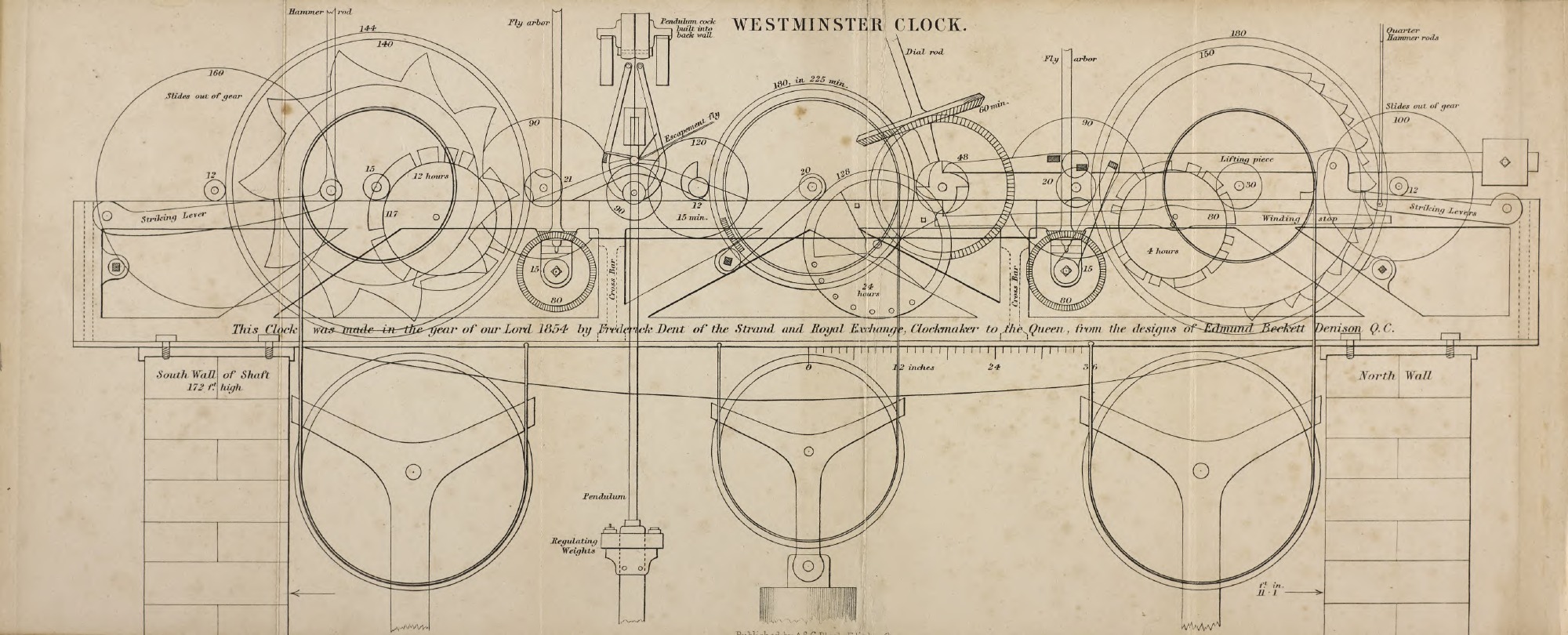
Figure 2. Foldout frontispiece of the 1857 edition. It shows the wheel trains, the pendulum supported from the wall behind, and the positions of the weights. The inscription names Edmund Beckett Denison as designer and Frederick Dent as maker. The draughtsperson and engraver are unknown. Source: digitised copy at the National Library of Scotland. The original drawing is in the public domain, having been published in 1857. Under the library’s rights policy, CC0 1.0 applies to the digital reproduction where rights arise. One page of the PDF was converted to JPEG and resized, with no cropping or additions.
The 1857 edition also includes a plan to raise the striking weights by water power and a proposal to check the clock against Greenwich time by telegraph. Frederick Dent completed the movement in 1854. The clock began keeping time in the tower on May 31, 1859. According to the UK Parliament, the Royal Observatory sent time signals by telegraph for accuracy checks after installation. The original book and Parliament’s records trace the project from proposals to operation.1 4 6
Watches, observing instruments and locks#
The section on watches explains how the chain acts on a larger radius of the conical fusee as the mainspring unwinds and weakens, evening out the torque delivered to the train. The discussion of marine chronometers for finding longitude covers compensation to keep the rate steady across temperatures and the trials at Greenwich. The section on transit instruments that follows introduces the dipleidoscope, which reveals the meridian transit of the Sun when two images coincide. The discussion moves from how to drive a timekeeper to how to obtain an observed time and compare the readings.1
The section on locks ranges from ancient Egyptian and common English locks to products by Bramah, Chubb and others. Alongside descriptions of designs, it covers competition around the Great Exhibition in London in 1851 and the debate at the time over how to assess lock security. Historian David Churchill draws on contemporary reporting to examine how public lock-picking contests demonstrated security and shaped the reputations of products and firms.1 7
Consulting the original#
In the public PDF, page 11 is the title page, pages 19–20 the preface, page 118 the start of the account of the Great Clock (printed p. 100), and page 197 the start of the section on locks (printed p. 179). The frontispiece has a correction to the numbers of teeth, for which the errata on PDF page 18 can be consulted when tracing the mechanism in the drawing.1
Related articles cover the Great Clock at Westminster, James Mackenzie Bloxam and the continuous-motion remontoire.
References#
- Edmund Beckett Denison, Clocks and Locks, second edition, Adam and Charles Black, 1857. Title page, frontispiece, contents, errata, preface, pp. 3–8, 40–49, 74–85, 100–130, 141–158, 174–196 and 229–236. National Library of Scotland digitised copy, accessed November 21, 2026.
- Edmund Beckett Denison, A Rudimentary Treatise on Clock and Watch Making, John Weale, 1850. Title page and contents, accessed November 21, 2026.
- Edmund Beckett Denison, A Rudimentary Treatise on Clocks and Watches and Bells, John Weale, 1860. Publication details, accessed November 21, 2026.
- UK Parliament, “Big Ben’s Great Clock celebrates its 160th Birthday”, 2019. Design, construction and the gravity escapement, accessed November 21, 2026.
- Parliamentary Archives, “Big Ben - Clock Construction letter”, WLS/2/199, transcription of Denison’s letter dated January 12, 1852. Proposed layout in the tower, accessed November 21, 2026.
- UK Parliament, “Constructing the most accurate clock in the world”. Installation in 1859 and comparison of time by telegraph, accessed November 21, 2026.
- David Churchill, “The spectacle of security: lock-picking competitions and the security industry in mid-Victorian Britain”, History Workshop Journal 80(1), 2015, pp. 52–74, DOI 10.1093/hwj/dbv018. Author’s manuscript in an institutional repository. Analysis of public competition, sales and reputation, with a reference to Denison p. 187. Accessed November 21, 2026.
- Edmund Beckett Denison, Clock and Watch Work, Adam and Charles Black, 1855. Title page and opening notice in the digitised original (PDF pp. 1 and 3), accessed November 21, 2026.