This article was translated from Japanese using AI. Read the Japanese original
Alexander Cumming published this technical work in 1766. It asks why pendulum clocks and watches gain or lose time, examining the relationships between oscillation, driving force, friction, oil and temperature. Across two essays, Cumming identifies what interferes with their motion and how design can reduce those effects. 1
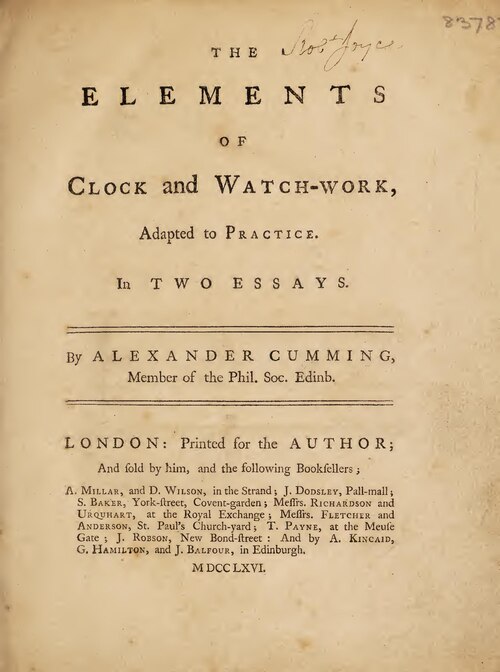
Figure 1. Title page of the 1766 original. Author Alexander Cumming, who died in 1814. The designers and typesetters are unknown. Original source Wellcome Library, b30529815. Wikimedia Commons file, PDF p. 3. Public domain, a reproduction of the original published in 1766, marked Public Domain Mark 1.0. The supplied 500-pixel-wide reproduction is used unchanged.
Bibliographic details and edition covered#
| Item | Details |
|---|---|
| Original title | The Elements of Clock and Watch-work, Adapted to Practice. In Two Essays |
| Author | Alexander Cumming |
| Publication | London, published by the author, 1766 |
| Language | English |
| Structure | Two essays on improving pendulum clocks and portable watches |
| Text and plates | 192 pages of text and 16 folding plates. Counts of preliminary and final leaves vary between library records. |
| Identifiers | ETH-Bibliothek Rar 10706, DOI 10.3931/e-rara-93286 |
The Wellcome catalogue identifies the printer as J. Hughes and lists booksellers in London and Edinburgh. The ETH catalogue records a first edition. Published before the ISBN system, the original has to be identified separately from later facsimiles that carry ISBNs. 2 3
Questions running through both essays#
A free pendulum and a pendulum in a clock#
The “General Plan” at the start of the first essay begins with Cumming’s observation that ordinary pendulum clocks keep better time than portable watches, a difference only partly explained by workmanship. He examines the physical principles governing accuracy and applies them to improving portable watches. 1
Isochronism means that the time for a complete oscillation remains constant as the amplitude changes. A clock’s pendulum also experiences air resistance, resistance at its suspension and force from the escapement, which stops and advances the wheels. Cumming examines the period of a driven pendulum as well as an ideal pendulum that swings freely. In §§155–177 he compares the effects of oil and contact at the escapement, distinguishing resistance at wheel arbors from that at surfaces that affect the pendulum directly. 1
How layout and motion affect the oil’s influence#
In §§167–172 on pp. 40–41, Cumming uses the rotational speeds and thicknesses of arbors to estimate where oil has the greatest effect in the train. The more revolutions one arbor makes relative to another, for instance, the more movement there is at its contact surfaces. He uses tables and references to folding plates to compare the contributions of individual parts. 1
Cumming’s discussion of “oil” documents an attempt to quantify how changes in the oil’s condition could disturb oscillation, a problem for clockmakers at the time. 1
Temperature and position in portable watches#
The second essay concerns portable watches powered by mainsprings. In §§394–396, Cumming argues that a small driving weight useful in a stationary clock behaves differently in a watch that moves. Motion of the whole instrument changes the pull of the internal weight on the part it drives. 1
On pp. 162–164, §§497–504, he considers the effects of temperature separately on the mainspring, oil, balance and balance spring. The balance is the oscillating wheel that regulates the rate, and the balance spring is the fine spring that returns it after it turns. Cumming sees the expansion of parts and the flow of oil as acting on the rate through different paths. He goes on to discuss the steel-and-brass compensating device in Plate XIV. In this context, “Thermometer” is used in connection with a device that responds to temperature by providing compensation. 1
The limits of making parts to ideal geometry#
Section 560 on p. 186 shows the difference between theory and manufacture. In theory, wheel teeth can be treated as lines without thickness. Actual teeth have thickness, and the maker must prevent a tooth from dropping incorrectly onto the edge of the cylinder. Reliable contact, adequate clearances and the actual dimensions of parts have to be accounted for in design to achieve accuracy. 1
Background and the author’s standpoint#
The book opens with a dedication to the King dated 26 February 1766. Cumming says royal support gave him time for research. The publication brought workshop knowledge to a wider audience under that patronage. In “To the Public,” he praises John Harrison’s abilities and then responds to criticism of his own work. 1
The preface is a primary source for Cumming’s own position. It shows that improving timepieces raised questions of both technical design and the inventor’s reputation. 1
Edition, plates and how to use the references#
The paragraphs are numbered and refer readers to plates or earlier paragraphs. Consult the section and plate numbers together with the page. The opening errata correct wording, references to plates and directions such as up and down. These affect how the values and orientations in the text should be interpreted. 1
The ETH and Wellcome digital sources agree on 192 pages of text and 16 plates, and count the unnumbered leaves differently. This article covers the 1766 edition. The print quality and changes in later facsimiles and the availability of translations remain unexamined here. 2 3 4
The English text uses eighteenth-century type, including the long s. Its OCR sometimes reads Cumming as Gumming. Check the original images alongside searchable text when studying a mechanism. ETH provides page images, and the Wellcome record links to Eighteenth Century Collections Online. 1 2 3
Scope#
The portions read in OCR were the title page, dedication, “To the Public,” errata, the start of the first essay, the sections on oil, drive and temperature compensation in portable watches, and the text around §560. The bibliographic details were checked against the Wellcome and ETH catalogues. Reviewing every section and plate, testing the effectiveness of individual designs, tracing later adoption or influence, and comparing all editions in detail were outside the scope.
Where to buy#
The link is for the English paperback facsimile published by Gale ECCO, Print Editions in 2012. The print quality and reproduction of folding plates were outside the scope of this article.
View the facsimile of *The Elements of Clock and Watch-work* on Amazon (advertisement)As an Amazon Associate, My Horology Notebook earns from qualifying purchases. Check the linked page for prices, availability and delivery conditions.
References#
- Alexander Cumming, The Elements of Clock and Watch-work, Adapted to Practice. In Two Essays (OCR of the 1766 original), Internet Archive / Wellcome Library, b30529815. Text pp. 40–41, 111–113, 162–164 and 186, among others. Accessed 22 October 2026.
2. Wellcome Collection, The elements of clock and watch-work, bibliographic details and holdings. Accessed 22 October 2026.
3. ETH-Bibliothek, The elements of clock and watch-work, Rar 10706, DOI 10.3931/e-rara-93286. Accessed 22 October 2026.
4. Wikimedia Commons / Wellcome Library, file information for a digital reproduction of the 1766 edition, b30529815. Accessed 22 October 2026.