This article was translated from Japanese using AI. Read the Japanese original
Essai sur l’horlogerie is a French-language technical work in two volumes published by Ferdinand Berthoud (article in Japanese) in 1763. Its original subtitle sets out its purpose: to explain horology as applied to everyday timekeeping, astronomy and navigation, on principles verified by experiment. 1
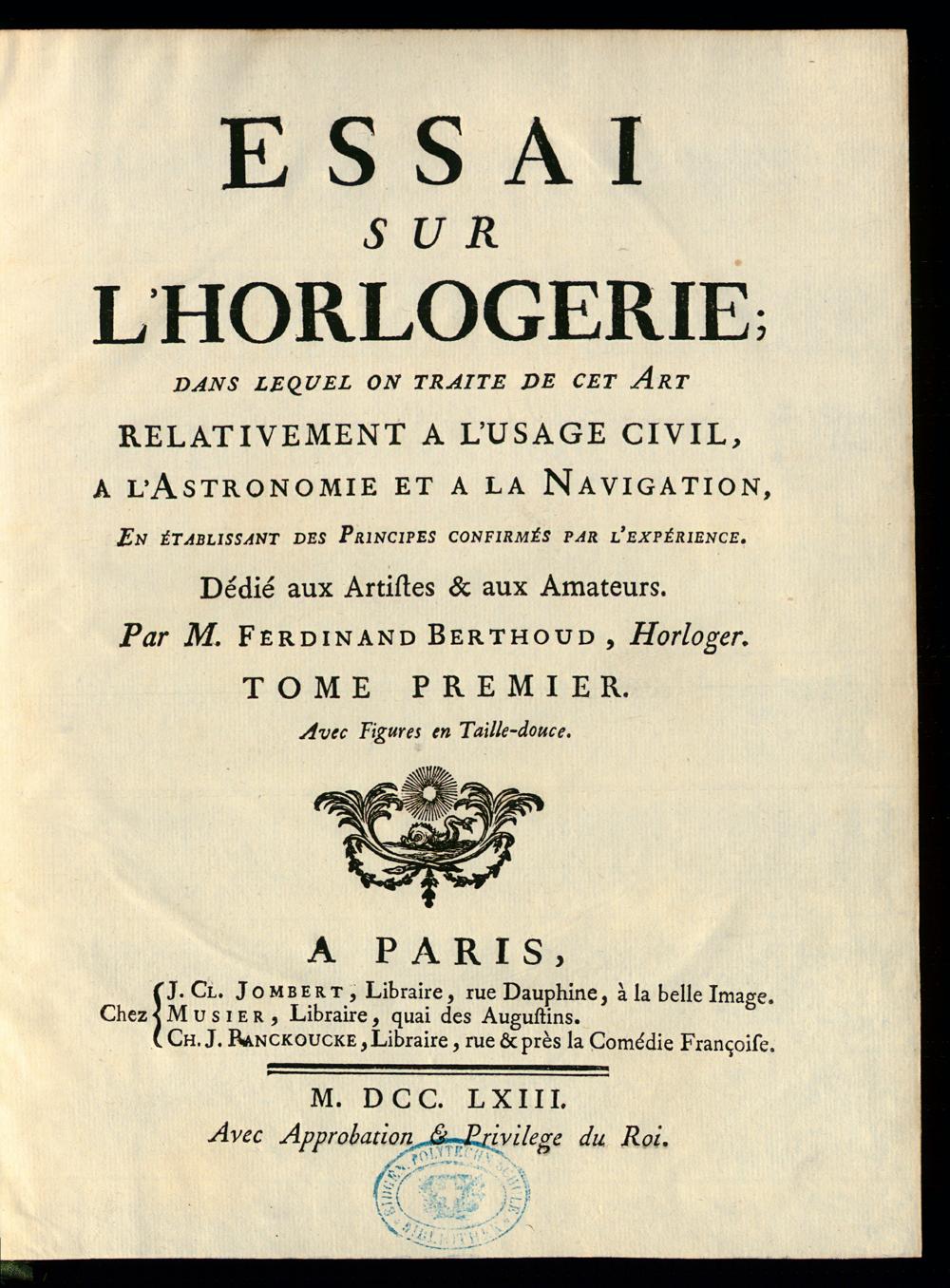
Title page. Ferdinand Berthoud, 1763. ETH-Bibliothek Zürich, Rar 4674. Original digitised on e-rara, Public Domain Mark. The image is the title page of the digitised original.
Bibliographic details#
| Item | Details |
|---|---|
| Original title | Essai sur l’horlogerie |
| Author | Ferdinand Berthoud |
| Publication | Paris, 1763 |
| Publishers | J. Cl. Jombert, Musier, Ch. J. Panckoucke |
| Language | French |
| Format | Two volumes with copperplate illustrations |
| Original consulted for this article | ETH-Bibliothek Zürich, Rar 4674, digitised on e-rara |
The bibliographic details come from the library’s catalogue and the title page of the first volume. The subtitle lists everyday, astronomical and marine applications and states that the work is dedicated to artisans and enthusiasts. 1
What the book sets out to explain#
The central question is how the parts of a timepiece work and how to make them so that it can measure time more accurately. This eighteenth-century technical work brings together mechanisms, tools, machining and experiments. The subtitle’s reference to principles verified by experiment captures that approach. 12
The two volumes can be approached as follows. 2
| Volume | Focus | Examples of topics covered |
|---|---|---|
| Volume 1 | How timepieces work and how their parts are made | Repeaters, equation-of-time displays, escapements, wheel-cutting engines, fusees, tools and machining |
| Volume 2 | Using calculation and experiment to study gain and loss | Calculations for gears, pendulums, thermal expansion, balances and balance springs, friction and oil, astronomical clocks, marine timekeepers |
The escapement releases the gears in steps and supplies power to the pendulum or balance. The balance and balance spring combine an oscillating wheel with a fine spring to produce a steady rhythm. Knowing what these parts do helps in following the chapters on what can disturb that rhythm.
How a mechanism relates solar time to clock time#
The equation of time provides a familiar point of entry. The length of a day measured by the Sun varies over the seasons. That produces a difference between the time on a sundial and the time on a clock that divides each day into 24 equal hours. An equation-of-time display accounts for that difference. 5
Berthoud’s astronomical regulator in the Metropolitan Museum of Art, dated to around 1768–1770, has an irregularly profiled cam. A part that follows the edge of the cam adjusts the hand that shows solar time. The museum connects this mechanism to the explanation in the Essai. The plate in the museum’s account is from the second edition of 1786, while this article covers the 1763 edition. 5
The example shows that the book addresses both how to make an accurate timepiece and what reference to use for time and how to represent the differences mechanically.
Sharing workshop knowledge in print#
In this context, the title’s artistes are artisans skilled in making timepieces. Amateurs includes enthusiasts who wanted to understand and assess how the mechanisms worked. The book addresses watchmakers’ practical work and the interests of readers who wanted to learn the principles of horology. 4
Historian Rossella Baldi describes the book as an effort to share knowledge often kept within workshops. The technical illustrator Louis-Jacques Goussier, who also worked on the Encyclopédie, made the drawings. Pierre-Philippe Choffard engraved the plates. The plates show shapes and relationships between components that are difficult to convey in words. 4
How it compares with the Traité des horloges marines#
Marine timekeepers appear in the second volume, but the book covers everyday, astronomical and marine horology as a whole. Ten years later, the Traité des horloges marines (article in Japanese), published in 1773, focused on designing, making and testing precision timekeepers for use at sea. 23
The Essai introduces the breadth of horology. The Traité takes up the particular problem of maintaining accuracy during a voyage. In these historical technical works in French, the plates and chapter titles are a starting point for finding a particular mechanism and then turning to the relevant explanation.
Viewing the original and identifying the edition#
The ETH-Bibliothek Zürich copy on e-rara provides images and contents for both volumes. The chapter titles in the contents can lead to topics such as tools, escapements, temperature compensation and marine timekeepers. 12
The bibliographic details and description of the book’s structure here concern the digitised 1763 edition. When looking for a reproduction or another edition, check the year, the volumes included and whether the plates are present to identify the copy.
Sources and scope#
This introduction draws on the library catalogue, published contents and title page, as well as English-language horological history and a museum account of a surviving instrument. It attributes later interpretations to their sources and identifies material from the 1786 edition as such.
Where to buy#
The links are for the separate volumes of the French-language facsimile issued by Hachette Livre BnF in 2016. The print quality and reproduction of the fold-out plates remain unverified.
- View the facsimile of volume 1 on Amazon (advertisement) (ISBN 9782011331212)
- View the facsimile of volume 2 on Amazon (advertisement) (ISBN 9782011331199)
As an Amazon Associate, My Horology Notebook earns from qualifying purchases. Check the linked pages for prices, availability and delivery conditions.
Sources#
- ETH-Bibliothek Zürich / e-rara, Essai sur l’horlogerie (1763) (bibliographic record, holdings, terms of use and the title page of vol. 1, accessed 16 October 2026).
2. e-rara, published contents of Essai sur l’horlogerie (chapter structure of vols. 1 and 2, accessed 16 October 2026).
3. Zentralbibliothek Zürich / e-rara, Traité des horloges marines (1773) (bibliographic record of the work used for comparison, accessed 16 October 2026).
4. Rossella Baldi, “The Art of Horology,” Ferdinand Berthoud (22 August 2017) (English-language historical account by the present-day brand of the same name, used for readership, the sharing of knowledge, and the production of the plates by Goussier and Choffard, accessed 16 October 2026).
5. The Metropolitan Museum of Art, Longcase astronomical regulator, 1982.60.50 (English-language account of the equation of time, the cam and the solar-time hand, and the connection to the plate from the 1786 second edition. Note 22 also cites the 1786 edition. Accessed 16 October 2026).