This article was translated from Japanese using AI. Read the Japanese original
Guilds, Innovation, and the European Economy, 1400–1800 asks how craft guilds in early modern Europe taught skills, controlled the quality of goods and helped spread new ways of making them. Chapter 9, on horology and precision instruments, begins where the manufacture of mechanical clocks and sundials intersected. The questions of where clockmakers learned their skills and how they passed them on beyond their workshops also run through chapters on industries such as silk weaving and glassmaking.1 2 3
Origins and structure of the collection#
Edited by S. R. Epstein and Maarten Prak, the book was published by Cambridge University Press in 2008. According to the acknowledgements, it began with a workshop they convened in Utrecht in January 2000. Four papers from the workshop were joined by other contributions. After Epstein died in 2007, Prak wrote the introduction using Epstein’s slides and research notes along with his own material.1 2
The eleven chapters after the introduction cover the training and movement of artisans, the organisation of production including subcontracting, and case studies of individual trades and cities. Chapter 2, for example, covers apprenticeship, while chapter 4 looks at the movement of skilled workers in central Europe. Industry studies include the Dutch art market, Venetian silk and glass, and the silk industry in Lyon. After the horological chapter, chapters 10 and 11 examine London craft guilds, including how regulation extended beyond city boundaries and how guilds changed in the seventeenth and eighteenth centuries.1 2
The editors’ introduction considers knowledge that can be put into words and skills that must be learned from others through repeated practice. Apprenticeship transmitted the latter by having apprentices learn a trade as they worked in a master’s shop. The editors also argue that artisans’ mobility, the division of work among different specialists and quality standards supported cumulative technical improvements. In a paper from the same period, Sheilagh Ogilvie responds to Epstein by asking whether the persistence of institutions is evidence of a benefit to the economy as a whole and drawing attention to the redistribution of resources to powerful groups.2 4
Horology and precision instruments in chapter 9#
Where mechanical clocks and sundials came together#
Anthony Turner’s ninth chapter (pp. 264–287) begins with the overlap between making clocks and watches and making precision instruments. In the opening available online, he explains how mechanisms that used falling weights to ring bells acquired displays for the time and the positions of the Sun and Moon. From the early to the mid-fifteenth century, the use of wound springs for power increased the variety of portable timekeepers.3
Sundials were used to set mechanical clocks after they stopped and to check whether they were fast or slow. Making mechanical timekeepers thus overlapped with making instruments that read time from the motion of the Sun. Turner opens with these technical connections and the different ways in which the occupations became organised.3
Workshops that spread the pendulum clock#
The editors summarise Turner’s argument in the introduction, using the rapid imitation and improvement of the pendulum clock to discuss the relationship between exclusive rights to inventions and the spread of technology. According to the Metropolitan Museum of Art, the clockmaker Salomon Coster of The Hague received a privilege from the Dutch States General on June 16, 1657. John, son of London clockmaker Ahasuerus Fromanteel, worked as a journeyman in Coster’s shop from September 1657 to May of the following year and learned to make pendulum clocks.2 5
Huygens published the design in Horologium in 1658. This case documents two ways in which the design spread. Readers could consult it in a book, and artisans who knew how to assemble the clocks could carry that knowledge between workshops. The second route, linking London and The Hague, gives a horological example of the movement of artisans and transmission of skills discussed in the introduction.2 5
Records and objects from the London Clockmakers’ Company#
The modern English translation of the London Clockmakers’ Company’s royal charter of 1631 records the power to inspect goods alongside the company’s officers and procedures for making rules. Section 26 sets out a procedure for entering ships or buildings suspected of containing horological goods in the company of a royal officer, inspecting goods including imports, and seizing defective wares or items made by people who had not completed the required apprenticeship. The City of London’s Guildhall Library lists the registers of apprentices and freemen among its related records.6 7
The charter names Edward East as one of the assistants among the company’s first officers. He made the watch shown here in London around 1640. The Metropolitan Museum of Art records its diameter as 3.3 cm and lists silver, gilt brass and blued steel among its materials. A surviving object thus documents the work of an artisan who appears in the company’s records.6 8
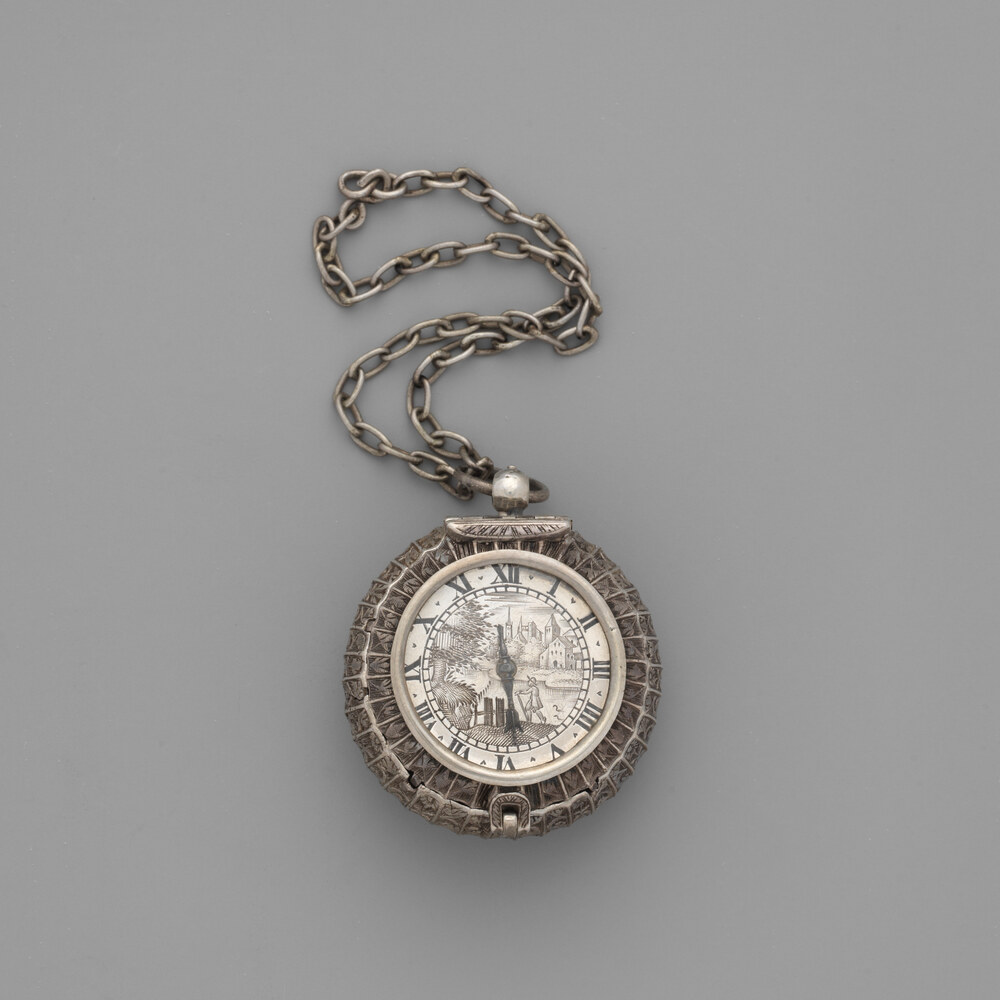
Figure 1. Watch and key by Edward East (c. 1640, The Met 17.190.1483a, b). Photograph by Richard Lee, Metropolitan Museum of Art. Source: Wikimedia Commons. Licence: CC0 1.0. Resized and recompressed as JPEG.

Editions and access#
| Edition | Bibliographic details |
|---|---|
| First hardcover | English, Cambridge University Press, 2008, ISBN 978-0-521-88717-5. |
| First paperback | English, Cambridge University Press, 2010, ISBN 978-0-521-15391-1. CiNii Books lists viii pages of preliminary matter and 352 pages of text and index. |
| Cambridge Core digital edition | Published online June 24, 2009, ISBN 978-0-511-49673-8. Each chapter has a DOI. |
Holdings in Japan can be found through CiNii Books using the ISBN or NCID (BB03775869 for the paperback). The publisher provides previews of the preliminary matter and introduction. The chapter 9 page gives its opening summary and page range. This account of the collection draws on the preliminary matter, introduction and the publicly available part of chapter 9.1 2 3 9 10
The related book Clocks and Culture examines how mechanical clocks related to culture and science in the societies where they spread. It offers readers interested in the clockmakers and instrument makers of this collection a way into the social history of the same period.
References#
All links checked November 21, 2026.
- Cambridge University Press, First edition front matter and contents, 2008. Title and copyright pages, contents, contributors and acknowledgements.
- S. R. Epstein and Maarten Prak, “Introduction”, 2008, pp. 1–24. Cambridge University Press sample and public preview of the digital edition, especially pp. 6–7, 14–15 and 23–24.
- Anthony Turner, “‘Not to Hurt of Trade’: Guilds and Innovation in Horology and Precision Instrument Making”, 2008, pp. 264–287. Public extract on Cambridge Core.
- Sheilagh Ogilvie, “Rehabilitating the Guilds: A Reply”, Economic History Review, 61(1), 2008, pp. 175–182. Public abstract.
- The Metropolitan Museum of Art, Ahasuerus I Fromanteel, “Hooded wall clock with calendar”. Collection account of the workshop, privilege and publication dates.
- The Worshipful Company of Clockmakers, The Clockmakers’ Royal Charter 1631, modern English translation, sections 9, 16 and 26.
- City of London, Guildhall Library, “Clocks and clockmakers”. Guide to company records and registers.
- The Metropolitan Museum of Art, Edward East, “Watch and key”, accession no. 17.190.1483a, b.
- Cambridge University Press, Cambridge Core bibliographic record and chapter list.
- CiNii Books, Paperback edition record and holdings (BB03775869).
Where to buy#
View the English paperback edition on Amazon (advertisement)As an Amazon Associate, My Horology Notebook earns from qualifying purchases. Check the listing for the current price, stock and delivery terms.