This article was translated from Japanese using AI. Read the Japanese original
Kikaishiki tokei 〈kaitai shinsho〉 (Mechanical Watches Illustrated), supervised by Seiji Honma, moves from the history of watches and clocks to how gears and springs keep time and how a finished watch is tested. It covers the way a watch displays the time, how its operation is checked and what watchmakers do. This article traces the book’s structure and examples of later citations using the publisher’s description, the public contents and technical literature. 1 4 5
Bibliographic details#
| Item | Details |
|---|---|
| Title | Kikaishiki tokei 〈kaitai shinsho〉 |
| Subtitle | Exploring the history and understanding the mechanisms |
| Supervisor | Seiji Honma |
| Publisher | Ōizumi Shoten, March 2001 |
| Format | Japanese, A5, 190 pages |
| ISBN | 978-4-278-05302-9 (ISBN-10 4-278-05302-9) |
Ōizumi Shoten records March 2001 as the first edition’s publication month. The National Diet Library holds a print copy under call number M197-G20, and university holdings can be found using NCID BA51448287 in CiNii Books. According to CiNii Books, the references are on page 187. 1 2 3
How watches keep time and how they are tested#
The book opens with horological history, then turns to timekeeping principles and performance. It goes on to useful functions, complications, watch design and the watchmaker’s work. The publisher says illustrations cover construction from basic mechanisms to complications, and photographs show watch design. The book also covers accuracy and water-resistance testing and includes interviews with Yoshihide Isogai and Yukinori Yamaguchi. 1
To read the mechanism drawings, it helps to identify the parts that store energy and the parts that determine when the hands advance. An exhibition guide from Nagoya City Science Museum describes how a mechanical watch uses the force of the unwinding mainspring, with a lever that locks and releases the escape wheel in time with the regular swings of the balance. The museum lists the 2001 book as a reference for the exhibit. 4
According to the biographical note at publication, Honma developed his skills at Daini Seikosha from 1949 to 1959 and spent two years teaching at Hiko Mizuno College of Jewelry. In 2001, he headed the Honma Watch Laboratory and worked on repairs, training watchmakers and appraising old watches. By moving from timekeeping principles to testing and watchmakers’ work, the book also shows the skills involved in keeping a watch in service. 1
The tourbillon in later technical literature#
Reiji Kimura and Yuichi Mori’s “Special mechanisms in mechanical watches”, published in 2017 in the Horological Institute of Japan’s journal, cites pages 108–111 of the book when explaining the tourbillon. Mori’s report in the same journal on the development of the slim hand-wound calibre 6830 cites the same pages in its explanation of the tourbillon. 5 6
A tourbillon (article in Japanese) places the balance and balance spring, lever and escape wheel in a rotating cage. When a pocket watch is upright, its rate can differ with its orientation. As the cage turns, the parts pass through different orientations relative to gravity, averaging the rate differences among upright positions. Breguet says Abraham-Louis Breguet patented this regulating mechanism in 1801. 5 7
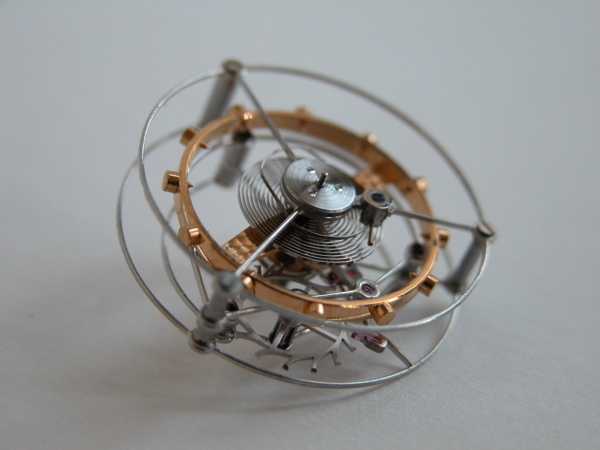
Figure 1. Rotating cage of a tourbillon by Frank Jutzi. Photograph illustrating the mechanism, by Simon Schaller. Source: Wikimedia Commons. Public domain, dedicated worldwide by the photographer, with permission for use where that dedication is not recognised. Unmodified.


The development report measured the rate of the same calibre 6830 with the cage fixed and with it rotating, across four upright positions. At a balance amplitude of 220 degrees, the variation in rate across the upright positions with the cage turning was 10–17% of the variation with the cage fixed. The 2017 report that cites the book thus explains the principle and shows how its effect was tested for a particular design and set of conditions. 6
Finding a copy#
National Diet Library Search lists holdings in its partner libraries throughout Japan. Mechanical Watch BIBLE, published by Seibundō Shinkōsha in 2013 under the same supervisor, also covers horological history and construction. To find the 2001 book, look for Ōizumi Shoten and ISBN 9784278053029. 2 3 8
References#
- Ōizumi Shoten, Kikaishiki tokei 〈kaitai shinsho〉, Hanmoto.com. Bibliographic details, description, contents and supervisor profile at publication. Accessed 20 November 2026.
2. National Diet Library, Kikaishiki tokei “kaitai shinsho”, bibliographic ID 000002963900, record and holdings. Accessed 20 November 2026.
3. CiNii Books, Kikaishiki tokei kaitai shinsho, NCID BA51448287. Bibliographic details, note on the list of references and holdings. Accessed 20 November 2026.
4. Koichi Mabuchi, “Ticking Mechanism”, Nagoya City Science Museum, “Familiar Machines” exhibition guide, section on mechanical timepieces and references. Accessed 20 November 2026.
5. Reiji Kimura and Yuichi Mori, “Special mechanisms in mechanical watches”, Micromechatronics, vol. 61, no. 217, 2017, pp. 49–54, especially p. 54, section 6.1 and reference 8. Accessed 20 November 2026.
6. Yuichi Mori, “Development of the Thin Tourbillon Watch”, Micromechatronics, vol. 61, no. 216, 2017, pp. 11–16, sections 1 and 3, fig. 7 and reference 3. Accessed 20 November 2026.
7. Montres Breguet, “The Tourbillon”, patent date and description of the regulator. Accessed 20 November 2026.
8. Seibundō Shinkōsha, Mechanical Watch BIBLE, bibliographic details and description of the 2013 edition. Accessed 20 November 2026.