This article was translated from Japanese using AI. Read the Japanese original
Set up a clock so that the pendulum ticks at equal intervals on either side of its swing. When advancing the hands of a striking clock, wait for it to finish striking each hour before moving on. In Horological Dialogues, published in 1675, John Smith used conversations between a clockmaker and an inquisitive reader to teach owners how to choose, transport, set up and set their clocks. He discusses why sundials and mechanical clocks disagree, and an appendix shows how to design a calendar display by calculating the numbers of teeth on its wheels.1
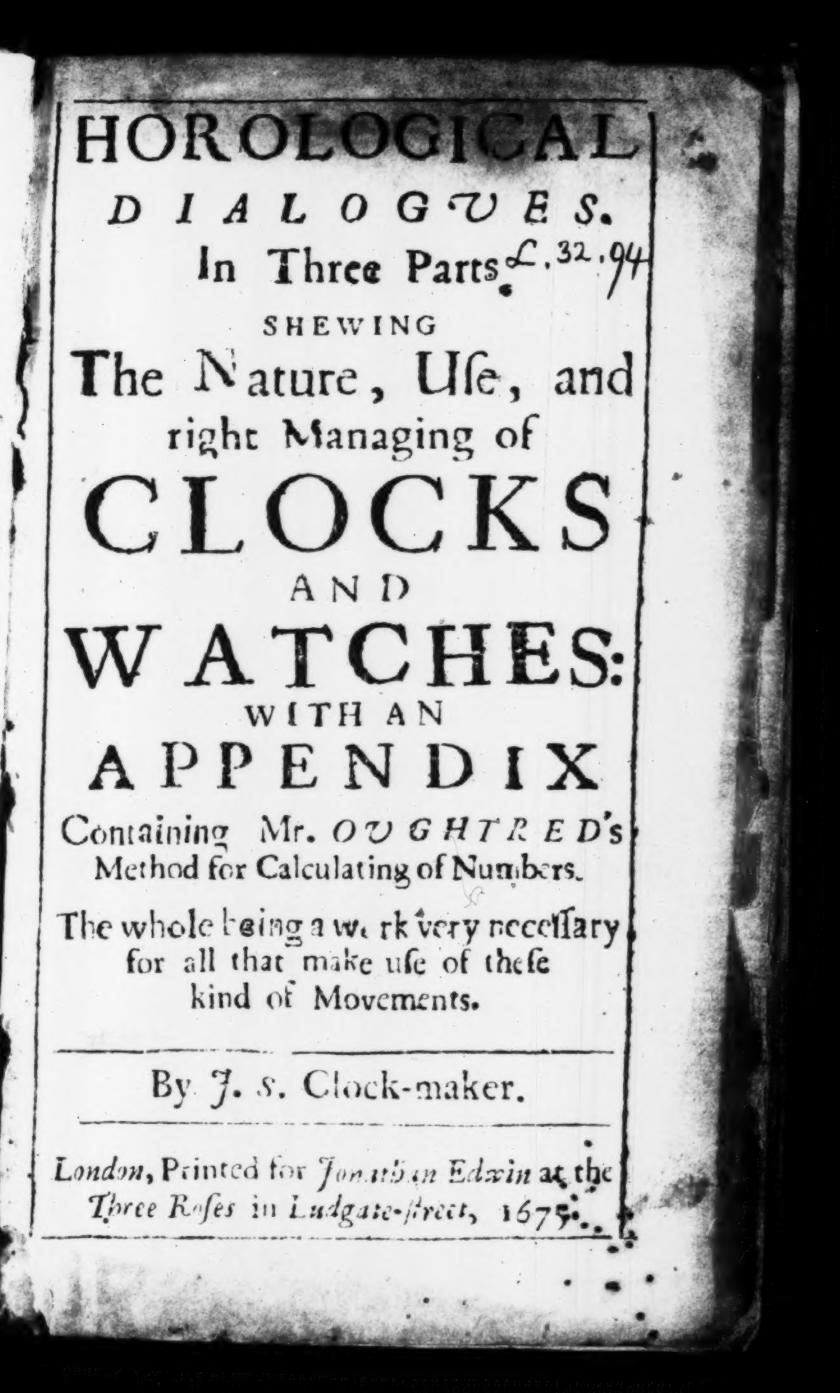
Figure 1. Title page of the 1675 edition of Horological Dialogues. Written by John Smith. The compositor is unknown. Source: facsimile on Wikimedia Commons, from the microfilm copy at the Internet Archive. The work is in the public domain because it was published in 1675 and the copyright term has expired based on the author’s death in the first half of the eighteenth century. One page of the PDF was converted to a grayscale JPEG, with no cropping or additions.
Bibliographic details and purpose#
| Item | Details |
|---|---|
| Main title and opening of the subtitle on the title page | Horological Dialogves. In Three Parts. Shewing the Nature, Use, and right Managing of Clocks and Watches |
| Author | John Smith, identified on the title page as “J. S. Clock-maker”. William Oughtred originally wrote the appendix. |
| Publication | London, 1675. Printed for Jonathan Edwin of Ludgate Street. |
| Language and structure | English. Three main parts and an appendix with its own title page and preface. |
| Identifiers | ESTC R10982, Wing S4105, EEBO-TCP A60472. The Huntington Library’s call number for its copy is 329589. |
In the preface, Smith traces clocks failing to meet their owners’ expectations to the maker’s skill and workmanship and the way owners handle them. The book deals with how owners can improve their handling. At the beginning of Part I, a listener outside the trade requests instruction from a clockmaker. Choosing a clock, bringing it home and using it day to day each raise different questions about the same object.1 2 3
Understanding the strike before setting the hands#
Part I classifies clocks by weight or spring drive, a balance or pendulum as regulator, the running time on one winding, and what, if anything, the clock strikes in addition to showing the time with hands. The names thus tell the owner something about installation and use. In explaining striking clocks, Smith distinguishes between the going train, the series of gears that keeps time, and the train that sounds the bell. At the hour the strike is released and the hammer continues until the locking lever falls into the next notch of the count wheel. The intervals between notches determine how many blows sound.1
This leads to Part II’s instructions for bringing the dial and strike into agreement. In the mechanism Smith describes, moving the hands forward by several hours at once can bring the locking piece against the pin that prepares the strike. Smith advises advancing the hands an hour at a time and letting the clock finish striking at each hour. If the hands and the count disagree, the owner lifts the locking lever and advances the strike one hour at a time until they match. Smith also describes a kind of quarter striking that sounds the number of elapsed quarters on a smaller bell every fifteen minutes after the hour.1
Setting up the pendulum and checking the rate#
To install a pendulum clock, Smith suggests listening to the ticks on the two sides of the swing as well as checking whether the case looks level. If successive intervals sound unequal, raise one side slightly and listen again. Adjust the clock until the intervals match. In a tall case with a long pendulum, also check that the pendulum clears the case before fixing the clock in place. Once the clock is set up, changing the effective length of the pendulum corrects its rate.1
English workshops were already making pendulum clocks when Smith wrote. The Metropolitan Museum of Art notes that Ahasuerus Fromanteel advertised pendulum clocks in 1658. A hooded wall clock made by Fromanteel around 1660–65 in its collection has a count wheel, a surviving example of the type of striking mechanism Smith describes. In his study of the Library Company of Philadelphia’s collection, Stiefel discusses its copy of the 1675 book, acquired in 1956, alongside a contemporary pendulum clock by John Fromanteel.4 5
Noon by the sundial and noon by the clock#
At the end of Part II, Smith advises using the same sundial each time the clock is set. At the start of Part III, he explains why even a well-adjusted clock differs from that sundial by a changing amount as the seasons pass. A sundial shows apparent solar time, following the Sun’s apparent position. Its difference from a clock that measures equal intervals varies throughout the year. Modern astronomy calls the difference between apparent and mean solar time at the same location the equation of time. The tilt of the Earth’s axis and the eccentricity of its orbit produce the variation.1 9
In the next dialogue in Part III, Smith deals with atmospheric refraction when the Sun is low. He includes a table of observations relating the Sun’s altitude to the difference in sundial readings. The seasonal difference and the shift in the Sun’s apparent position near the horizon are subjects of separate dialogues. Later he explains the fusee, a conical pulley that evens out the mainspring’s force by transmitting it through a small radius when freshly wound and a larger one as it runs down. He also describes experiments comparing numbers of ticks at different pendulum amplitudes. Desborough uses the book to investigate the relationship between clocks and sundials and how lunar displays were used.1 6
An appendix on gearing for the age of the Moon#
The appendix, A Method of Calculating all Numbers for Watches, is a method of gear design by the mathematician William Oughtred. In his preface to the appendix, Smith says Oughtred wrote it for friends at the university who were studying how clocks worked. Multiplying the tooth-count ratios of the individual stages gives the ratio of rotation through the complete train. The designer establishes the required ratio first and then expresses it as tooth counts that can be cut.1 3
In the example of a lunar-age display, a dial wheel that revolves once every 12 hours carries a 10-tooth pinion driving a 40-tooth wheel. A four-tooth pinion on the same arbor as the 40-tooth wheel turns a 59-tooth ring. For each revolution of the ring, the dial wheel makes (40 ÷ 10) × (59 ÷ 4) = 59 revolutions. At 12 hours each, these amount to 29.5 days. The appendix translates a relationship in time obtained by observing the Sun and Moon into integer gear ratios on the dial.1
Editions and access#
The Huntington Library holds the 1675 edition, and the Internet Archive provides access to a microfilm copy of that edition. The EEBO-TCP transcription is searchable, and the page images preserve the layout of equations and fractions in the appendix. Smithsonian Libraries and Archives also holds a 1962 facsimile that includes the 1675 title page.1 2 3 7
In 1694 Smith published a separate book, Horological Disquisitions concerning the Nature of Time, on the length of the day from noon to noon and the time kept by clocks. The comparison of clocks and sundials continued from the 1675 book into his later work.1 8
References#
- John Smith, Horological Dialogues, London, 1675. Facsimile. Title page, preface, Part I dialogues 1, 2 and 6, Part II dialogues 1 and 3–5, Part III dialogues 1–4, and appendix preface, I–II and IV §27. Checked November 21, 2026.
- The Huntington, Horological dialogues. In three parts, call no. 329589. Checked November 21, 2026.
- Early English Books Online Text Creation Partnership, A60472. TEI transcription and bibliographic details for the 1675 edition. Checked November 21, 2026.
- The Metropolitan Museum of Art, Hooded wall clock with calendar, by Ahasuerus I Fromanteel, accession no. 1974.28.93. Checked November 21, 2026.
- Jay Robert Stiefel, “A Clock for the rooms”: the Library Company’s Horological Legacy, 2006, p. 2, note 8, plates III and VI. Checked November 21, 2026.
- Jane Desborough, The Changing Face of Time: the Making of the Modern Clock & Watch Dial 1550–1770, University of Leeds, 2016, chapters 4 and 6. Checked November 21, 2026.
- Smithsonian Libraries and Archives, Horological dialogues / by John Smith. 1962 facsimile, TS545.S551 1675aZ. Checked November 21, 2026.
- John Smith, Horological Disquisitions concerning the Nature of Time, London, 1694. Facsimile. Checked November 21, 2026.
- U.S. Naval Observatory, The Equation of Time. Apparent solar time, mean solar time and why they differ. Checked November 21, 2026.