This article was translated from Japanese using AI. Read the Japanese original
Horologium oscillatorium is a Latin book on pendulum clocks and their motion published by Christiaan Huygens in 1673. Starting from the construction of the clock, it uses geometry to ask how oscillations can take the same time even as their amplitude changes, and how the periods of pendulums with different shapes and distributions of mass can be compared. Clockmaking and the mathematics of motion meet in this book. 1 2 4
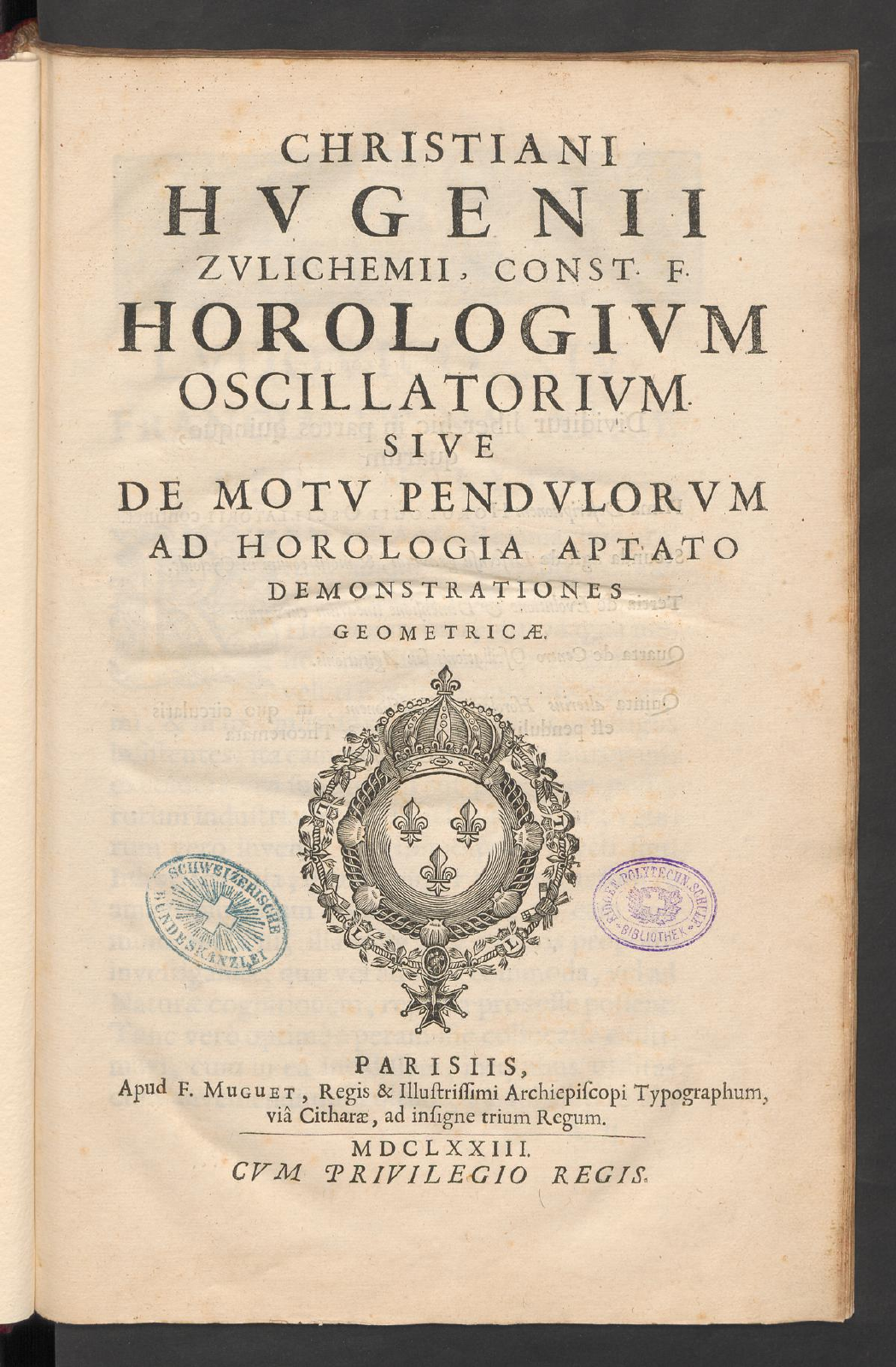
Figure 1. Title page of the 1673 edition. Author Christiaan Huygens, publisher F. Muguet. Copy and image ETH-Bibliothek Zürich, Rar 4649. Digitised original at e-rara, DOI 10.3931/e-rara-11164. Public domain, as recorded in the library’s item rights statement and Public Domain Mark 1.0. The PDF title page was converted to PNG and resized without cropping or adjustment to tone.
The book and the editions discussed here#
| Item | Details |
|---|---|
| Original title | Horologium oscillatorium, sive de motu pendulorum ad horologia aptato demonstrationes geometricae |
| Author | Christiaan Huygens (1629–1695) |
| Meaning of the title | The Pendulum Clock, or Geometrical Demonstrations Concerning the Motion of Pendulums as Applied to Clocks |
| Publication | F. Muguet, Paris, 1673 |
| Language and structure | Latin, in five parts, with diagrams of the clock and geometrical figures |
| Original consulted | ETH-Bibliothek Zürich, Rar 4649, digitised by e-rara. The main text is paginated through p. 161 |
| Transcription and French translation | Oeuvres complètes de Christiaan Huygens, vol. 18, 1934 |
Bibliographic details were checked against the library catalogue and the original title page. Oscillatorium refers to oscillation, and horologium means clock. The short title Horologium oscillatorium is used here for the 1673 original. The French translation and editorial notes appear in the separate 1934 collected edition. 1 6
Why a real clock leads to geometry#
Following his Horologium of 1658, Huygens used this book to explain an improved clock and a theory of the pendulum. His dedication to Louis XIV gives weight to questions that connect practical utility and an understanding of nature. He presents the clock as a mechanical invention founded on geometry. Astronomical observation and measuring longitude at sea were among the intended uses. 2 6 7
Clock gears turn in fixed ratios and require a pendulum to mark off regular intervals of a defined length. An ordinary suspended pendulum’s period can vary with amplitude. Part I compares two pendulums of the same length, one swinging through a large arc and the other through a small one. The latter gets ahead. 2
The book investigates the conditions for regular motion. It diagrams the clock, then examines falling bodies and curves to address problems raised by the design. It goes on to the motion of rods and other bodies with distributed mass. Each part develops questions raised by the preceding work on regulating a clock. 1 2 4
How the five parts connect#
| Part | Main question | Subjects covered |
|---|---|---|
| I | How can a clock be built to run regularly? | Gearing and pendulum, curves guiding the cord, maintaining power during winding, rate adjustment and trials for use at sea |
| II | What path makes objects take the same time to fall? | Fall of heavy bodies, motion on a cycloid and isochronism |
| III | What curved surfaces produce the desired pendulum path? | Geometry of a cord wound onto and unwound from a curve, and the lengths of curves |
| IV | How can pendulums with distributed mass, such as rods or discs, be compared? | Centre of oscillation, simple and compound pendulums, adjusting weights and a standard of length |
| V | Can a pendulum travelling in a circle drive a clock? | A clock using circular motion and theorems on centrifugal force |
The five-part structure appears in the original contents and in the text of each part. 1 6
Example 1. Using a curve to limit the effect of amplitude#
What is a cycloid?#
A cycloid is the curve traced by a point on the circumference of a circle that rolls along a straight line without slipping. Proposition 25 in Part II shows that when the curve is suitably oriented, a body released from rest takes the same time to reach the lowest point from different starting heights. Isochronism here means that descent from different starting points to the same bottom takes equal time. 1 3
The result follows from the assumptions about falling bodies in the book, setting aside air resistance and friction. Huygens explains in Part I that the drive transmitted by the gears need not always reach the pendulum with equal strength and that this can cause changes in amplitude. 2 3
What the cheeks that touch the cord do#
An ordinary pendulum suspended on a cord describes a circular arc. In Huygens’s clock, curved plates stand on either side of the cord, which wraps against one of them as the pendulum swings sideways. The portion of cord supported by the plate changes, so the bob follows a path different from a circular arc. The plates are the cycloidal cheeks. 1 2
The geometry in Part III connects the shape of the cheeks to the bob’s path. It investigates the curve traced by the end of a taut cord as it is unwound from another curve and shows how a cycloid gives rise to another cycloid of the same shape. That property gives the clockmaker a way of shaping the plate to produce the desired path. 1 3
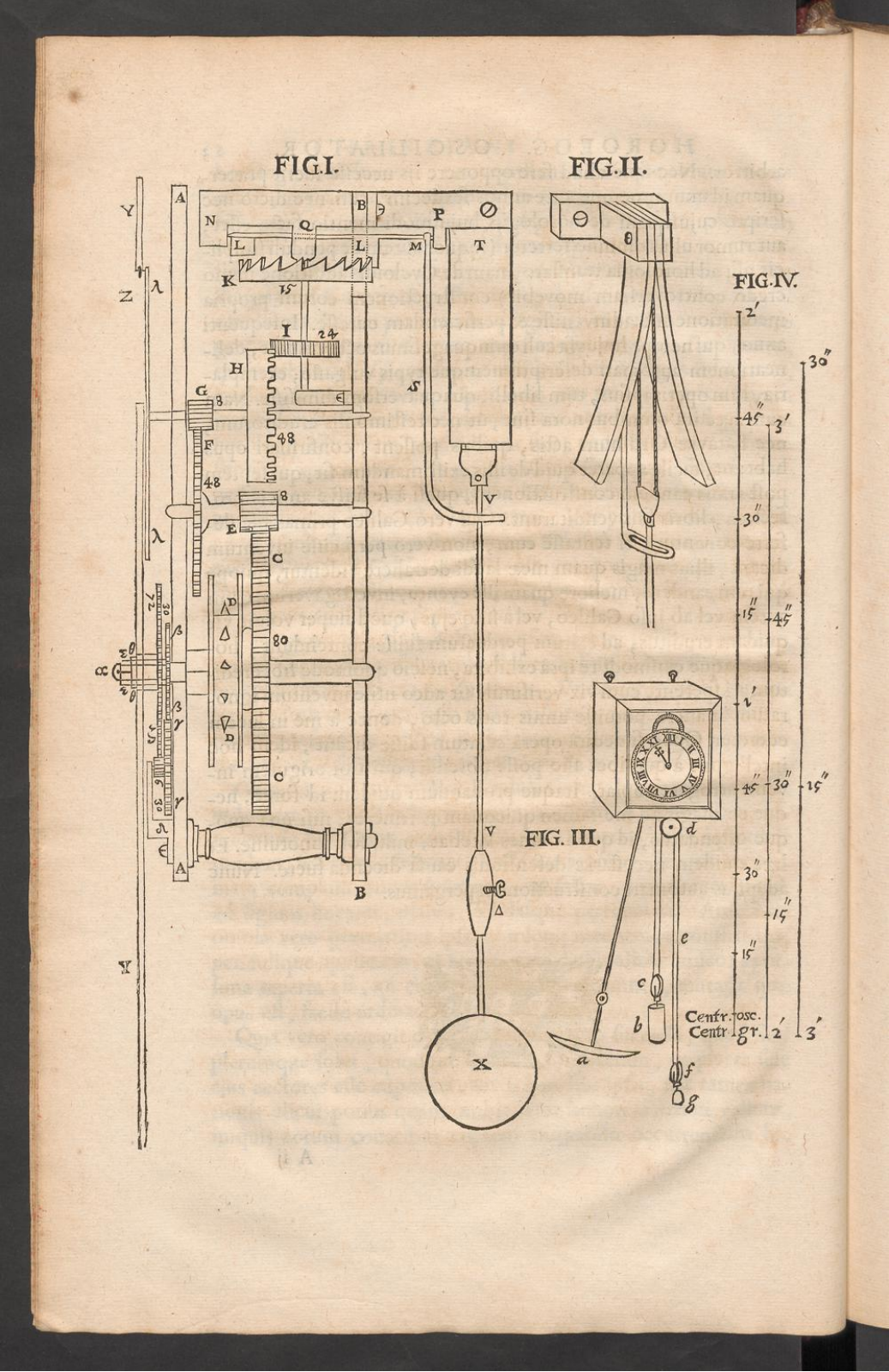
Figure 2. Plate from Part I of the original. FIG. I shows the gearing and pendulum, FIG. II the cord and cheeks, FIG. III the suspension of the driving weight and FIG. IV the adjusting scale. Author Christiaan Huygens, engraver unknown. Copy and image ETH-Bibliothek Zürich, Rar 4649. Digitised original at e-rara, DOI 10.3931/e-rara-11164. Public domain, as recorded in the library’s item rights statement and Public Domain Mark 1.0. Page 23 of the PDF was converted to PNG and resized without cropping or adjustment to tone.
Example 2. Why moving a weight changes the rate#
Part IV distinguishes a simple pendulum with all its mass concentrated at a point at the end of a slender cord from a compound pendulum whose mass is distributed, as in a rod or disc. Parts of a compound pendulum travel at different speeds in the same angular motion because they lie at different distances from the pivot. Treating all of the mass as concentrated in a single place cannot by itself establish a comparison of periods. 1 4
Huygens therefore introduces the centre of oscillation. An equivalent simple pendulum has the same period as the compound one. The point at its effective length from the suspension identifies the centre of oscillation of the compound pendulum. This has a different role from the centre of gravity, which concerns the balance of weight. Definition 9 in Part IV identifies the centre of oscillation by this equivalence of period. 1 4
Clock adjustment led Huygens back to this abstract question. With a small movable weight in addition to the main bob at the foot of the rod, he could adjust the rate finely by moving the smaller weight, provided he knew how the distribution of mass affected the period. This connects the adjustment scale in FIG. IV of Part I with the theory of Part IV. The scale is calculated for the relationship specified in the text between the weights and the rod. 2 4
Proposition 20 in Part IV shows that exchanging the positions of the suspension point and the centre of oscillation preserves the period. The book goes on to connect a pendulum of a given period to a standard of length. The practical adjustment of a clock thus leads to the theory of motion and measurement. 1 4
Maintaining power and experimenting at sea#
Part I discusses practical pendulums as well as the ideal case. It mentions lead bobs or lead enclosed in copper and describes a shape that reduces air resistance. It also shows an arrangement of a continuous cord and several pulleys to keep the clock powered while its driving weight is wound up. 1 2
The pendulum sets the rhythm of timekeeping, while the drive keeps it moving. Even a theoretically regular period gives no uninterrupted record if winding stops the movement. The cheeks, adjusting weight and maintaining power each solve a separate problem. 2 4
The design of a marine clock had to account for its suspension aboard a moving ship and the regulation of the power reaching the movement. Huygens reports sea trials and writes at the end of Part I that the new arrangement described there still needed to be tested at sea. His account covers both tested designs and designs awaiting trial in the development of a clock for finding longitude at sea. 1 2
Part V connects clocks and circular motion#
Part V deals with a pendulum moving in a horizontal circle. As the bob revolves, its cord traces the surface of a cone. This is the motion of a conical pendulum. The theorems at the end compare bodies of equal weight each moving at uniform speed in a circle. At equal speed, a smaller radius gives a greater centrifugal force. At equal radius, the force is proportional to the square of the speed. 1 5
These theorems connect the study of pendulum clocks with the laws of circular motion. Huygens reserves their proofs for another occasion. Later historians of science distinguish the results about acceleration in circular motion published in 1673 from the derivation, which does not appear in that book. 5 10
Origins and later editions#
Huygens’s description of a clock in 1658 and the investigation of cycloidal isochronism were separate steps towards the book. Historian of science C. D. Andriesse dates Huygens’s completion of the proof of the cycloid’s isochronism to 15 December 1659. 7 9
| Date | Relation to the book |
|---|---|
| 1658 | Publication of the earlier Horologium |
| December 1659 | Completion of the proof of cycloidal isochronism, as dated by later research |
| 25 March 1673 | Date of the dedication to Louis XIV |
| 1 April 1673 | Date of completion of printing in the original |
| 1934 | Volume 18 of the collected works includes the original, a French translation, related material and editorial notes |
| 1986 | Iowa State University Press publishes Richard J. Blackwell’s English translation |
The 1673 dates come from the dedication and the end of the printing privilege. The book also mentions royal permission in late September and registration in November. Those were steps taken in 1672 before the book appeared. 1 6
An English edition is Christiaan Huygens’ The Pendulum Clock, or, Geometrical Demonstrations Concerning the Motion of Pendula as Applied to Clocks (1986), translated with notes by Blackwell and with a foreword by H. J. M. Bos. CiNii lists xxxii pages of front matter and 182 pages of main text, ISBN 0-8138-0933-9. 8
Consulting the original and the translations#
E-rara hosts the 1673 original, and Cornell University Library’s eCommons provides PDFs by part. The images allow readers to check the original wording and figures. The 1934 collected edition on DBNL has the Latin text and French translation and lets readers compare the figures with their definitions. 1 6 11
Reading the original involves following points and lines in diagrams alongside propositions and proofs in Latin. Part I describes the clock’s construction. Parts II and III give the foundations of isochronism, and Part IV covers the adjusting weight and distributed mass. The book concerns the historical design and its theory. 1 2 3 4
A question running through the book is what conditions produce ideal motion and how a clock can approximate them. The effects of amplitude, the curves governing the cord’s path, the distribution of mass and the continuity of the drive each show why a pendulum alone does not guarantee a steady rate. 1 2 4
Scope of this account#
This account compares the title page, contents, illustrations and relevant text in the 1673 original with the Latin text and French translation in the 1934 collected edition, catalogue records and accounts in the history of science. It discusses selected results and checks the bibliography of the 1986 English translation.
References#
- ETH-Bibliothek Zürich / e-rara, Christiani Hugenii… Horologium oscillatorium (1673). Rar 4649. Title page, contents, Part I plate, selected text from each part, imprint and rights conditions. Accessed 16 October 2026.
2. Christiaan Huygens, Part I, description of the clock, Oeuvres complètes XVIII (1934), pp. 86–123. Latin and French translation. Mechanism, cheeks, maintaining power, materials and form, movable weight and trials at sea. Accessed 16 October 2026.
3. Huygens, Parts II and III, same volume, pp. 124–241. Especially the assumptions and Proposition 25 in Part II and the definitions and Proposition 6 in Part III. Accessed 16 October 2026.
4. Huygens, Part IV, centre of oscillation, same volume, pp. 242–359. Especially the opening, definitions 3, 4 and 9, assumptions 1 and 2, and propositions 6 and 20. Accessed 16 October 2026.
5. Huygens, Part V, same volume, pp. 360–365, and theorems on centrifugal force, pp. 366–368. Clock using circular motion, theorems 2 and 3 and the deferral of their proofs. Accessed 16 October 2026.
6. DBNL, Oeuvres complètes XVIII, contents and bibliography, dedication, pp. 74–81, and privilege and completion of printing, p. 84. Accessed 16 October 2026.
7. DBNL, bibliography of Horologium (1658). Distinguishes it from the 1673 book. Accessed 16 October 2026.
8. CiNii Books, Christiaan Huygens’ The Pendulum Clock (1986), NCID BA04040496. Translator, foreword author, publisher, date, pagination and ISBN. Accessed 16 October 2026.
9. C. D. Andriesse, Huygens: The Man behind the Principle (Cambridge University Press, 2005), available front matter, pp. xii–xiii. Consulted for the date of the cycloid proof. The full book was not consulted. Accessed 16 October 2026.
10. Biography published by KNAW, “Christiaan Huygens 1629–1695”, pp. 479–481. Especially the account of pendulum theory and circular motion on p. 480. Accessed 16 October 2026.
11. Cornell University Library, eCommons, Horologium oscillatorium. Bibliography of the 1673 edition and access to PDFs by part. Accessed 16 October 2026.