This article was translated from Japanese using AI. Read the Japanese original
Shoichiro Komaki’s A Course in Mechanical Watches is a technical book on how mechanical watches work and why they gain or lose time. It starts with how gears transmit motion and goes on to the amplitude of the balance, which does the work of a pendulum, the sounds of the escapement, and errors when starting and stopping a chronograph. The published contents and book description outline the book’s structure, while Komaki’s papers provide examples of adjustment and measurement. 1234
Bibliographic details and origins of the series#
| Item | Details |
|---|---|
| Title | 機械式時計講座 (A Course in Mechanical Watches) |
| Author | Shoichiro Komaki |
| Publication | University of Tokyo Press, August 2014 |
| Format | Japanese-language print book, 27 cm, 247 pages (National Diet Library catalogue) |
| ISBN | 978-4-13-068800-0 |
| Holdings | National Diet Library, call no. M197-L9, bibliographic ID 025696601 |
The book grew out of “An Introductory Course in Mechanical Watches,” a series in World Photo Press’s magazine Sekai no Udedokei (Wristwatches of the World). The Japan Clock & Watch Association describes the volume as an edited compilation of the series. Minami Kimura’s bibliographic guide in the journal of the Horological Institute of Japan traces it from the first instalment, “How a Wristwatch Works,” in issue 56 in 2002, through instalments on the regulator and the sound of the ticking. In addition to Komaki, Muneo Tohkoku contributed instalments on the power source, gear train and new escapements. 135
Komaki joined Daini Seikosha in 1958 and worked on watch design and research. According to the author biography published with the book, he was responsible for submitting mechanical watches to Swiss observatory trials. In quartz watchmaking, his roles included heading research, development and design. The book treats mechanical timekeeping from design through measurement and adjustment. 23
From gears to the balance#
Chapter 1 starts with the gear train, a series of gears working together. The going train carries power from the mainspring to the escapement. The escapement releases the train in step with the oscillation of the balance and replenishes the balance’s energy. The first few instalments in the magazine likewise proceed from the overall operation of a watch to its power source, train and escapement, following the path power takes through the watch. 1256
Chapter 2 covers rate, the speed at which a watch gains or loses time relative to a reference. Chapter 3 covers amplitude, the angle the balance swings to one side from its resting position. As the mainspring unwinds and supplies less energy to the balance, amplitude also falls. Isochronism is the property of keeping the same period of oscillation as amplitude changes. A watch’s rate may vary with amplitude even in the same position, so both values matter when making adjustments. 26
Komaki’s 2010 paper gives one example of adjustment. The balance spring (article in Japanese) shifts its centre of gravity as the balance moves, one reason a watch’s rate changes between different vertical positions. Komaki made prototypes with adjusted curves near the inner end of the spring and compared their rates in four vertical positions. He calculated the rates at an amplitude of 220 degrees from the measurements. For the prototype with the smallest spread, the difference between the fastest and slowest positions was 1.3 seconds per day. 46
Using the ticking sound to examine the escapement#
Chapter 4 studies the short sounds made by the escapement as it operates. Measuring the interval between ticks shows how the watch gains or loses time. Looking at the sound waveform also shows the order in which sounds arise during each action. The published contents list a section applying this method to the co-axial escapement. Chapter 5 also covers errors when starting and stopping a chronograph, which measures elapsed time. 257
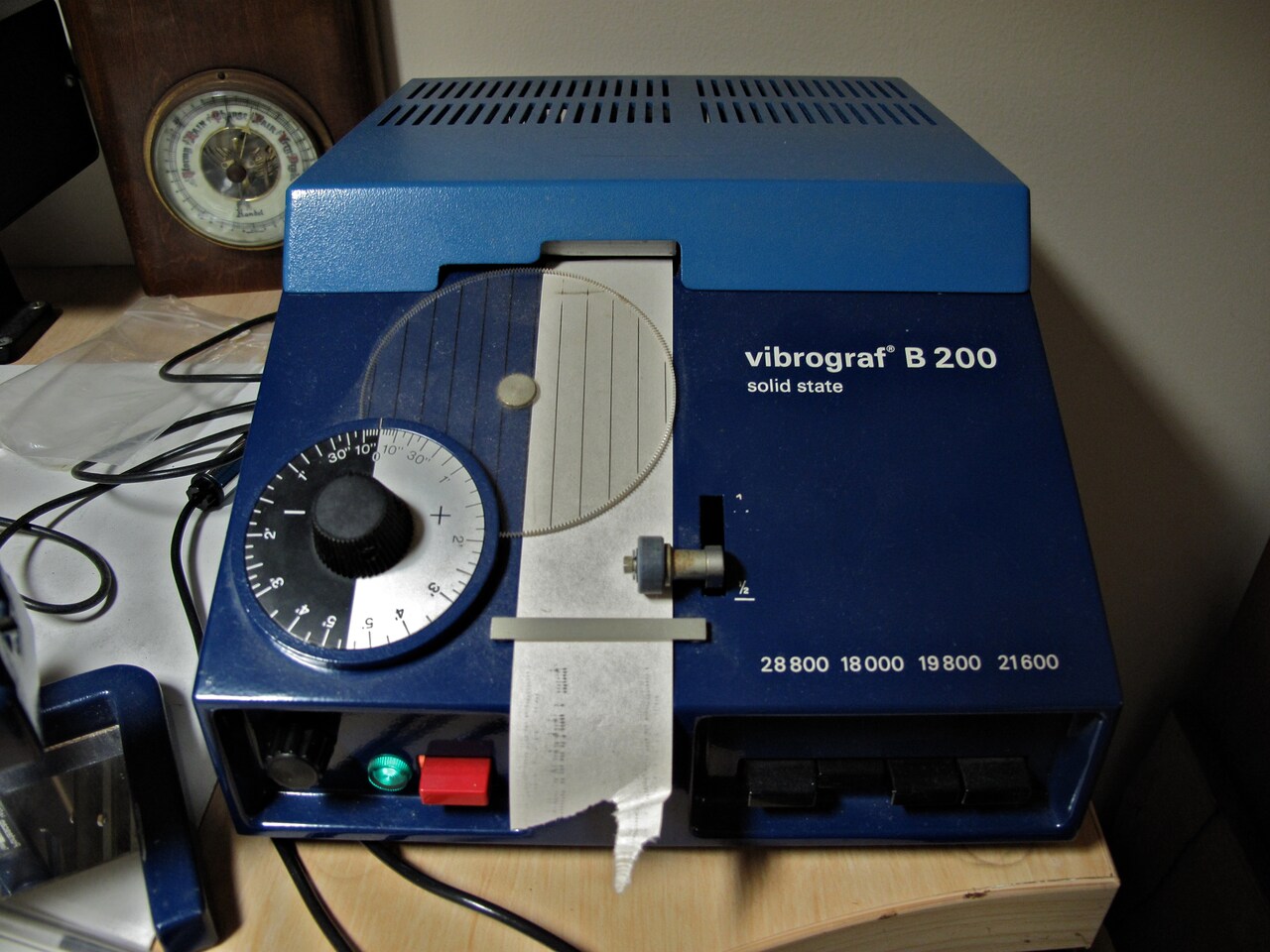
Figure 1. The Vibrograf B 200, an example of an instrument for measuring rate. Photograph by Jason7825. Source Wikimedia Commons. Public domain (worldwide release by the photographer, with a licence for jurisdictions where the release is unavailable). Reduced in size and recompressed as JPEG. Original composition and colours retained.


The final chapter also includes a section on British horology. In a report on the same subject published in 2006, Komaki describes visiting George Daniels (article in Japanese) in his workshop and introduces a tall floor-standing clock Daniels made with a grasshopper escapement. Figures 1–3 of the same report show sound waveforms from a chronometer escapement and a co-axial escapement, which Komaki uses to identify the sequence of contacts between the parts. 27
Library holdings and electronic access#
The National Diet Library Search lists holdings of the print book at participating libraries across Japan. The University of Tokyo Press lists a sixth printing as of May 2018. KinoDen, an electronic library service for universities, added a PDF based on the August 2014 publication to its list of new titles for June 2025. Access to the electronic edition depends on the reader’s library subscription. 189
References#
- National Diet Library, “A Course in Mechanical Watches,” bibliographic ID 025696601 (catalogue record, opening of the published contents and holdings, accessed 20 November 2026).
- Kinokuniya, “A Course in Mechanical Watches,” publisher’s description, contents and author biography at time of publication (accessed 20 November 2026).
- Japan Clock & Watch Association, “Books on Time and Timepieces,” introduction to A Course in Mechanical Watches (accessed 20 November 2026).
- Shoichiro Komaki, “A new understanding of Phillips condition and the practice of adjustment of inner terminal curve of hairspring,” Micromechatronics, vol. 54, no. 202, 2010, pp. 1–10, especially fig. 9 in sec. 5 and sec. 6 (accessed 20 November 2026).
- Minami Kimura, “Introducing the Technical Series on Mechanical Timepieces,” Micromechatronics, vol. 63, no. 221, 2019, pp. 53–55, refs. 34–59 (accessed 20 November 2026).
- Kazuki Hayakawa and Hisashi Fujieda, “Principles and Accuracy of Mechanical Wristwatches,” Micromechatronics, vol. 61, no. 217, 2017, pp. 43–48, mechanism and factors affecting accuracy (accessed 20 November 2026).
- Shoichiro Komaki, “Recent Developments in British Horology,” Micromechatronics, vol. 50, no. 195, 2006, pp. 44–52, figs. 1–3 for tick sound waveforms and fig. 9 for Daniels’s floor-standing clock (accessed 20 November 2026).
- University of Tokyo Press, Publishers’ Review, May 2018, sixth printing listed among new publications and reprints (accessed 20 November 2026).
- Kinokuniya, “KinoDen New Arrivals, June 2025,” publication year and ISBN of the source edition, product ID KP00117583 (accessed 20 November 2026).