This article was translated from Japanese using AI. Read the Japanese original
Jean-André Lepaute’s Traité d’horlogerie is a French technical work on choosing and regulating timepieces and designing their mechanisms. First published in 1755, it moves from everyday use to gear combinations, escapements and pendulum calculations. It credits the mathematician Nicole-Reine Lepaute for a table relating pendulum length to beat frequency. 1 (contents and p. 282) 2
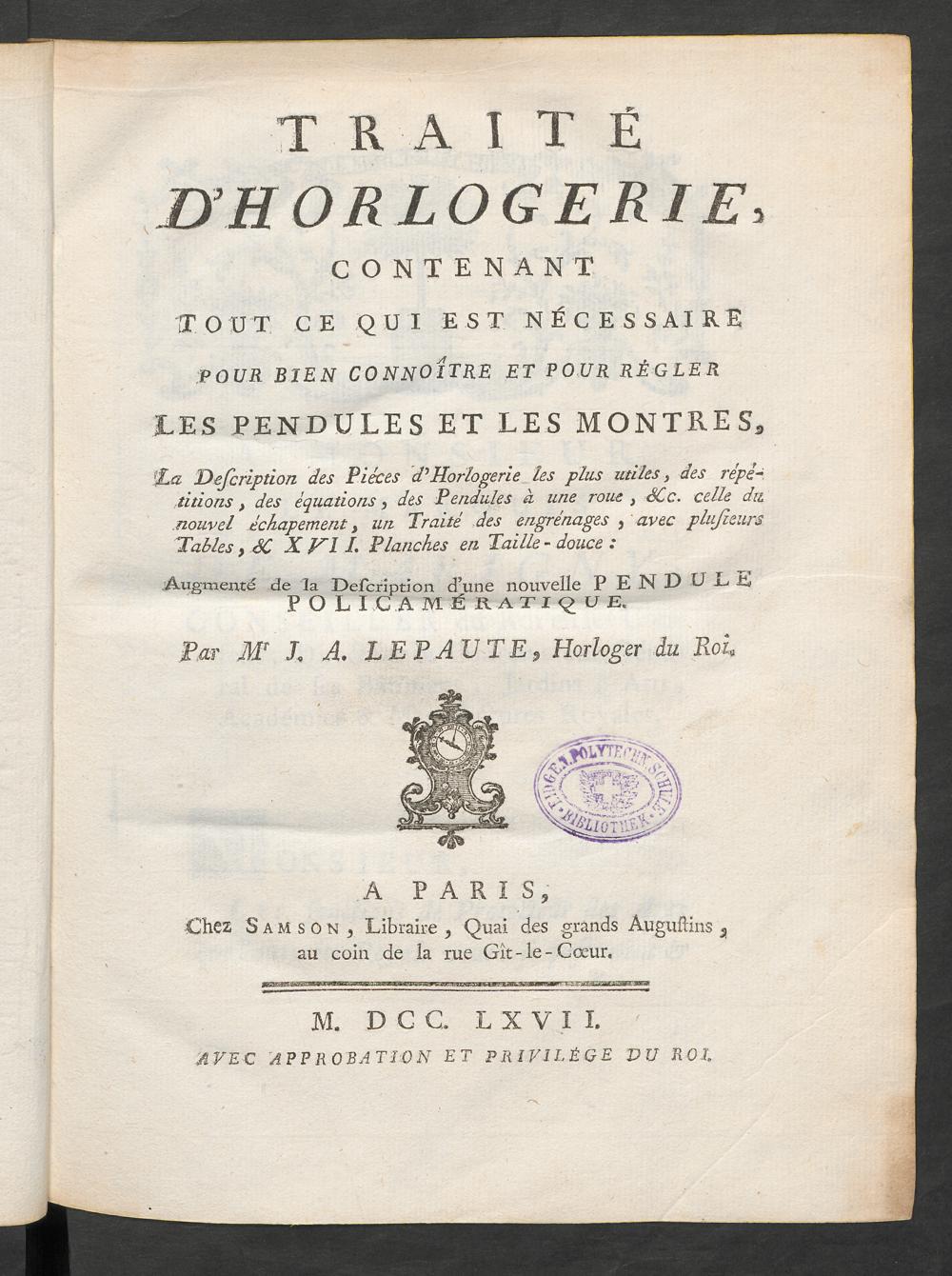
Figure 1. Title page of the 1767 edition. Author Jean-André Lepaute. Collection and image courtesy of ETH-Bibliothek Zürich, Rar 4743. Source e-rara original. Public domain (rights statement for the library copy, Public Domain Mark 1.0). The supplied image is reproduced without cropping or changes to the colours.
Bibliographic details and edition examined#
| Item | Details |
|---|---|
| Author | Jean-André Lepaute |
| Original title | Traité d’horlogerie, contenant tout ce qui est nécessaire pour bien connoître et pour régler les pendules et les montres |
| First published | Paris, 1755 |
| Edition consulted here | Paris, Samson, 1767 |
| Language | French |
| Description of the ETH copy | XXVIII preliminary pages, 308 pages of text, XXXV end pages, XVII folding copperplates, 25.5 cm |
| Collection and identifiers | ETH-Bibliothek Zürich, Rar 4743, DOI: 10.3931/e-rara-20387 |
Dijon’s public catalogue also lists the 1755 edition. The 1767 title page announces the addition of a description of a new clock called a policamératique. 1 (title page) 2 3
From using timepieces to designing them#
The treatise has two parts. The first has eight chapters. It explains seconds-pendulum clocks and ordinary portable timepieces, then discusses how to choose a timepiece, adjust its gain or loss, inspect its components and check its rate against the Sun or stars. Rate means how much a timepiece gains or loses over a given interval. Lepaute treats timepieces as instruments whose accuracy can be tested against a reference. 1 (contents and Part I)
The second part has 21 chapters. It covers striking, repeaters that sound the time on demand, alarms, maintaining power, clocks with simple trains, escapements, equation-of-time displays, gear meshing and pendulum motion. The equation of time is the difference between time based on the Sun’s apparent motion and uniformly advancing mean time. Clock design thus connects the motion of wheels with the astronomical question of which time to display. 1 (Part II contents and pp. 211–228)
The historical preface presents Lepaute’s view that horology combines theory with delicate workmanship and serves astronomy and navigation. His title of clockmaker to the king and the dedication to the Marquis de Marigny show how workshop expertise reached print under royal patronage. 1 (dedication and historical preface)
Understanding a seconds-pendulum clock through its tooth counts#
Chapter 2 of Part I explains, component by component, a clock whose pendulum beats once per second. One beat here is a single swing from one side to the other. The period in modern physics measures a complete oscillation. The chapter shows how the pendulum connects to the train and the display. 1 (pp. 6–9 and 278)
The train in the chapter pairs a 96-tooth wheel with an eight-leaf pinion, repeats 96 and 8, then uses 84 and 7, and 70 and 7. The total increase in rotational speed is 12 × 12 × 12 × 10 = 17,280. The final, 30-tooth escape wheel makes one revolution per minute, so the first wheel makes one per 17,280 minutes, or 12 days. The example calculates the relationship between the turning times from the tooth counts and connects it to the display by the hands. 1 (pp. 7–9)
The escapement releases the train in steps while transmitting power to the oscillator. After discussing escapements in general, Lepaute describes his own new design in Chapter 14 of Part II and gives a sequence for making it. The chapter title on p. 191 dates the invention to early 1753, according to the author’s own account. 1 (pp. 153 onward and pp. 191–210)
The new escapement and a surviving clock#
In Lepaute’s description, pins set in the side of a wheel act against pallet surfaces. His revised design alternates the pins on the two sides of the wheel. The section on fabrication explains how to lay out the holes, insert the pins and cut away the part of each pin that does no work. The treatise gives the practical sequence for making the components as well as drawings of the mechanism. 1 (pp. 191–210)
The Metropolitan Museum of Art’s account of the mechanism of its Mantel clock (“Pendule Uranie”), dated to around 1764–1770, identifies an Amant pinwheel escapement and distinguishes it from Lepaute’s own improved design. 4
Nicole-Reine’s pendulum table#
The final chapter of Part II distinguishes an ideal simple pendulum whose mass is concentrated at a point from an actual pendulum whose mass is distributed through its rod and bob. It explains that large swings alter the period, while small swings are nearly isochronous. Isochronism means that the time taken for an oscillation changes little or remains constant as amplitude varies. 1 (pp. 273–283)
Page 282 states that under the same gravity the length is inversely proportional to the square of the frequency. It then explains how to use Nicole-Reine’s table to choose the required pendulum length from the number of beats per hour called for by the train. To double the frequency under the same conditions, the pendulum must be one quarter as long. 1 (pp. 281–283 and Table VI)
Table VI names “Madame Lepaute” as its calculator. It documents her mathematical contribution within a technical work published under a clockmaker’s name. The table’s role in the workshop was to connect whole-number combinations of gear teeth with the continuously variable length of a pendulum. 1 (p. 282 and Table VI)
Edition and how to consult it#
The work first appeared in 1755. This article uses the digitised 1767 edition and focuses on the contents, preface, Chapter 2 of Part I, Chapters 14 and 21 of Part II, and Table VI. A close reading of every chapter, a line-by-line comparison with the 1755 edition and evaluation of translations or modern facsimiles were outside its scope.
The ETH copy is available through page images, OCR and a table of contents. OCR can misread old spellings and numbers, so verify tooth counts and figure numbers against the images before quoting or using them in calculations. In particular, check the historical units of length and conventions for counting beats before converting them to metres and full periods. 1 3
References#
- Jean-André Lepaute, Traité d’horlogerie, Paris: Samson, 1767. ETH-Bibliothek Zürich, Rar 4743. Original, OCR and contents. Passages consulted include the dedication, historical preface, contents, pp. 6–9, 191–210 and 273–283, and Table VI. Accessed 13 November 2026.
2. Bibliothèque municipale de Dijon, Traité d’horlogerie, 1755, call no. 18263. Public catalogue. Accessed 13 November 2026.
3. ETH-Bibliothek Zürich, Traité d’horlogerie. Bibliographic record and terms of use for the 1767 edition. Accessed 13 November 2026.
4. The Metropolitan Museum of Art, Mantel clock (“Pendule Uranie”), 29.180.2. Object description, especially notes 13–14 on the escapement and Lepaute 1755. Collection entry and description. Accessed 13 November 2026.