Les montres compliquées, a guide to the mechanisms of complicated watches#
This article was translated from Japanese using AI. Read the Japanese original
François Lecoultre’s Les montres compliquées is a technical book about mechanisms added to mechanical watches, including hands that register short intervals, hammers that strike the time and date mechanisms that handle the ends of months. Based on lectures at the Geneva School of Watchmaking, it was written to help readers trace component layouts and the flow of power at the repair bench. This article draws on a publicly available excerpt covering the preface, introduction and chapter on foudroyante seconds. The structure of the other chapters was checked against the publisher’s table of contents and specialist literature. 1 5 7
From the classroom to the repair bench#
In his preface, Lecoultre recalls that when the Biel publisher Magron approached him about publishing his lectures, he felt the 40-hour annual course did not have enough material to make a book on its own. Former students he kept in touch with after leaving teaching encouraged him, and he expanded the lectures for publication. The preface presents the book as a guide for young watchmakers and repairers to understand the layout and operation of complications as a whole. 1
In the introduction, Lecoultre sorts complications into three groups: additional hands indicating time, mechanisms that sound the time, and astronomical displays including calendars. He calls a watch that combines all three groups a grand complication. When working through the parts, readers first identify what the mechanism communicates and then follow several ways of achieving the same function. 1
Two gear trains measuring fractions of a second#
The watch in the chapter on the foudroyante (secondes foudroyantes) has a central seconds hand that circles the dial once a minute and a subdial hand that completes a turn every second. The subdial hand divides each second into quarters or fifths on its way around. Lecoultre describes a quarter-second type whose balance makes 14,400 vibrations per hour (four per second) and a fifth-second type that makes 18,000 vibrations per hour (five per second). 1
The design depends on how the two gear trains are coupled. In the train that drives the hour and minute hands, the escape wheel advances to the beat of the balance. A 30-tooth wheel fixed to the escape-wheel pinion momentarily locks the star wheel on the subdial hand’s arbor and releases it on the next vibration. The star wheel has four or five teeth and turns by a quarter or a fifth of a revolution each time it is released. The barrel on the seconds-display side supplies the power to turn the hand. The timekeeping side determines when that power is released. 1
The chapter also describes how to position the wheel and star so the tips of their teeth do not collide, and how to align the central seconds hand with a graduation precisely when the subdial hand points to zero. In explaining where the teeth and hands must sit once assembled, as well as the function of each part, the book shows its origins in a course on watch repair. 1
Mechanisms for striking and calendar displays#
Setting the number of strikes#
A repeater sounds the time on demand. The table of contents lists repeaters with intervals of 15 minutes, five minutes, seven minutes and 30 seconds, and one minute. Winding, activation, hammers and snails, stepped cams read according to their angular position, are treated individually. In a minute repeater, following how these parts interact shows how the watch takes the time indicated by the hands, derives the number of strikes and actuates the hammers in sequence. 1 5 7
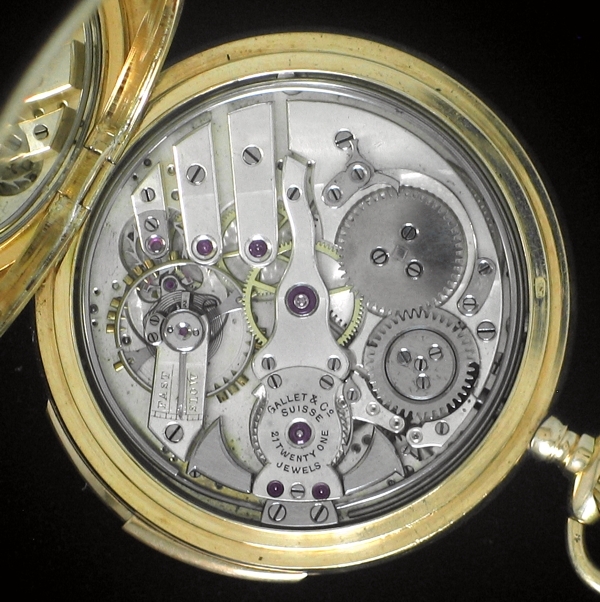
Figure 1. Example of a minute repeater mechanism. The Wikimedia Commons description identifies it as a Gallet pocket watch made in 1905. Photograph by Time Maven. Source and rights notice (public domain, released by the photographer). Unmodified.

How fast the date changes and how long the month lasts#
The calendar chapter covers mechanisms from a simple date display to the perpetual calendar. The English edition’s table of contents distinguishes perpetual calendars with continuously advancing displays, instantaneous changes and retrograde displays, whose hand returns to the start of the scale after reaching its end. Alongside the way the mechanism detects the end of the month, the chapter addresses when and how the display advances. 5 7
A European patent published in 2000 that cites pages 206–230 of the book as prior literature shows an example of an instantaneous change that accounts for short months. The step height on the part representing the month changes the travel of a lever, making the date wheel advance farther at the end of the month alone. The February step has a cam that changes its height once every four years. This is the mechanism illustrated in the patent, which also shows how later design documents drew on Lecoultre’s book. 8
Displaying the difference between a sundial and a mechanical clock#
The equation of time is the difference obtained by subtracting mean solar time, which averages the Sun’s apparent motion, from the apparent solar time a sundial shows at a given location. It varies with the seasons because of Earth’s axial tilt and the eccentricity of its orbit. For the fifth French edition in 2013, Ilan Vardi of the École polytechnique fédérale de Lausanne (EPFL) revised the chapter on the equation of time. The revision is also documented in an EPFL laboratory’s annual report. 4 6 9
Original editions, translations and differences in the plates#
| Edition | Verified bibliographic details and features |
|---|---|
| 1949 French edition | Éditions Simonin presents it as the first edition. 2 |
| 1951 second French edition | Éditions Booksimonin describes it as a reprint with the same content as the first edition. The US National Association of Watch & Clock Collectors (NAWCC) lending catalogue also lists the 1951 edition. 3 10 |
| 1952 English translation, A Guide to Complicated Watches | Biel, C. Rohr. Open Library gives the English translation as 220 pages. The NAWCC catalogue also lists a second English edition from 1985 and a third edition from 2004. 7 10 11 |
| 2013 fifth French edition (deluxe edition) | Neuchâtel, A. Simonin. The Swiss National Library’s national bibliography gives 158 pages, 47 fold-out plates and 14 loose plates. ISBN 978-2-9700775-6-5. 4 6 12 |
| Fourth English edition | The publisher describes 47 numbered fold-out plates gathered at the back of the volume, with references to them from the text. The chapter on the equation of time was also revised. 5 |
The title page of the public excerpt gives the names Éditions Horlogères and Charles Rohr, the printer in Biel. 1
The loose plates in the deluxe edition reproduce Lecoultre’s original classroom drawings, some of which carry signatures or annotations. When looking in later editions for a mechanism cited by page number in an early edition, the chapter title and figure number can help locate it. 4 5 12
Use as a repair reference#
In 1985 Joseph G. Baier recommended the English translation as a source for repairing old complicated watches in the American trade journal Horological Times. He described its coverage of jumping seconds hands and counters, striking mechanisms, several kinds of perpetual calendar and tables of the equation of time. In design literature, European patent EP 2096504 B1 cites pages 15–19 of the 1951 edition as an example of a second gear train driving an independent seconds hand. EP 3136188 A1 lists the book as a practical reference on striking mechanisms and repeaters. 7 13 14
The 2023 book Théorie des montres compliquées (article in Japanese) shows how mechanisms are organised in watchmaking education today. Both books cover striking mechanisms and calendars. Lecoultre’s treatment of how parts engage, where hands should be fitted and in what order to make adjustments gives a concrete record of mid-twentieth-century repair teaching. 1 7
References#
- François Lecoultre, Les montres compliquées, Éditions Horlogères / Imprimerie Charles Rohr. Public excerpt, PDF (title page, author’s preface, first half of the introduction and start of the foudroyante chapter through printed p. 22).
- Éditions Booksimonin, Les Montres Compliquées, bibliographic details for the 1949 first edition.
- Éditions Booksimonin, Les montres compliquées, bibliographic details for the 1951 second French edition.
- Watchprint, Les montres compliquées (deluxe edition).
- Éditions Booksimonin, A Guide to Complicated Watches, contents and revisions of the fourth English edition.
- EPFL Instant-Lab, Annual Report 2013, p. 21.
- Joseph G. Baier, “Complicated Watches: A Selected List of References with Recommendations for the Practical Mechanical Watchmaker”, Horological Times, November 1985, pp. 18–19.
- EP 1004947 A2, Mécanisme de correction rapide du quantième pour mouvement d’horlogerie muni d’un quantième, published 2000, mechanism description and figs. 1–2.
- U.S. Naval Observatory, “The Equation of Time”.
- National Association of Watch & Clock Collectors (NAWCC), Lending Library, p. 31.
- Open Library, A guide to complicated watches, C. Rohr, 1952 edition (OL20695751M).
- Bibliothèque nationale suisse, Le Livre suisse 2015/03, p. 45.
- EP 2096504 B1, Mécanisme d’affichage des secondes mortes, paras. [0003]–[0005].
- EP 3136188 A1, Mécanisme de sélection de mélodie pour pièce d’horlogerie à sonnerie, background art.
Online sources checked on 21 November 2026.