This article was translated from Japanese using AI. Read the Japanese original
Dava Sobel’s Longitude tells the history of how navigators kept the time of a distant place in order to find their east–west position at sea. Centred on the eighteenth-century clockmaker John Harrison, it connects making timekeepers with navigation, astronomy and disputes over a prize. Rumi Fujii translated the book into Japanese as Keido e no chōsen.1 2 3
How a clock can tell you where you are#
Chapter 1, “Imaginary Lines”, introduces the longitude problem through the lines drawn on a globe. Comparing the local time on board with the time at a reference location of known longitude at the same instant gives a time difference that can be converted to an east–west angle. One hour corresponds to 15 degrees of longitude, and four minutes to one degree. A practical comparison requires both readings to use the same time scale. Mean solar time averages out changes in the length of the solar day, while apparent solar time follows the observed motion of the Sun.1 4
The difficulty was preserving the reference location’s time throughout a long voyage. Sobel describes obstacles including the ship’s movement, temperature and changes in oils and metal components. In addition to a readable indication, a precision timekeeper needs to hold a steady rate as its surroundings change.1
The introduction directly connects the lines used to express position to the action of a machine. It explains why longitude mattered to clockmakers before turning to the story of how they made the clocks.1
Harrison at the centre of the story#
The book follows Harrison as he makes his timekeepers, tries them at sea and seeks recognition and payment. The publisher describes it as an account of astronomy, navigation and clockmaking centred on his work over many years. The published contents list fifteen chapters, including making and testing the timekeepers, Cook’s voyage, and the work of later makers and spread of the technology.1 2
In an academic review in Japanese, Takehiko Hashimoto highlights how the book made Harrison’s biography into a story with dramatic conflict. The same review discusses The Quest for Longitude, the conference proceedings associated with its origins.3
How the book came about#
According to Hashimoto, Sobel attended a longitude symposium at Harvard University in 1993 and wrote about it for Harvard Magazine. The article led to the book project, bringing specialist research on historic timekeepers together with science journalism.3
An edited record of Sobel’s 1996 talk also recalls that a publisher at Walker saw the magazine cover story and approached her about a book. Her account and the later review agree on how the project began.9
Writing for a general audience involved finding a narrative in the research. The book uses Harrison to follow who tried what and which obstacles they encountered. That clear focus also led later researchers to examine how the narrative handles institutions and other methods.3 5
The story and the history of the institutions#
From the first chapter, Sobel emphasises the conflict between Harrison and Astronomer Royal Nevil Maskelyne. Treating that personal dispute as a verdict on longitude methods as a whole or on the institutions’ aims can obscure the work needed to make sea watches widely usable.1 5
In a 2003 rhetorical analysis, Davida Charney argues that framing the story as a contest between a hero and the establishment pushed practical criteria other than accuracy into the background. It also mattered whether clocks could be reproduced and afforded and whether the mechanism could be disclosed for others to verify.5
Royal Museums Greenwich’s account distinguishes between Harrison’s fourth sea watch, H4, meeting the accuracy requirement on trial and payment being conditional on other makers’ ability to produce similar watches. Early marine timekeepers were expensive, and widespread use required improvements by later makers. The history includes both the invention and its adoption.6
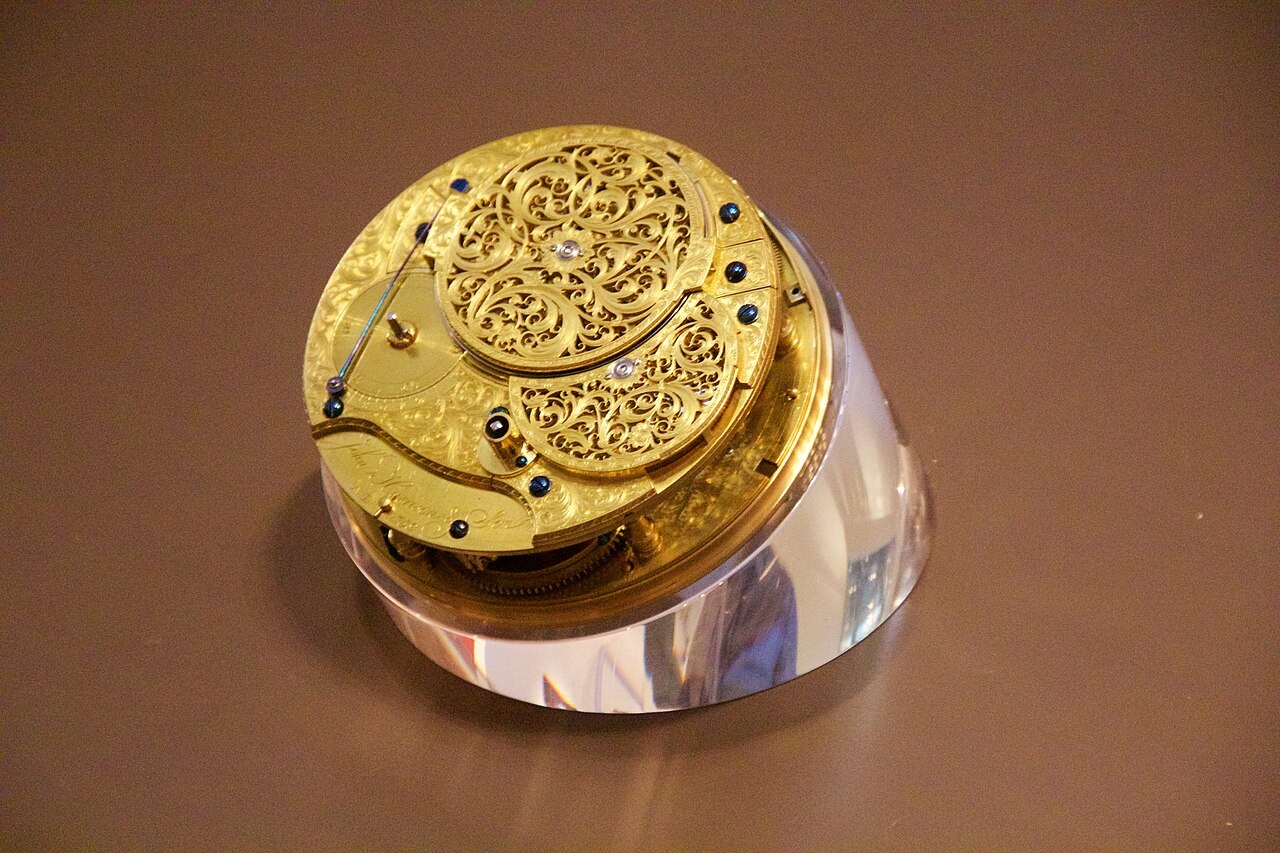
Figure 1. Movement of H4 at the Royal Observatory, Greenwich, photographed on April 15, 2015. This photograph of the surviving H4 movement relates to the book’s subject and was sourced separately from its illustrations. Photograph by Mike Peel (www.mikepeel.net). Source: Wikimedia Commons file page. Licence: CC BY-SA 4.0 International. The image uses the 1,280-pixel-wide version generated by Commons, with no cropping or colour changes. The resized image carries the same CC BY-SA 4.0 licence.

Bibliographic details, editions and the Japanese translation#
The full original title is Longitude: The True Story of a Lone Genius Who Solved the Greatest Scientific Problem of His Time, by Dava Sobel.2
| Edition or publication | Documented differences |
|---|---|
| Original US edition, Walker & Co., 1995 | Dava Sobel’s English original. Hashimoto’s review distinguishes the UK Fourth Estate edition, dated 1996. |
| The Illustrated Longitude, 1998 | The author’s official site lists it separately as co-authored with William J. H. Andrewes. The complete text and illustrations have not been compared for this article. |
| Tenth-anniversary edition, 2005 | The author’s site identifies this as a reissue with a foreword by Neil Armstrong. |
| English paperback, ISBN 9780802715296 | The publisher’s catalogue gives November 5, 2007, and 208 pages. This pagination applies to the paperback. |
| HarperCollins ebook, ISBN 9780007382002 | The authorised preview includes Neil Armstrong’s foreword dated April 2005, the fifteen-chapter contents and chapter 1. Page counts on ebook listings are separate from print pagination. |
| Keido e no chōsen: Ichibyō ni kaketa yonhyakunen, translated by Rumi Fujii | Japanese translation published by Shoeisha in 1997, 205 pages according to Hashimoto’s review. |
| Keido e no chōsen, translated by Rumi Fujii, Kadokawa Bunko | The publisher’s record gives June 23, 2010, 226 pages and ISBN 9784042982081. |
The original, its Japanese translations, and print and digital issues from different years can differ in pagination and preliminary matter despite sharing a title. Whether the two Japanese editions differ throughout the translation remains unverified here.1 2 3 7 8
Sources consulted and how to access them#
The examples come from the contents, Armstrong’s foreword and chapter 1 of the authorised preview that names HarperCollins as rights holder. The text from chapter 2 onwards was not read in full for this article. Independent reviews and research were used for the book’s origins and place in the history. The book’s text, the publisher’s description and later assessments supply different kinds of evidence.1 3 5
The English preview provides the introductory explanation, and the publisher provides bibliographic details for the Japanese edition. The book describes how precision timekeeping came to address a problem of navigation and gain wider recognition.1 2 7
Where to buy#
The links are for an English edition and a Japanese translation. The Japanese listing is the 1997 Shoeisha issue, which differs in format and publication date from the 2010 Kadokawa Bunko edition. Check the condition and what is included when buying a used copy.
- View the English edition of Longitude on Amazon (advertisement) (2007 paperback, ISBN 9780802715296)
- View the Japanese translation Keido e no chōsen on Amazon (advertisement) (translated by Rumi Fujii, Shoeisha, 1997 Japanese print edition, ISBN 9784881355053)
As an Amazon Associate, My Horology Notebook earns from qualifying purchases. Check the listing for current prices, stock and delivery terms.
References#
1. Dava Sobel, Authorised preview of Longitude. HarperCollins, ebook ISBN 9780007382002. Contents, Neil Armstrong’s foreword from April 2005 and chapter 1, “Imaginary Lines”. Accessed October 18, 2026.
2. Bloomsbury Publishing, Longitude. Description and bibliographic details for ISBN 9780802715296. Accessed October 18, 2026.
3. Takehiko Hashimoto, Review of Dava Sobel’s Longitude, translated by Rumi Fujii as Keido e no chōsen: Ichibyō ni kaketa yonhyakunen, and related works, Technology and Civilization, vol. 11, no. 1, 1998, pp. 39–42. Origins on p. 40, bibliography on p. 42. Accessed October 18, 2026.
4. J. L. E. Dreyer, “Time, Measurement of”, 1911. “Determination of Time” and “Longitude”. Relationship between solar time and longitude. Accessed October 18, 2026.
5. Davida Charney, “Lone Geniuses in Popular Science: The Devaluation of Scientific Consensus”, Written Communication 20(3), 2003, pp. 215–241, especially pp. 223–228. DOI 10.1177/0741088303257505. Accessed October 18, 2026.
6. Royal Museums Greenwich, “Longitude found – the story of Harrison’s timekeepers”. H4 trials, terms of payment and later adoption. Accessed October 18, 2026.
7. KADOKAWA, Keido e no chōsen. Translated by Rumi Fujii, Kadokawa Bunko, 2010. Accessed October 18, 2026.
8. Dava Sobel, “Longitude”. Author’s official site distinguishing the 1995 original, 1998 illustrated edition and 2005 tenth-anniversary edition. Accessed October 18, 2026.
9. Dava Sobel, “Sobel’s Longitude: The Best Seller No One Would Buy”, ScienceWriters. Edited record of the talk given on November 11, 1996, recalling the path from reporting to publication. Accessed October 18, 2026.