Making Time — Astronomical Time Measurement in Tokugawa Japan#
This article was translated from Japanese using AI. Read the Japanese original
In Making Time: Astronomical Time Measurement in Tokugawa Japan, historian Yulia Frumer traces changes in how people in Tokugawa Japan measured and understood time. The history includes the replacement of Japanese clocks by Western timepieces and focuses on how astronomers’ observations and calculations helped foster an idea of universal time that flows uniformly. 1
Unequal hours as a system sustained by society#
The book starts with a system in which the length of an hour varied with the seasons. The available excerpt from chapter 1 explains that daylight and night were each divided into six. An hour in this system therefore varied in length rather than always equalling two modern hours. It also distinguishes the use of the twelve animal signs of the East Asian zodiac to name hours from the numerical sequence of nine, eight, seven, six, five and four repeated for day and night. 2
The chapter also questions the idea that simply observing sunrise and sunset establishes the time. Light changes gradually at dawn, and terrain and weather vary, so a convention is needed to decide when day begins. The chapter distinguishes a unit used in astronomical calculations, one hundredth of a day, from seasonally varying hours. It shows how calculations with equal units supported the operation of the unequal-hour system. 2
The book also approaches the issue through the use of objects. Incense clocks measured elapsed time by burning incense, and the spacing between time marks could be adjusted for seasonal differences. The system of hours, its calculation and the adjustment of instruments were connected. Frumer asks how people established and shared time, a practice that goes beyond the presence of mechanical clocks. 2
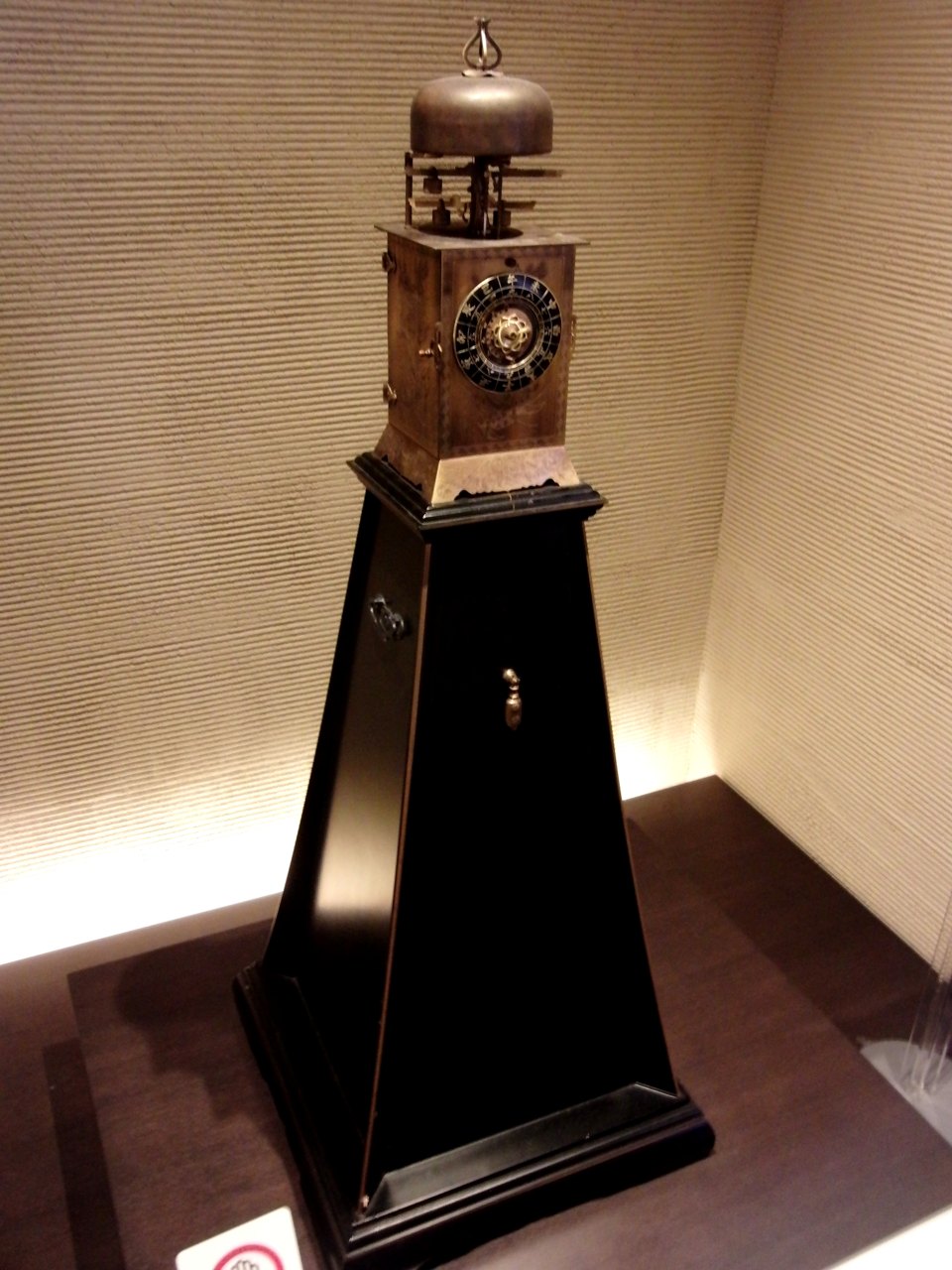
Figure 1. Mid-Edo-period Japanese lantern clock with a double foliot mechanism, exhibited by the National Museum of Nature and Science. It is an example of the Japanese clocks discussed as a subject in the book. Photograph by Momotarou2012. Source Wikimedia Commons. Licence CC BY-SA 3.0. Resized and recompressed as JPEG only. The edited image carries the same licence.

From observation to mapping, navigation and clockmaking#
The book has an introduction, eight chapters, a conclusion and appendices. The chapter abstracts trace a progression from the time system and the design of Japanese clocks through astronomy, surveying and navigation, to clockmakers and early Meiji reforms. The book puts variations in clock design and ideas about the nature of time in the same history. 1 3
| Section | Questions and examples |
|---|---|
| Chapters 1 and 2 | How did people use the unequal-hour system and display its time? These chapters explore the system and the diversification of Japanese clock dials and mechanisms. |
| Chapters 3–5 | How did time in astronomical observations relate to places on land and routes at sea? The chapters cover Shibukawa Shunkai, Asada Gōryū’s school, Inō Tadataka’s surveys and Honda Toshiaki’s plans for navigation. |
| Chapters 6 and 7 | How did specialists pass on their ideas of time? Examples include Endō Takanori of Kaga and Tanaka Hisashige and other makers of clocks and mechanical automata. |
| Chapter 8 and conclusion | How did Western-style time become associated with progress and enlightenment and come to be chosen as a standard for society as a whole? |
The table follows the published contents and chapter abstracts. Its scope is the structure of the book. 3
Determining time from astronomical observations also meant expressing the apparent positions of celestial objects as angles and numbers. The abstract of chapter 3 connects changes in observation and mathematics with changes in how people understood time. Chapters 4 and 5 turn to surveying that linked different places by the times of observations and plans to use a marine chronometer for navigation. These cases show what people wanted their instruments to do and allow the relationship between precision and social ideas of time to be examined in context. 3
Research background and scope#
The author biography published with the book identifies Frumer as a scholar of East Asian science and technology at Johns Hopkins University. The book considers the transfer of clock technology in relation to the customs and values of the society adopting it. 3
In her Physics Today review, Sara J. Schechner highlights how the book shows societies shaping technology according to their values and activities as well as practical needs. She places it within the history of science, technology and Japanese culture. Its scope differs from a specialist work giving comprehensive details of mechanisms and makers. She also sees room to consider the material culture of timekeeping more broadly, including sundials. 4
Takehiko Hashimoto’s review in East Asian Science, Technology, and Medicine asks whose conception of time the book describes. He notes that it principally concerns people trained in astronomy. How ordinary people used clocks and understood time, and how accurately the official time system was applied in practice, remain questions for further research. He also notes that the makers, owners and provenance of surviving Japanese clocks are often unknown, complicating efforts to date their adoption. 5
Bibliographic details, publication dates and access#
| Item | Details verified |
|---|---|
| Original title | Making Time: Astronomical Time Measurement in Tokugawa Japan |
| Author | Yulia Frumer |
| Publisher and language | The University of Chicago Press, English, one volume |
| Copy described | Print edition dated 2018 in CiNii Books |
| Print ISBN | 978-0-226-51644-8 |
| E-book ISBN | 978-0-226-52471-9 |
| E-book DOI | 10.7208/chicago/9780226524719.001.0001 |
| Pagination | The publisher lists 272 pages. CiNii Books lists 270 pages of text and eight pages of plates. |
Bibliographic details were checked against the publisher, BiblioVault and CiNii Books. 1 3 6 The publisher’s page shows ©2017 and BiblioVault gives 2017, while CiNii Books and the authorised public excerpt give 2018. The page counts above follow their respective sources.
CiNii Books lists Japanese library holdings under NCID BB26234041. AbeBooks hosts an authorised excerpt of chapter 1, and BiblioVault provides chapter abstracts. The publicly available material consists of catalogue records, abstracts and the excerpt. 2 3 6
The parts read directly for this introduction were the sections “Hours” and “Seasons” and part of “Calendars” in the available chapter 1 excerpt. The published contents and chapter abstracts document the book’s structure. Two independent reviews provide its place in historical research and discuss its limits. Reading all the chapters, checking the complete set of illustrations or the original sources in the notes, and comparing the complete texts of translations and editions were outside the scope.
Where to buy#
The link is for the English hardcover (2018, ISBN 978-0-226-51644-8). Check the listing for the edition and availability.
View *Making Time* on Amazon (advertisement)As an Amazon Associate, My Horology Notebook earns from qualifying purchases.
References#
- University of Chicago Press, Making Time, bibliographic details, description and contents. Accessed 7 November 2026.
- Yulia Frumer, available excerpt from chapter 1 of Making Time on AbeBooks, “Hours,” “Seasons” and part of “Calendars.” Acknowledges permission from the University of Chicago Press. Accessed 7 November 2026.
- BiblioVault, Making Time, bibliographic record, author biography at publication and abstracts of all chapters. Accessed 7 November 2026.
- Sara J. Schechner, “Telling time in Tokugawa Japan”, Physics Today, vol. 72, no. 6, 2019, pp. 57–58, DOI: 10.1063/PT.3.4229. Accessed 7 November 2026.
- Takehiko Hashimoto, review of Making Time, East Asian Science, Technology, and Medicine, vol. 50, 2019, pp. 180–183. Accessed 7 November 2026.
- National Institute of Informatics, CiNii Books: Making Time, NCID BB26234041. Accessed 7 November 2026.