Moinet’s horological treatise, from workshop practice to the time standard#
This article was translated from Japanese using AI. Read the Japanese original
Louis Moinet’s Nouveau traité général astronomique et civil d’horlogerie théorique et pratique is a French-language horological treatise connecting mechanisms and manufacture with geometry, materials and astronomical time. It covers how to make gears, what to set a completed timepiece against and how to test theoretical improvements in use. Specific tasks illustrate the range of knowledge a workshop needed in the first half of the nineteenth century. 1
What a small gear reveals about workshop practice#
“Making Pinions” on page 389 of Part I shows the book’s practical character. A pinion is a small gear with few teeth that meshes with a larger wheel. Moinet explains that buying or ordering pinions for table clocks had become routine and that specialised tools made their manufacture more regular and saved time. He still considers it necessary to know how to make them when the required dimensions are unavailable. 1
He advises preparing the pinion first and determining the dimensions of the larger wheel from the measured dimensions of the pinion. Altering the completed pinion is difficult, while its mating wheel is easier to adjust. The order of work reflects both the geometry of the parts and the constraints of the materials and parts actually available. 1
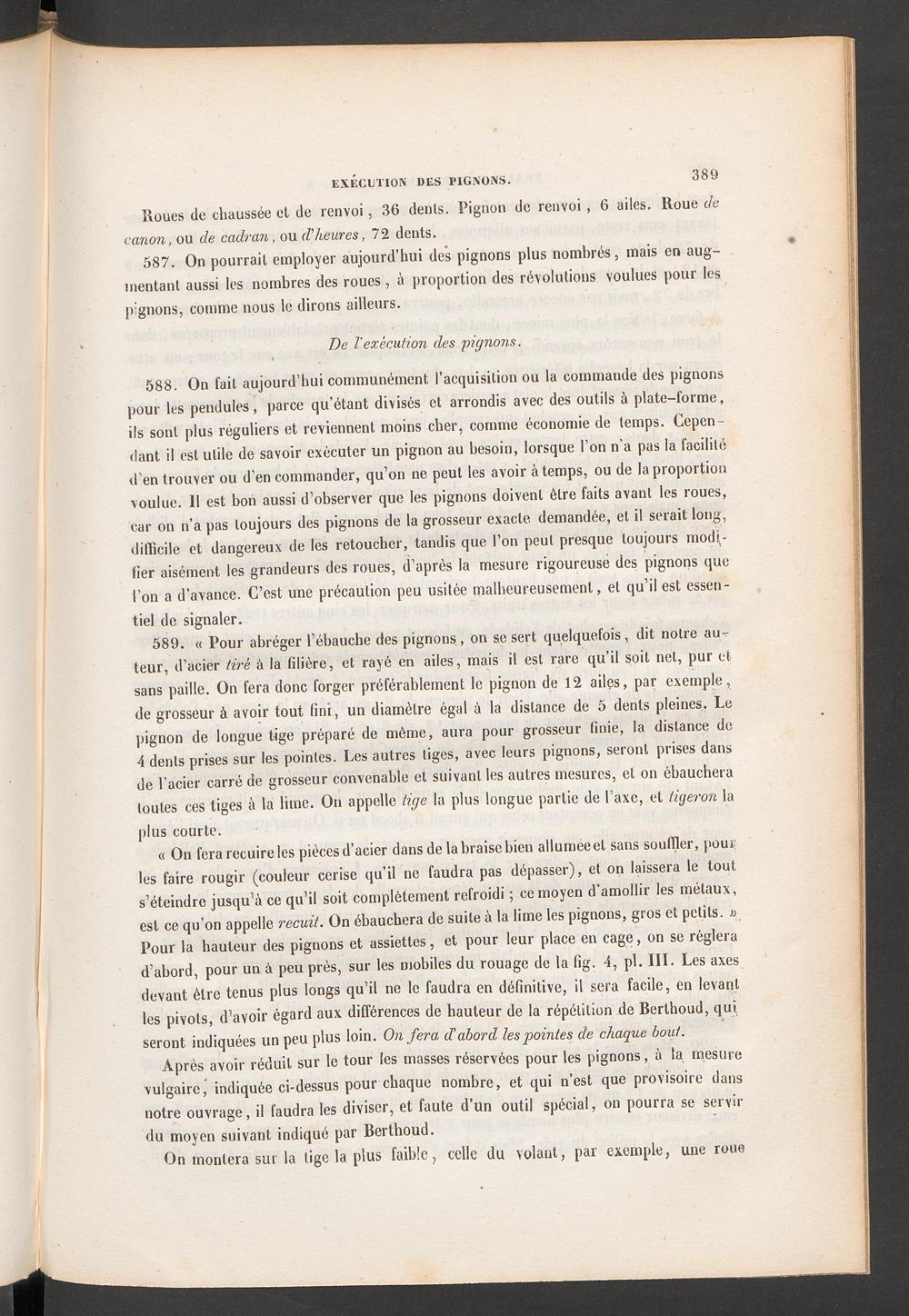
Figure 1. Part I, p. 389, “Making Pinions”. Author: Louis Moinet. Held and digitised by ETH-Bibliothek Zürich, Rar 17375: 1. Source: original on e-rara, persistent identifier. Rights: Public Domain Mark 1.0. The provider’s reduced image was used without cropping or colour changes.
On page 390 Moinet describes a method for working without a dedicated dividing tool. Dividing means marking a circle at equal intervals. A 72-tooth wheel serves as a scale. For pinions with six, eight or twelve leaves, stop at intervals of twelve, nine or six teeth respectively and mark the cutting positions. The lathe and an existing part turn a mathematical relationship into a workshop procedure. 1
Astronomy for setting a clock#
The book’s scope extends beyond the movement. In the discussion of sundials on pages 294–295 of Part I, Moinet notes that a provincial post office may intend to work by mean time but have no way of establishing it if the locality has no meridian line or sundial. A meridian line is a reference for locating the Sun at its upper culmination. 1
Time obtained from the Sun and mean time shown by a uniformly running clock differ by an amount that varies with the seasons. The difference is the equation of time, and the treatise includes tables for converting between the two. The difference between a clock running evenly and a clock being set to the correct time explains why a maker’s book also deals with sundials and astronomy. 1
The original includes tables of simple pendulum lengths and numbers of oscillations, tables concerning stars and mean solar time, and tables of the thermal expansion of glass and metals. Thermal expansion is a change in dimensions with temperature. It matters for temperature compensation in pendulums and balances, which seeks to stabilise the rate as temperature changes. The figures, material names and temperature scales reflect the period of publication and should be read in that context. 1
Connecting theory and use#
On pages 502–503 of Part II, Moinet argues for both theory and practice. Theory can predict results and organise methods, although it may not fully account for materials or workshop conditions. Practice alone may fall short of explaining and evaluating subtle effects. An initial success is therefore only a start. An improvement should be tested over a long period of use. 1
The book shows how a horological technician of the period distinguished what could be made, what could be explained and what continued to work well in use. Alongside methods of manufacture, it documents an approach to evaluating technology.
Bibliographic details and differences in dates#
| Item | Details |
|---|---|
| Author | Louis Moinet (1768–1853) |
| Original title | Nouveau traité général astronomique et civil d’horlogerie théorique et pratique d’après les plus habiles auteurs et les progrès récents de l’art |
| Language and format | French, two parts. The ETH catalogue records two volumes, 27 cm |
| Main copy consulted | ETH-Bibliothek Zürich, Rar 17375. e-rara DOI 10.3931/e-rara-50842 |
| Imprint in the ETH catalogue | Paris, chez Dutertre Editeur, 1841 |
| Later edition | Second edition, 1853. The recorded title includes élémentaire and pour les usages civils et astronomiques |
Sources give different publication dates. The ETH catalogue gives 1841, but page 502 of Part II in the digitised original quotes a letter dated 18 August 1847. The contents of the two-part set therefore cannot all date from 1841 or earlier. 1
FHH’s profile of Moinet places publication in 1848. The Google Books record identifies the 1853 volume as a second edition. This article does not compare the full texts to determine differences between editions. 2 3
Holdings and text consulted#
Both parts of the ETH copy are available through e-rara. There is also a digitised version of the 1853 second edition on Google Books. Check the edition when using page references. 1 3
This introduction draws chiefly on pages 389–390 and 294–295 and the opening tables of Part I, and pages 502–503 of Part II in the ETH copy. For the 1853 edition, only the bibliographic record and contents were checked. It is an introduction based on selected passages, and the workshop methods belong to their period. Along with the French technical vocabulary, readers need to take account of historical units and temperature scales.
References#
- Louis Moinet, Nouveau traité général astronomique et civil d’horlogerie théorique et pratique, ETH-Bibliothek Zürich, Rar 17375, catalogue imprint 1841. e-rara catalogue and originals of both parts. Consulted passages: Part I, pp. 294–295 and 389–390 and opening tables, and Part II, pp. 502–503. Accessed 9 November 2026.
2. Fondation Haute Horlogerie, Louis Moinet. The author’s place in horological history and the 1848 publication date. Accessed 9 November 2026.
3. Louis Moinet, Nouveau traité général élémentaire, pratique et théorique d’horlogerie pour les usages civils et astronomiques, 2nd ed., vol. 1, Dutertre, 1853. Google Books bibliographic record and contents. Accessed 9 November 2026.