This article was translated from Japanese using AI. Read the Japanese original
In Postwar Japanese Wristwatches: Seiko and Takano, Yoshio Nagao and Yoshitaka Kimura trace postwar watches from the two brands through photographs and notes on individual models. The Seiko Gyro Marvel entry compares the spinning-top mark on the dial with the automatic winding mechanism. The Takano Chateau entry documents the case, case back and hand-wound movement. This introduction draws on publicly available pages and the contents of the 1994 edition. 1 2 9
Hand winding and automatic winding in the Seiko section#
The Seiko section reviews its history from its founding to the end of the war and covers postwar hand-wound wristwatches model by model, including the Super, Marvel, Cronos and Crown. The chapter on watch exteriors examines dials and case markings. The back of the book includes a diagram of movement families and a production timeline. Page 113 uses a second-hand Crown to discuss checking the case for scratches and loss of the gold-coloured finish, and inspecting the dial and crystal. 9
The comparison of hand-wound movements on p. 137 shows the insides of the Lord Marvel 36000, Grand Seiko, King Seiko and King Seiko Chronometer together with their model names. 2
The Gyro Marvel entry on p. 95 shows the front of the dial alongside a photograph of the movement with the back removed. It dates the start of production at Suwa Seikosha to July 1959 and lists the 17-jewel Cal. 290, the ball bearing at the centre of the rotor and the spinning-top mark on the dial. The rotor turns with wrist motion to wind the mainspring. According to the Seiko Museum, this model’s Magic Lever winds the mainspring whichever way the rotor turns. 2 3
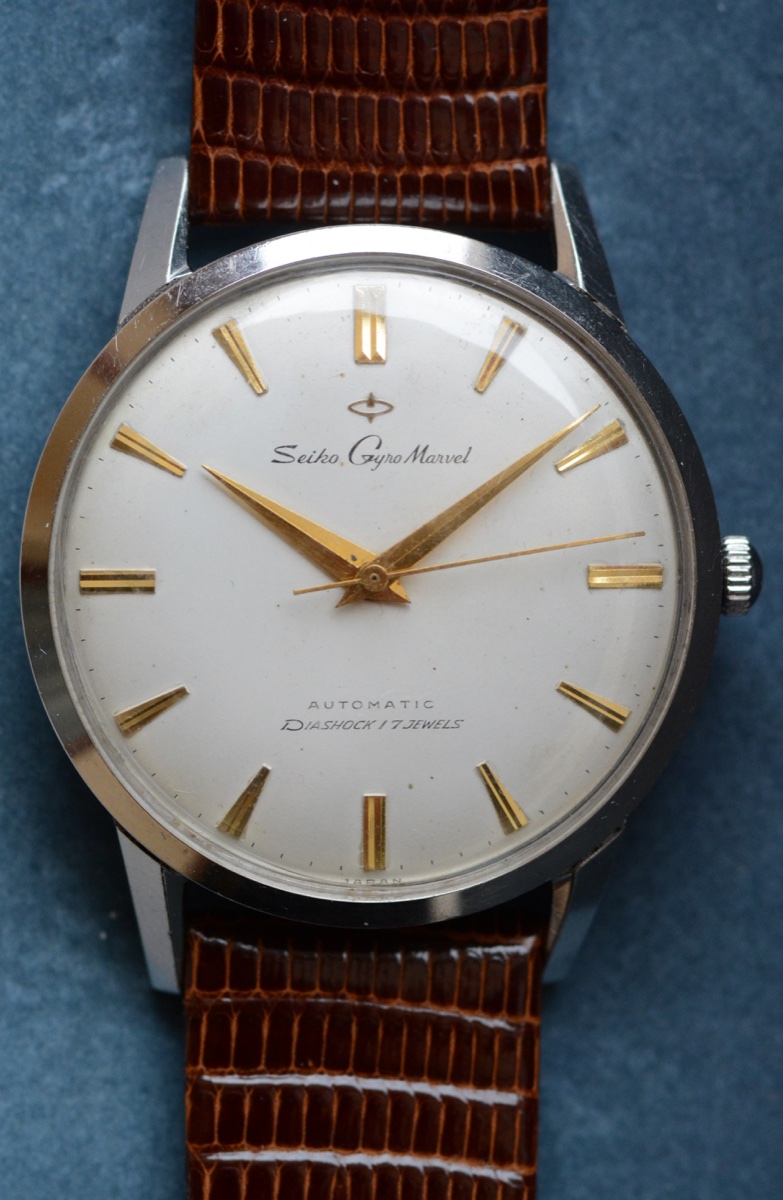
Figure 1. A surviving example of the Gyro Marvel model covered in the book. Photograph by Dnalor 01. Source Seiko Gyro Marvel Automatic on Wikimedia Commons, CC BY-SA 3.0 Austria. Resized to 1,200 pixels on the longest side and distributed under the same licence.

The Chateau and Ricoh watches in the Takano section#
The Takano section opens with the history of Takano Precision Industries and then covers the Laco and Chateau types, the Opal and models from the beginnings of Ricoh Watch. The appendices include advertisements, product sample charts, parts price lists and lists of common parts. They help readers use model names to look up sales materials and components. 9
On p. 219 Kimura presents a 21-jewel Chateau with a hand-wound Cal. 531. Photographs of its front and movement accompany details of its gold-plated case and snap-on stainless steel back. Kimura writes that he bought this watch from a dealer in Osaka in 1989. The proprietor told him about the relationship between Takano and Ricoh Watch and about the early Laco type. The entry thus documents how the individual watch was acquired alongside its calibre and exterior. 2
Page 238 shows the Opal alongside watches identified as Ricoh models, with photographs of the movement sides of the Chateau, Chateau Calendar and Dynamic Auto. The bridge of the Chateau’s Cal. 531 is marked “TAKANO”. “RICOH” appears on the Chateau Calendar’s Cal. 534 and on the Dynamic Auto’s rotor. The book’s classification and the markings on surviving examples both help trace products from the period when the company’s name changed. 2 5
The period covered and later publications#
Takano Precision Industries entered wristwatch production in 1957. The industrial heritage record compiled by the Japan Clock & Watch Association describes the “200 Series 121,” mass-produced that year, as a 17-jewel model with central hour, minute and seconds hands. Ricoh Elemex’s company history records extensive damage to Takano’s main factory in the Ise Bay Typhoon in 1959, the launch of the Chateau the following year and the change of name to Ricoh Watch in 1962. 4 5
While both companies’ watches were on the market, the National Research Laboratory of Metrology compared Japanese and foreign wristwatches bought from Tokyo department stores and specialist shops. Its 1963 report describes retesting 23 watches after about a year and a half of use and measuring them again after disassembly and oiling. Seiko and Takano were among the companies asked to service the watches. The tests documented the accuracy in use of Japanese watches sold at retail. 6
Nagao later devoted separate volumes of Tombow Publishing’s Japanese Wristwatches series to the Crown, Cronos and Marvel. With additional contributions from Yoshihiko Honda, the three volumes appeared in 2014 as an expanded edition of Japanese Wristwatches: Seiko Crown, Cronos and Marvel (article in Japanese). For more on Takano and Ricoh, the same publisher issued Toshiki Mori’s Japanese Wristwatches: Takano and Ricoh in 2019. 7 8
Bibliographic details and holdings#
| Item | Details |
|---|---|
| Title | Postwar Japanese Wristwatches: Seiko and Takano |
| Authors | Yoshio Nagao and Yoshitaka Kimura |
| Publication | Tombow Publishing, Osaka, 10 May 1994 (first edition, first impression) |
| Format | Japanese, 253 pages, 21 cm |
| ISBN | 4-88716-089-5 |
| NCID | BN11272347 |
National Diet Library Search and CiNii Books provide holdings information. CiNii Books lists Tokyo Keizai University and Momoyama Gakuin University. 1 9
References#
- National Diet Library Search, “Postwar Japanese Wristwatches: Seiko and Takano,” and CiNii Books, “BN11272347.” Bibliographic details and holdings. Accessed 20 November 2026.
- Yoshio Nagao and Yoshitaka Kimura, Postwar Japanese Wristwatches: Seiko and Takano, Tombow Publishing, 1994. Book entry in Plus9Time’s “Japanese Domestic Watch Series,” with front and back covers, photographs of pp. 95, 137, 219 and 238, and the site’s account. Accessed 20 November 2026.
- Seiko Museum Ginza, “Gyro Marvel.” The 1959 model and its winding mechanism. Accessed 20 November 2026.
- Center of the History of Japanese Industrial Technology, National Museum of Nature and Science, “Wristwatch, 200 Series 121.” Japan Clock & Watch Association survey, record no. 108810991215. Accessed 20 November 2026.
- Ricoh Elemex, “Launch of an 80th-Anniversary Wristwatch,” 28 March 2018. Takano Precision Industries’ wristwatch business and changes of company name. Accessed 20 November 2026.
- Shōzō Matsushiro and Tomiji Kitsunezaki, “Comparative Accuracy Tests of Japanese and Foreign Wristwatches,” Journal of the Horological Institute of Japan, no. 25, 1963, pp. 71–86. Test conditions on p. 71. Accessed 20 November 2026.
- National Diet Library, “Japanese Wristwatches: Seiko Crown, Cronos and Marvel, expanded edition.” Catalogue record for the 2014 publication and note on the combined volumes. Accessed 20 November 2026.
- Osaka Municipal Library, “Japanese Wristwatches: Takano and Ricoh.” Catalogue record and description of Toshiki Mori’s book, Tombow Publishing, 2019. Accessed 20 November 2026.
- Yoshio Nagao and Yoshitaka Kimura, Postwar Japanese Wristwatches: Seiko and Takano, Tombow Publishing, 1994. Publicly available photographs of a physical copy, images 6, 7, 15 and 16 (contents), 11 (p. 113) and 19 (publication page). Accessed 20 November 2026.