This article was translated from Japanese using AI. Read the Japanese original
The Principles of Mr. Harrison’s Time-Keeper is the English publication of 1767 that disclosed the construction of John Harrison’s fourth marine timekeeper, now known as H4, through written explanations and copperplate illustrations. It deals with how the design could be passed on to other watchmakers, as well as with the watch’s performance. It allows the technical explanation by Harrison and his son to be read alongside the astronomer Nevil Maskelyne’s notes from questioning them. 1 2
Bibliographic details and edition discussed#
| Item | Details |
|---|---|
| Original title | The Principles of Mr. Harrison’s Time-Keeper; with Plates of the Same. Published by Order of the Commissioners of Longitude |
| Technical account submitted by | John Harrison and his son William Harrison |
| Preface and notes from the examination | Nevil Maskelyne, Astronomer Royal |
| Publication | London, 1767, by order of the Commissioners of Longitude |
| Printers and booksellers | Printed by W. Richardson and S. Clark, sold by John Nourse and Messrs Mount and Page |
| Language | English |
| Contents | Preface pp. v–viii, notes from the examination pp. ix–xvii, principles and explanation of the drawings pp. 19–31, ten leaves of plates |
| Public identifier | Library of Congress LCCN 08021916 |
The edition discussed here is the English original of 1767. The title page does not name an individual author. The preface identifies the account submitted by the Harrisons and explains Maskelyne’s editorial role. Library catalogues list John Harrison as the author. 1 2
Why the watch’s construction was disclosed#
One way to find longitude at sea, the ship’s east–west position, is to compare the local time with the time at a reference location. At 360 degrees of Earth rotation in 24 hours, one hour of time difference corresponds to 15 degrees of longitude. A watch that carried reference time on a voyage had to retain a stable rate, the amount it gained or lost over a given interval, despite changes in temperature and the motion of the ship. 3
The Commissioners of Longitude wanted the design to be reproducible. The 1765 proposal BGN/9 in the Royal Museums Greenwich collection records the payment terms for disclosing the principles and handing over the watch, along with conditions for making and testing other timekeepers on the same principles. 4
According to pp. v–vi of the preface, John and William submitted a written account and original drawings under oath, took the watch apart and answered questions. Those present included clockmakers Thomas Mudge and Larcum Kendall, instrument maker John Bird, Maskelyne and others. The publication grew out of a process in which the watch itself was shown and its makers explained it and responded to questions. 1
Technical questions the book addresses#
Delivering power while limiting its influence on timekeeping#
Page 19 begins by describing the fine pivots and ruby holes that support the wheels and reduce friction. It then says that the timekeeping part is wound once every eighth of a minute, or 7.5 seconds. This is an operation repeated at short intervals inside the movement. Winding the whole watch each day was a separate task for the user. A small source of stored energy replenished at intervals to regulate the driving force is the principle of a constant-force device called a remontoire. 1, p. 19.
Keeping the watch running while the user winds the mainspring presents a separate problem. Page 20 describes a supplementary spring inside the fusee. The fusee is a conical component that transmits the mainspring’s force through a chain or similar means. The supplementary spring supplies power while the mainspring is out of action during winding. Short-interval replenishment and maintaining power during winding serve different purposes. 1, pp. 19–20.
On pp. 20–21, Harrison argues for reducing the effect of the train’s driving force on the oscillations of the balance and balance spring. The balance is the wheel that oscillates to regulate the watch, and the fine spring returns it towards equilibrium. Harrison also discusses measures to counter changes in temperature, ship motion and amplitude, arguing that the watch’s performance came from deliberate design. The book documents the factors he regarded as important and how he explained the principles. 1
Following the letters on the drawings#
From p. 22, the explanation follows the labels from Fig. 1 onwards on drawings used to make H4. Fig. 3 on p. 23, for example, identifies the first wheel, a section through the fusee, the internal ratchet and the barrel holding the supplementary spring. A ratchet has teeth that work with a pawl to control the direction of rotation. A barrel houses a spring. The drawings and captions can be read together to show how the parts transmitting power fit over or inside one another. 1
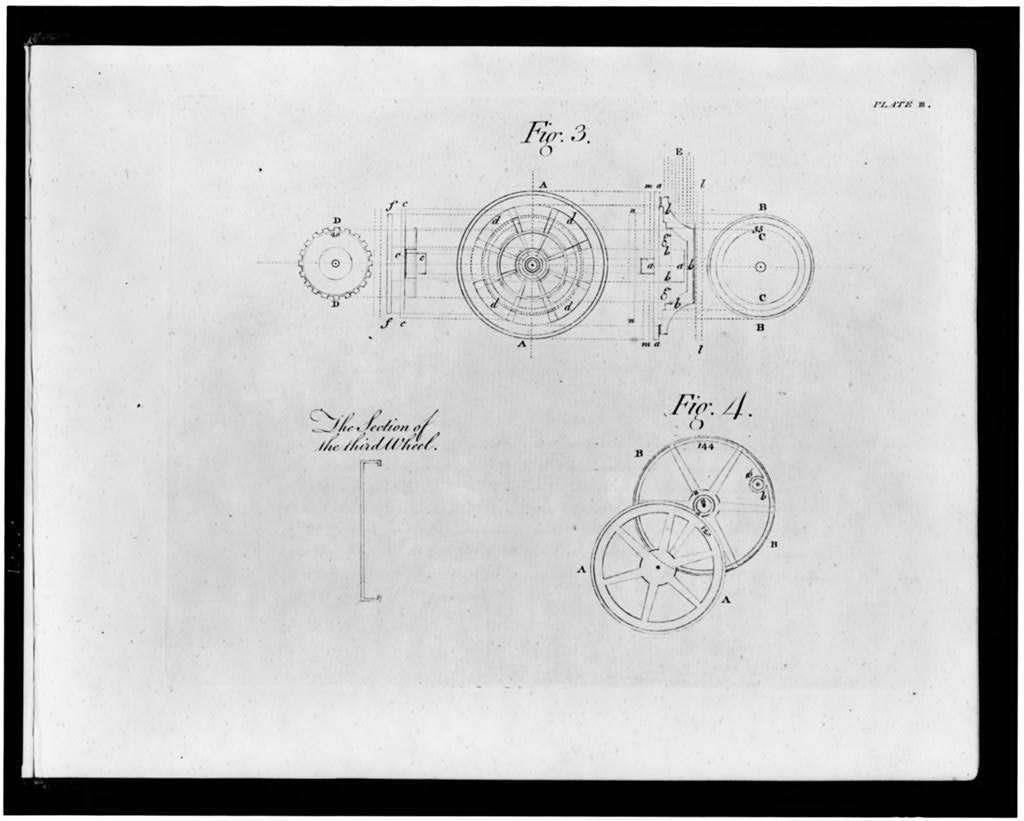
Figure 1. Plate III, figs. 3 and 4 of the first edition. The upper illustration separates the parts and uses letters to connect sections and positions. Original drawing by John Harrison, who died in 1776, as attributed by the Library of Congress. Engraver unknown. Original source Library of Congress, LCCN 2006691764. Source and rights notice Wikimedia Commons file. Public domain as a faithful reproduction of a drawing published in 1767 by an author deceased for more than 100 years. Public Domain Mark 1.0. The 1,024 × 821 pixel JPEG distributed by the Library of Congress was used without additional cropping, annotation or colour changes.
Temperature compensation and handling in the examination notes#
On pp. xii–xiii, Maskelyne’s notes describe a temperature compensator called a thermometer kirb. Thin pieces of brass and steel are riveted together so that their different rates of thermal expansion cause the assembly to bend. Two pins at the free end change the active length of the balance spring to compensate for changes in rate with temperature. The notes also describe comparing cold outdoor air with a position near a fire, and setting the compensation before adjusting for differences between positions. 1
Page xvi warns that when the watch is repositioned for winding, turning it suddenly in the plane of the balance’s rotation can stop it. The notes also say to give the pallets and pivot holes a small quantity of oil. Practical knowledge for handling the watch accompanies the description of its mechanism. 1
The accuracy of the plates and what drawings can convey#
Pages vi–vii of the preface describe the difficulty of reproducing the drawings accurately. Maskelyne says he checked the engraved lines against the originals and warns that impressions on ordinary paper vary in dimension from the originals and from one another because the dampened paper shrinks as it dries. A small number of impressions on India paper were therefore prepared for craftspeople who might make watches based on Harrison’s design, to avoid shrinkage during drying. The printing process itself affected the transmission of information about a precision mechanism. 1
Differences between the figures also need explanation. The preface, pp. vii–viii, describes different positions for the escapement pallets in figs. 8 and 9. The pallets receive the teeth of the escape wheel and transmit power to the oscillator. Figure 9 shows an earlier design and Fig. 8 a subsequent change. Reading the figures together as a specification of one state of the watch would hide this change. 1
Accurate plates can still leave gaps in the knowledge needed to build a watch. In a 2019 technical article, Tim Lake compared the original explanations and plates with the object and later observations and argued that the published account alone is insufficient to reproduce H4. 5
Translation and place in horological history#
Richard Dunn of the Science Museum says that a French translation appeared within weeks of the English publication in 1767. His article reproduces a plate captioned in English and French from Principes de la montre de M. Harrison. Dunn says that despite criticism of the book’s usefulness, it influenced makers in France and elsewhere, and that Pierre Le Roy acknowledged its influence. The volume explained an individual watch and carried technical knowledge across borders. 3
| Period | Development related to the book |
|---|---|
| 1765 | The Commissioners of Longitude’s terms raise the question of disclosing the watch’s construction principles and reproducing them in other watches |
| 1767 | The English original appears in London, with a preface, examination notes, technical description and ten leaves of plates |
| 1767 | A French translation appears, bringing the explanation to French makers |
| 2019 | Tim Lake compares the original text and drawings with evidence from the watch, reproduction and examination under a microscope |
The book documents how one timekeeper was explained and its design made public. The articles on John Harrison and Nevil Maskelyne cover related biographical and longitude history. The book’s particular value is in showing how the mechanism of a physical watch was conveyed through published drawings. 1 3
Access to the original and scope of the review#
The Library of Congress makes the 1767 volume available as a digital reproduction of 64 images. Cambridge University Library also provides an open reproduction, and the Wellcome Collection lists an electronic copy via Eighteenth Century Collections Online. Access conditions vary by source, and some may require institutional authentication. 1 2 6
The title page, preface on pp. v–viii, examination notes and text on pp. 19–31 were checked against the original plates. The account draws particularly on pp. 19–23 for the principles and parts and on the preface for the accuracy of printing. The examination notes are attributed separately from Harrison’s text, and dimensions from the plates have been treated as printed dimensions. The review did not exhaustively compare the full French translation, reproduction quality in later facsimiles or the availability of a Japanese translation.
References#
- John Harrison and Nevil Maskelyne, The Principles of Mr. Harrison’s Time-Keeper; with Plates of the Same, 1767, Library of Congress. LCCN 08021916 and digital original. Preface pp. v–viii, Notes pp. ix–xvii, text pp. 19–31 and plates I–X. Accessed 7 November 2026.
- Wellcome Collection, The principles of Mr. Harrison’s time-keeper. Catalogue record for the printers, booksellers, language and electronic edition of the 1767 publication. Accessed 7 November 2026.
- Richard Dunn, Movements and maps – the French quest for longitude, Science Museum, 5 December 2024. Longitude and time difference, the French translation and technical exchange. Accessed 7 November 2026.
- Royal Museums Greenwich, Proposal by the Board of Longitude to pay John Harrison a sum of money for the development of his timekeepers, BGN/9, 1765. Collection record of the proposal for disclosure, handover and tests of other watches. Accessed 7 November 2026.
- Tim Lake, In-Depth: The Microscopic Magic of H4, Harrison’s First Sea Watch, SJX Watches, 2 September 2019, with additions in 2019 and 2021. Technical study comparing the explanations and plates in the original publication. Accessed 7 November 2026.
- Cambridge University Library, The Principles of Mr. Harrison’s Time-Keeper, PR.PBA.1740. Open reproduction of the 1767 volume. Accessed 7 November 2026.