This article was translated from Japanese using AI. Read the Japanese original
Disassemble a watch and several similar screws can end up on the bench. The Watchmakers’ Hand Book illustrates making holes in a board to match where the screws came from and placing them there one by one. This practical manual in English is arranged so watchmakers can look up subjects as needed at the bench, from organising the work to the principle of the screw used to measure a part. 1 2
A book for the workshop#
The title page of the 1881 edition names Claudius Saunier as author and Julien Tripplin and Edward Rigg for translation, revision and additions. Tripplin is identified as a watch manufacturer in Besançon and Rigg as an analyst at the Royal Mint. The publishers are J. Tripplin in London and L. H. Keller & Co. in New York. 1
According to the preface, the editors combined Saunier’s French practical works Guide-Manuel de l’Horloger and Recueil des procédés pratiques, rearranging the entries and adding information. The German Watch Museum in Glashütte lists the latter in its library catalogue in an 1874 edition from the Bureau de la Revue chronométrique in Paris. It bears the name of the horological journal that the American trade press credits Saunier with founding in 1853. 1 3 4
Tripplin and Rigg intended the book as a practical companion to their earlier work on A Treatise on Modern Horology in Theory and Practice. The preface envisages repairers who had brief apprenticeships and worked on many watches for low fees. It retains expedient repair methods for cases where suitable replacement parts are hard to obtain or make. The index and cross-references were expanded for day-to-day use, with a table for finding the relevant text from the plates at the back. 1 5
Measuring, inspecting and repairing#
The earlier parts of the six-part manual cover calculation, geometry, measurement, materials and their treatment, working posture and tool handling. The later parts cover lathes and other tools, inspection and servicing, and work on particular areas of a watch. For gears, for example, readers can consult one chapter on checking the depth of mesh and another on tools for shaping the teeth. 1 2
Turning screw rotation into a measurement#
Section 30 in Part I of the American edition shows a screw that advances 1 mm per turn, fitted with a graduated disc divided into 100 parts. One division represents 0.01 mm of travel at the screw tip. The zero is where the fixed point and screw tip meet. The reading is taken with a part fitted between them. The book specifies that the screw must be accurate and play when the direction of rotation is reversed must be sufficiently small. 2
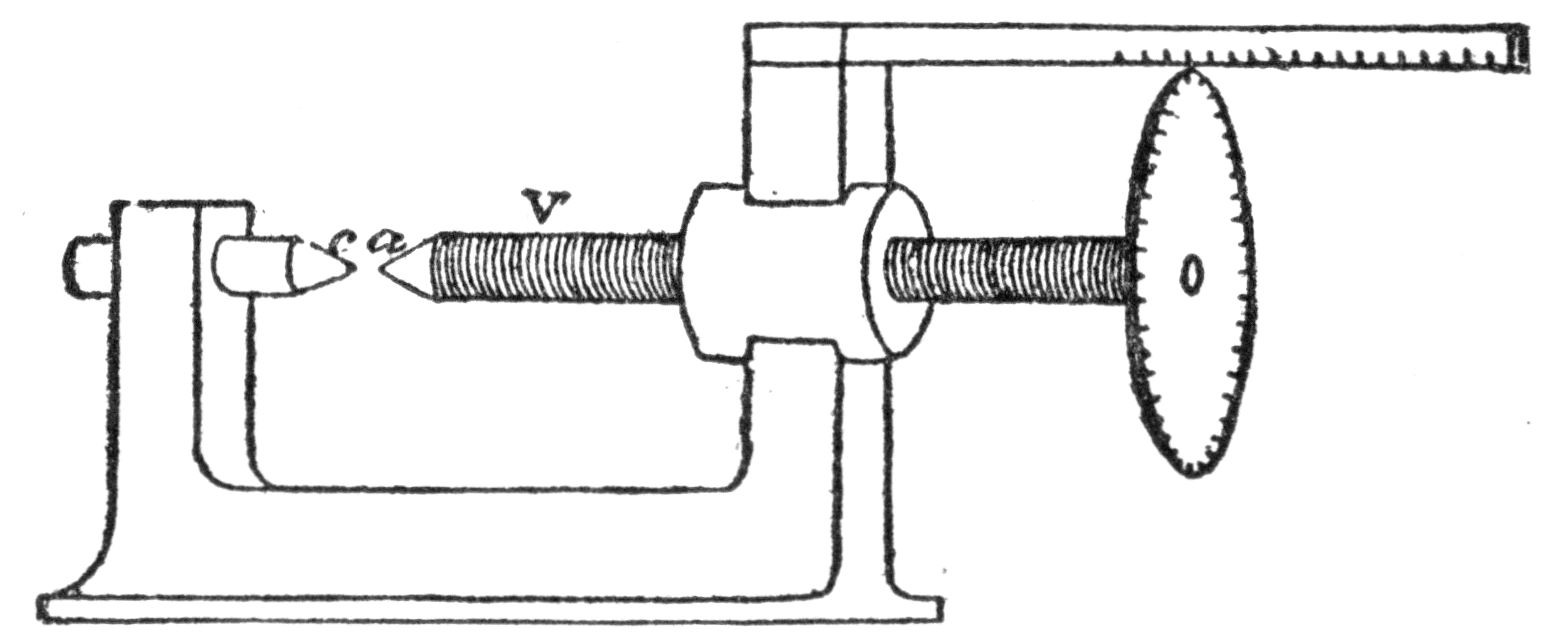
Figure 1. Instrument for reading the distance between two points from the rotation of a screw. 1894 American edition, p. 39, fig. 15. The illustrator is not separately credited. Source: public mirror of the Project Gutenberg edition. Public domain (published in 1894, copyright term guidance from Japan’s Agency for Cultural Affairs). Unmodified.
Endshake and where to put removed screws#
In the example of a Geneva movement in Part V, the repairer checks whether adjacent parts clear one another and how far wheel arbors can move along their axes. The latter motion is called endshake. One example calls for gently lifting the balance and letting it down again, observing the change in clearance between the collet that fastens the inner end of the balance spring to the staff and the bridge that supports the staff. 2
The same part’s advice for beginners includes a board with holes for the screws and a box with compartments. It also recommends writing down the watch number and the work to be done, then crossing off each job as it is finished. Keeping track of which watch and position a part came from reduces the chance of mixing up parts during reassembly. 2
Checking the workshop’s time reference#
Part I of the American edition says the regional standard times used by the railways were telegraphed at noon each day and that watchmakers could use them for comparison. In cities that also used local time, taking noon as the Sun’s transit of the local meridian, the book gives a way to reconcile the two times using longitude and check the workshop’s reference clock. 2
Reading the 1881 edition and the 1894 American edition#
The Internet Archive has a scan of the 1881 edition with its title page, preface, text and plates. A 1935 horological bibliography prepared by the US National Bureau of Standards lists a 1924 London edition of Tripplin and Rigg’s English translation. 1 6
The Project Gutenberg edition is the illustrated American edition expanded by Henry G. Abbott and published by Geo. K. Hazlitt & Co. in Chicago. Its title page gives 1894 and its copyright notice 1892. Abbott says in the preface that he moved illustrations from the back to the relevant explanations. He replaced older bow-driven tools with coverage of foot wheels, lathes and their attachments. At the start of Part I, he observes that manufacture of interchangeable parts in America gave repairers fewer occasions to make their own. Calculation and geometry were still useful in repairing imported watches and converting key-wound watches to stem winding. The illustrations and choice of tools reflect the needs of American workshops. 2
References#
- Claudius Saunier, translated and enlarged by Julien Tripplin and Edward Rigg, The Watchmakers’ Hand-Book, 1881. Title page, preface pp. v–viii, table of contents and plate reference table at the back. Internet Archive original (accessed 21 November 2026).
- Claudius Saunier, revised and enlarged by Henry G. Abbott, Watchmakers’ Hand Book, Geo. K. Hazlitt & Co., 1894. Title page, preface, Part I §§ 1, 30 and 52–53, Part V §§ 453–456 and 464, and Parts IV and VI. Public mirror of the Project Gutenberg edition (accessed 21 November 2026).
- Deutsches Uhrenmuseum Glashütte, Bibliotheksbestand, FU sau 12.1 U 370. Library catalogue (accessed 21 November 2026).
- “Death of Claudius Saunier”, The Keystone, January 1897, pp. 17–18. Digitised copy held by NAWCC (accessed 21 November 2026).
- Claudius Saunier, translated by Julien Tripplin and Edward Rigg, A Treatise on Modern Horology in Theory and Practice, 2nd ed., 1887. Digitised New York Public Library copy (accessed 21 November 2026).
- National Bureau of Standards, Books on Watchmaking and Timepieces, Letter Circular 442, bibliography. Digitised US government publication (accessed 21 November 2026).