The Science of Clocks and Watches — The Physics of Timekeeping Accuracy#
This article was translated from Japanese using AI. Read the Japanese original
The Science of Clocks and Watches is an English-language technical work by A. L. Rawlings (Arthur Lionel Rawlings) that uses physical principles to explain how timepieces work and how accurately they keep time. It connects the oscillations of pendulums and balances with the impulses of the escapement and the effects of friction. The first edition appeared in 1944, followed by an expanded second edition in 1948. The British Horological Institute (BHI) published a third edition in 1993 with additions by specialists. 1 2 3
The principles behind making and repairing timepieces#
A power source alone cannot make a clock keep steady time. A swinging pendulum or an oscillating balance provides the reference period, and the escapement adds energy to sustain the oscillations while releasing the gears in increments. The point in the swing at which the impulse is given, and what happens as amplitude changes, affect how the timepiece gains or loses.
In January 1952 Scientific American introduced the second edition in a follow-up note to an article on a homemade Synchronome clock published the previous July. It described the book as emphasising physical explanations over workshop procedures for manufacture and repair. It has a chapter on electric pendulum clocks, with mechanical timepieces as its main subject. Topics include oscillation, escapements and their errors, marine chronometers, gear trains, springs, friction and striking. 2
The book treats accuracy as a property of the whole timepiece. The way the gears move the hands and the stability of the oscillation that keeps time are separate questions. The process of transmitting power can disturb the oscillation. The account presents the book as a resource for investigating how the motion of a timepiece leads to timekeeping errors. 2
The U.S. National Bureau of Standards also listed the second edition among technical works in its April 1950 guide Modern Books on Horology. The guide listed English-language books for watchmakers, collectors and other readers, documenting the work’s availability as a reference at the time. 4
What the 1993 third edition added#
The third edition makes it possible to distinguish the older text from later contributions. According to Henry B. Fried’s 1994 review, specialists’ additions appear at the ends of chapters in a different typeface, followed by the contributors’ initials in bold. The illustrations were also redrawn. Additions included George Daniels on escapements and J. Duncan Weaver on subjects ranging from electronic and quartz timepieces to atomic clocks. 3
Fried links the new edition to the BHI’s plans for education in horological science. He was also a friend of Rawlings and contributed a reminiscence to the edition. His contemporary review documents specific editorial changes, and his relationship to Rawlings provides context for his assessment. 3
How to read a diagram of temperature compensation#
One subject is how temperature affects a timepiece’s rate. As temperature rises, the restoring force of a steel balance spring decreases and the oscillations slow. A compensation balance uses a split rim made of different metals. As temperature changes, the weights shift inwards or outwards, altering the moment of inertia, which measures resistance to a change in rotation. The changes in the spring and in the balance are designed to offset one another. 5
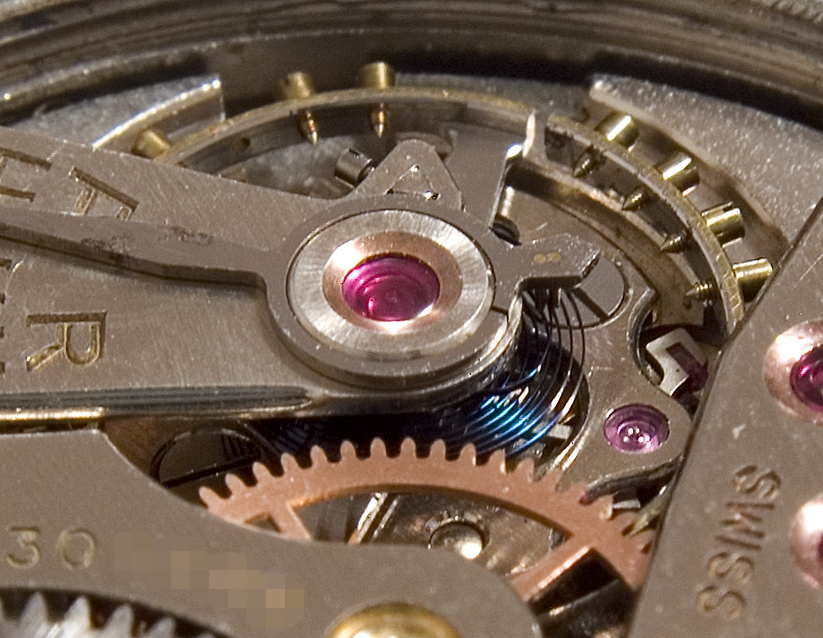
Figure 1. Compensation balance and balance spring of an Omega 30t2. This separate photograph illustrates the kind of mechanism relevant to the book’s discussion of temperature and oscillation. Photograph by Duxbelli. Source Wikimedia Commons file. Public domain. The photographer released the image worldwide and permits use without conditions wherever that release is unavailable. Reproduced unchanged.

Even when a watch is adjusted to the same rate at two temperatures, it can gain by a residual amount at temperatures between them. This is the middle-temperature error. David Boettcher reproduces an explanatory figure from Rawlings’s third edition and examines its comparison of weight position with the square root of the spring’s restoring force. He questions reading the pronounced curvature in the diagram as if it represented actual material coefficients. 5
A conceptual diagram and the size of the error in an actual watch answer different questions. Moving the weights inward reduces inertia. Determining how much compensation is possible across the temperature range requires material properties and numerical analysis. 5
Rawlings’s technical background#
According to New York University’s collection guide, Rawlings was from Britain and worked on patents involving gyrocompasses, ship stabilisation and fire control. He worked at Sperry, in the Scientific Research Branch of the British Admiralty and at the U.S. Time Corporation, among other places. He later worked in research and development at Bulova. From 1956 until his death in 1959 he served as curator of the museum that housed the James Arthur collection of timepieces. 6
This career helps explain why the book approaches timepieces as instruments for controlling and measuring motion. NYU’s guide also records a lecture Rawlings gave on 15 May 1953 about advances in timekeeping from 1650 to 1950, under the theme “From Hours to Microseconds.” 6
Editions and access#
| Edition | Publication and bibliographic details | Points of distinction |
|---|---|---|
| First edition | 1944, Pitman Publishing Corporation, New York and Chicago. ix preliminary pages, 236 pages of text. LCCN 44006516. | The ISBN below belongs to a later edition. |
| Second edition | 1948, Pitman Pub. Corp., New York. xi preliminary pages, 303 pages of text. LCCN 48006748, NCID BA69207848. | An expanded edition, covered by the 1952 account. |
| Third edition | 1993, British Horological Institute, Upton. Edited by Timothy and Amyra Treffry. ISBN 0-9509621-3-9. The contemporary review gives 393 pages and 146 black-and-white illustrations. | A revised, annotated edition based on the second edition of 1948, with additions distinct from the original text. |
The first and third editions were checked against Open Library’s edition records, the second against CiNii and the NBS guide, and the physical details of the third against the contemporary review. 1 3 4 7
CiNii’s record of the second edition leads to holdings in Japanese university libraries. Pagination varies by edition, so identify the edition before using a page number to look up a passage. 7
Sources and scope#
This introduction draws on the contemporary notice of the second edition, the detailed review at the time of the third edition, the compensation diagram reproduced and assessed in later research, and catalogue records for the editions. The full text, preface and complete set of illustrations were outside the scope of the reading. The descriptions taken from reviews are attributed to their sources. Any Japanese translation and textual differences between printings remain unverified here.
References#
- Open Library, The science of clocks and watches, bibliographic data by edition. The 1944, 1948 and 1993 editions. Accessed 7 November 2026.
2. Scientific American, January 1952, digitised issue (PDF), PDF p. 84, note introducing the second edition. Accessed 7 November 2026.
3. Henry B. Fried, “Book Reviews,” Horological Times, May 1994, pp. 42–43, AWCI PDF. Editing, contents and background of the third edition. Accessed 7 November 2026.
4. National Bureau of Standards, Modern Books on Horology, Letter Circular LC981, 1 April 1950, p. 5, item 56, NIST PDF. Accessed 7 November 2026.
5. David Boettcher, Middle Temperature Error, pp. 10–15, especially fig. 4 on p. 13 and the discussion on pp. 14–15, PDF from Horological Science Newsletter. Publication year unconfirmed. Accessed 7 November 2026.
6. New York University Archives, Records of the James Arthur Collection of Clocks and Watches, RG.42.1, “Biography of Arthur Lionel Rawlings”. Accessed 7 November 2026.
7. National Institute of Informatics, CiNii Books: The science of clocks and watches, 2nd ed., 1948, NCID BA69207848. Accessed 7 November 2026.