This article was translated from Japanese using AI. Read the Japanese original
Vintage Seiko watches with similar dials can differ in how the date advances and in the movement visible when the case back is removed. Toshiki Mori’s Japanese Wristwatches: Seiko Automatics traces representative models from the mid-1950s through the 1960s using photographs of their exteriors and movements. This introduction to the expanded edition of 2012 draws on published photographs of the pages and their table of contents. 1 2 3
Comparing models in one series through photographs#
Pages 12–13 show the Sportsmatic (245), Sportsmatic Calendar (790) and Sportsmatic “5” (410) together. The photographs of the fronts progress from a dial without a date window to a window for the date, then a shared window for day and date. Page 13 also has a photograph with the back removed, showing the rotor, the weight that turns with wrist motion and winds the mainspring. The listed first production years, jewel counts and calibre numbers help connect differences on the outside with those inside. 3
On pp. 16–17, the Sportsmatic “5” Deluxe (7606A) and Sportsmatic Deluxe (7605A) appear across a two-page spread. The 7606A entry notes a push-button at the 3 o’clock side of the case that advances the date. The controls visible from the side help identify the model alongside the dial normally seen on the wrist. 3
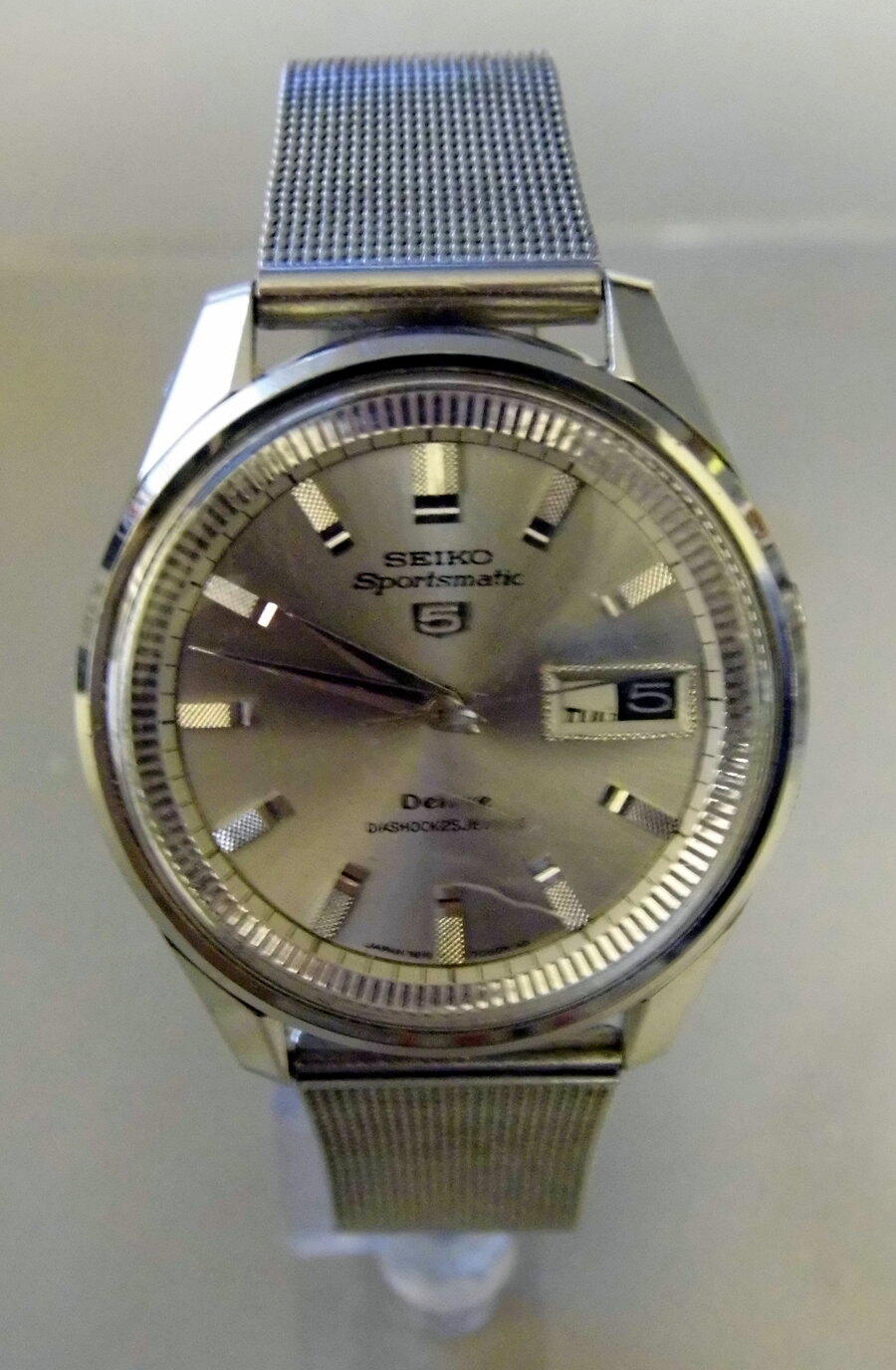
Figure 1. Sportsmatic 5 Deluxe with 25 jewels marked on the dial and a combined day-and-date window at 3 o’clock. Photograph by Joe Haupt. Source Wikimedia Commons. Licence CC BY-SA 2.0. Resized and recompressed as JPEG only.

The 62 series and specialised wristwatches#
Page 20 identifies the 62 Grand Seiko Calendar as calibre 6245A, with 35 jewels and production starting in 1967. The example shown has a “GS” mark on its dial. Grand Seiko’s official history also identifies the 62GS as the brand’s first automatic model, in 1967. The published contents list separate entries for the 62 Chronometer and 62 Grand Seiko, allowing comparison of watches with similar names. 2 3 4
Page 21 then shows the front, case back and movement of the World Time (6217A). Seiko’s design account explains that in this 1964 watch the crown turns an inner ring marked with city names. Used with the 24-hour hand, it lets the wearer read the time elsewhere. The SilverWave examples on pp. 22–23 show rotating scales on watches from the Seikomatic and Sportsmatic series. The book also shows how watches let travellers read times elsewhere and how a movable scale can show elapsed time. 3 5
When automatic winding became widespread#
The contents begin with the first automatic model and continue with the Gyro Marvel, Seikomatic and Sportsmatic. The Automatic that Seiko launched in 1956 could be wound automatically or by hand and had a power-reserve scale near 12 o’clock. The Magic Lever first appeared in the Gyro Marvel of 1959. The rotor moves a lever with two pawls back and forth, winding the mainspring in either direction of rotor rotation. 2 6 7 8
According to the Seiko Museum, the Sportsmatic 5 launched in 1963 was a practical watch that combined this winding mechanism with water resistance and day and date in one window. Mori’s photographs show how the displays and controls on watches for daily wear evolved as the mechanism spread. The back of the book contains a glossary and a history of Seiko’s automatic wristwatches. 2 3 9
The earlier volumes and the expanded edition#
| Item | Details |
|---|---|
| Title | Japanese Wristwatches: Seiko Automatics, expanded edition |
| Author | Toshiki Mori |
| Publication | Tombow Publishing, Osaka, 1 December 2012 |
| Format | Japanese, 152 pages including 55 in colour, 27 cm, hardcover |
| ISBN | 978-4-88716-110-8 |
| National Diet Library | Bibliographic ID 024097826, call no. DL456-L2 |
The expanded edition combines Mori’s Seiko Automatics 1 (volume 5 in the Japanese Wristwatches series, 1996) and Seiko Automatics 2 (volume 9, 1997). The CiNii Books record notes the principal references on p. 144 and another list of principal references for the added material on p. 152. 1 10
Tombow Publishing’s announcement lists six added examples. They include the first automatic without a power-reserve scale, a Gyro Marvel with a large spinning-top mark, and a 56KS without a date display. The expanded edition includes models distinguished by differences in their dial displays and markings within the same series. 11
Libraries holding the print book can be found through National Diet Library Search and CiNii Books. The French-language site Wadokei cites the expanded edition as one of its sources for tracing automatic calibres in its family tree of Seiko’s mechanical movements. 1 10 12
References#
- National Diet Library, “Japanese Wristwatches: Seiko Automatics, expanded edition.” Bibliographic details, note on the combined volumes and holdings. Accessed 20 November 2026.
- Hanmoto.com, “Japanese Wristwatches: Seiko Automatics.” Bibliographic record and contents. Accessed 20 November 2026.
- Toshiki Mori, Japanese Wristwatches: Seiko Automatics, expanded edition, Tombow Publishing, 2012, pp. 12–13, 16–17 and 20–23. Copy and photographs of the pages in a sale listing. Accessed 20 November 2026.
- Grand Seiko, “Grand Seiko History.” 62GS, 1967. Accessed 20 November 2026.
- Seiko Watch, “1964: The Seiko World Time, a Japanese First.” Accessed 20 November 2026.
- Seiko Watch, “1956: Automatic.” Accessed 20 November 2026.
- Seiko Museum Ginza, “Gyro Marvel.” Accessed 20 November 2026.
- Shigeru Aoki, “A Systematic Survey of Timepiece Technology,” Survey Reports on the Systematization of Technologies, National Museum of Nature and Science, vol. 24, 2017, fig. 2.14, sec. 3.2 and fig. 3.5. Accessed 20 November 2026.
- Seiko Museum Ginza, “Seiko Sportsmatic 5 (Five).” Accessed 20 November 2026.
- National Institute of Informatics, “Japanese Wristwatches: Seiko Automatics.” Edition, combined volumes, bibliography pages and holdings. Accessed 20 November 2026.
- Tombow Publishing, “Books on Timepieces.” Publisher’s former catalogue, archived in April 2013. Date of publication, book production details and additions. Accessed 20 November 2026.
- Arnaud.A, “L’arbre généalogique Seiko,” Wadokei. Example of a reference in French. Accessed 20 November 2026.