This article was translated from Japanese using AI. Read the Japanese original
William Derham’s The Artificial Clock-maker is an English technical book explaining how to choose the tooth counts of clock wheels to get a desired running time or strike count. The first edition of 1696 connects names of parts with proportional calculation, pendulum adjustment and testimony about inventions of the period. It shows how to express a clock’s movements in numbers and what knowledge clockmakers shared in the late seventeenth century. 1
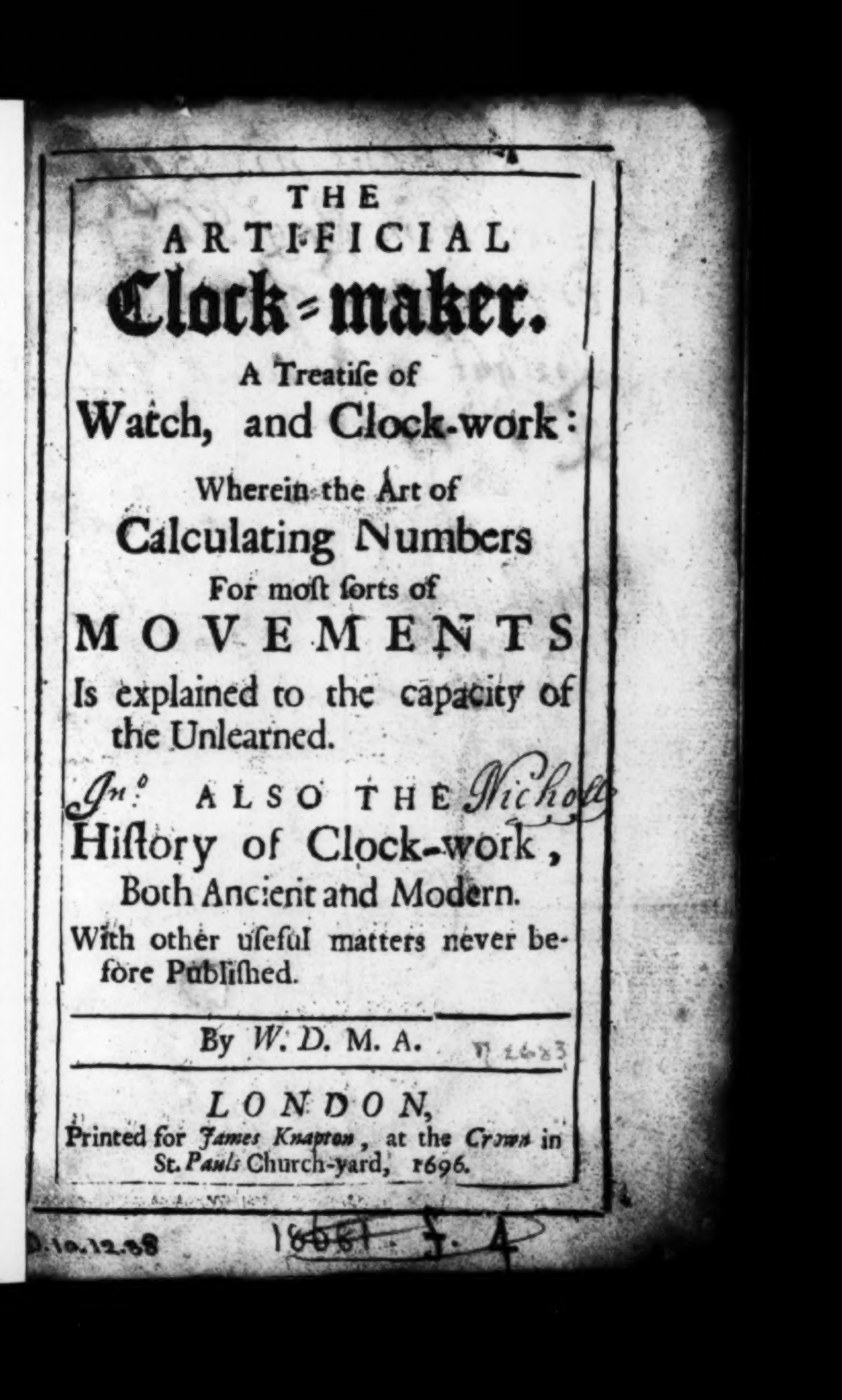
Figure 1. Title page of the 1696 first edition. Author, William Derham, who died in 1735. Title-page typesetter unknown. Source, Internet Archive item bim_early-english-books-1641-1700_the-artificial-clock-mak_derham-william_1696, PDF p. 1. A faithful reproduction of a work published in 1696 whose author died more than a hundred years ago. The page was rendered at 1,400 pixels on the long edge and converted to JPEG without cropping or additions. Wikimedia Commons file Public Domain Mark 1.0
Bibliography and edition#
| Item | Details |
|---|---|
| Main title of the first edition | The Artificial Clock-maker |
| Scope of the subtitle | Mechanisms of watches and clocks, calculating tooth counts for different trains, and a treatise on ancient and modern horology |
| Author | William Derham (1657–1735). The first-edition title page gives W. D. M. A. |
| First edition | London, James Knapton, 1696 |
| Language | English |
| First-edition contents | Eleven chapters, ending on numbered p. 130, followed by Addenda. Includes diagrams and tables |
| Public reproductions of the first edition | Early English Books microfilm at the Internet Archive. A separate public reproduction is available from the Getty Research Institute’s copy |
| Example of another edition | Fourth edition, 1734, at ETH-Bibliothek, Rar 2002, DOI 10.3931/e-rara-15925 |
The preface and main text of the first edition are the focus here. The PDF sequence differs from the printed pagination because of fold-outs and additional exposures. Page numbers below generally refer to the printed first edition. 1 2 3
Connecting workshop practice and calculation#
Derham was a clergyman and naturalist. In the first-edition preface he explains that he compiled the material for himself in his leisure in the country and published it for people interested in mechanics and for those who made their living from it. He explains how to solve proportions from the beginning, with skilled makers in mind who may have had little opportunity to learn calculation. 1 4
He mentions William Oughtred’s method and works by Jonas Moore and William Leybourn, explaining that he expresses existing algebraic approaches in plainer language and examples. He also discusses the 1675 Horological Dialogues and a Latin publication of 1677 in which Oughtred’s method appeared. The account of their publication is Derham’s own. 1
Derham says he prepared chapters on solder and colouring metals but left them out to keep the price down for apprentices and workmen. He also leaves out a full discussion of machines for cutting teeth and making fusees to keep the book manageable. The omissions reflect whom he expected to read the book and how he chose to publish it. 1
Working examples of how to calculate motion#
From teeth to rotations and beats#
The opening pages introduce parts such as the fusee, arbor, pinion and escapement. A pinion is a small gear meshing with a larger wheel. A fusee is a cone-shaped part that transmits spring force through a chain or similar link. The book’s “Watch-part” means the timekeeping side and “Clock-part” the striking side, regardless of whether the instrument is portable. 1, pp. 1–7.
Chapter 2 starts with a wheel driving a pinion. Dividing the wheel tooth count by that of the pinion gives the ratio. If a wheel of 60 teeth drives a pinion of six, the pinion makes ten turns for each turn of the wheel. For a train with several stages, multiply their ratios. The book lays out tooth counts and ratios in a notation resembling long division. 1, pp. 8–11.
Pages 12–13 give an example with a dial-side ratio of 8, three following ratios of 11, 9 and 8, and a crown wheel of 17 teeth. The crown wheel of a verge escapement has teeth projecting from the edge of the ring. They act alternately on two pallets, so the tooth count is multiplied by two to calculate beats, each corresponding to one swing. In modern notation the calculation is as follows.
8 × 11 × 9 × 8 × 17 × 2 = 215,424 beats per revolution of the dial wheel
The book takes that revolution as twelve hours, giving 215,424 ÷ 12 = 17,952 beats per hour. The example connects tooth counts, revolutions and beats. It is a worked example for that train. 1
Turning strikes and tunes into gears and pins#
For striking, a twelve-hour sequence with one blow at one o’clock, two at two and so on totals 78 blows. Derham relates running time and the available turns from winding to the number of hammer-lifting pins and rotations of the count wheel that stops the strikes. The method works back from the required strike count to the train. 1, pp. 33–44.
For chimes, positions along a pinned cylinder correspond to different notes, and positions around its circumference correspond to the passage of time. The pin positions determine which bell rings and when. Derham relates examples of music, including the tune of Psalm 100, to pin positions and explains that wrapping the flat table around the cylinder transfers the arrangement. He also mentions adding hammers for repeated notes in succession. 1, pp. 45–52.
Converting old clocks and adjusting pendulums#
Chapter 3 covers conversion of an older balance clock to a pendulum. Derham diagrams the existing train, calculates its beat count, compares it with the beat required by the intended pendulum and adds the missing gear ratio. It shows how makers retained old movements while changing the regulator. 1, pp. 62–68.
Chapter 5 uses proportions to calculate other pendulum lengths and rates from one reference. On pp. 75–76, Derham takes 39.2 English inches for a pendulum making 60 beats per minute. For n beats per minute, its length L follows this relation.
L = 39.2 × (60 ÷ n)² English inches
At n = 153, for example, L ≈ 6.03 English inches, matching the original example of about six inches. Derham also considers bob size and centre of oscillation, amplitude, weather and dirt. 1, pp. 71–80.
Calculations and late seventeenth-century testimony#
The later chapters move from ancient timekeeping to pendulum clocks, regulation of watches and repeaters. A repeater sounds the time on demand. Pages 106–108 compare Edward Barlow’s and Daniel Quare’s systems. Barlow’s uses separate controls for hours and quarters, while Quare’s sounds both from one operation. 1
The way Derham gathered information is also documented. The first-edition preface credits “Dr. H…” and “Mr. T…” among his sources on recent inventions, leaving the names abbreviated. The Linda Hall Library identifies the two contributors as Robert Hooke and Thomas Tompion. 1 4
Pages 95–96 give an attribution to Clement and then Hooke’s objection. On invention of the pendulum clock, Derham supports Huygens while reporting Galileo’s side. The dates and priorities, including dates of adoption in England, are the history Derham compiled at the time. The book preserves differing accounts from the period when these technologies became established. 1, pp. 93–108.
The final tables include tooth counts and methods of setting clocks by the stars. Pages 125–126 explain comparing a clock with the return of a star to the same direction and allowing for the difference between the sidereal and mean solar days. Pages 127–130 use a table of solar atmospheric refraction attributed to Flamsteed and discuss comparison with sundials. Train calculation and regulation are thereby tied to external time references. 1
Editions and how to consult them#
| Year | Edition and documented features |
|---|---|
| 1696 | First edition, with preface, terminology, train calculations, pendulums, history of inventions, tooth counts and time tables |
| 1700 | Expanded second edition. The Huntington catalogue lists a Supplement on clock construction, Rømer’s satellite display, pendulum clock adjustment, Flamsteed’s tables, meridians and telescopes for stellar observation |
| 1714 | Third edition. The Linda Hall Library describes its pendulum-clock frontispiece. The Huntington also records a copy dated 1714 |
| 1734 | Fourth edition, advertised as much corrected. The ETH catalogue records 140 pages of text, five folding tables and two folded copperplates |
The catalogue lists the topics of the second-edition supplement. Identifying all the additions would require comparing the actual texts. The later 140-page count and frontispiece are features of later editions. 3 4 5 6
The 1734 preliminaries reprint an address to the reader about the third edition. It says useful parts of the second edition’s supplement were incorporated at appropriate places in the text. Pages 121–122 of the 1734 edition give the Hampton Court clock’s train as of 1711 and describe Bradley fitting missing gears and making repairs. Pages 128–134 discuss establishing a meridian and observing instruments, but p. 130 retains 1731 as the reference year within the text. The publication year alone cannot date every figure in the book. 3
The German Der kunstreiche Uhrmacher of 1708 is catalogued as an appendix to Welper’s sundial book edited by Doppelmayr. A French Traité d’horlogerie pour les montres et les pendules appeared in Paris in 1731 from Dupuis. These are translations of the English work. The translators, the editions used and how closely the translations follow them remain unconfirmed here. 7 8
In the original, the long s “ſ” resembles f. The notation for fractions and division and older word usage also need attention. The train calculations can be followed with arithmetic and proportions. The text assumes the tools, escapements and standards of its time, so reproducing a calculation is distinct from adopting it as a modern servicing procedure. 1
Scope#
This account draws on the title page, preface, contents and terminology of the first edition, chapter 2 on trains, striking and chimes, chapter 3 on conversion, chapter 5 on pendulums, chapters 7–9 on inventions, chapters 10–11 for tooth counts and tables, and the addenda. For the 1734 edition it checks the title page, preliminary matter, contents, pp. 121–122 and pp. 127–136. Individual calculations and classical citations across the chapter 4 discussion of wheel dimensions and chapter 6 account of ancient timekeeping were outside the review. Collection catalogues provide the bibliographic information. The coverage does not extend to a line-by-line comparison across editions or a full reading of every translation and reprint.
Where to buy#
The available English paperback is a 2010 Gale Ecco, Print Editions reprint (ISBN 9781170546673) based on the 1759 printing of the fourth edition. Differences from the 1696 first edition and the reproduction quality of the printing and plates were not assessed here.
View the fourth-edition reprint of The Artificial Clock-maker on Amazon (advertisement)As an Amazon Associate, My Horology Notebook earns from qualifying purchases. Check the listing for price, availability and delivery terms.
References#
- William Derham, The Artificial Clock-maker, James Knapton, London, 1696. Used mainly for the preface, pp. 1–80 and 93–130, and Addenda. Internet Archive reproduction. Accessed 7 November 2026.
2. Getty Research Institute and Internet Archive, The artificial clock-maker, holding and reproduction of the 1696 edition. Item artificialclockm00derh, OCLC 606552550. Bibliography and holdings. Accessed 7 November 2026.
3. ETH-Bibliothek, The artificial clock-maker, catalogue and scan of the fourth edition, 1734. Rar 2002, DOI 10.3931/e-rara-15925. Title page, preliminary matter, contents, pp. 121–122 and 127–136, and catalogue. Accessed 7 November 2026.
4. Linda Hall Library, “William Derham”, Scientist of the Day, 26 November 2014. Author and copies of the first and third editions. Accessed 7 November 2026.
5. The Huntington, The artificial clock-maker, expanded second edition, 1700. Call number 290207. Catalogue entry listing the Supplement. Accessed 7 November 2026.
6. The Huntington, The artificial clock-maker, 1714 edition. Call number 496475. Date, author and publisher. Accessed 7 November 2026.
7. Universitäts- und Landesbibliothek Düsseldorf, Neu-vermehrte Welperische Gnomonica, Nuremberg, Weigel, 1708. Edited by Johann Gabriel Doppelmayr. Catalogue of the appendix, Der kunstreiche Uhrmacher. URN urn:nbn:de:hbz:061:1-174115. Accessed 7 November 2026.
8. Rijksmuseum, catalogue record for Traité d’horlogerie pour les montres et les pendules, William Derham, Paris, Dupuis, 1731. Language, publication and author. Accessed 7 November 2026.