Théorie générale de l’horlogerie, from mainspring power to timekeeping errors#
This article was translated from Japanese using AI. Read the Japanese original
Léopold Defossez’s Théorie générale de l’horlogerie is a textbook for Swiss watchmaking schools about how to transmit the energy stored in a mainspring and keep the period of oscillation constant. Volume I covers power and gearing, while Volume II focuses on oscillation, escapements and rate adjustment. The book also shows how to check a watch’s operation by recording its sound, alongside calculations of dimensions and forces. 1 2
Why the watchmaking schools rewrote their textbook#
In 1945 the heads of Swiss watchmaking schools set out to reissue the 1911–1912 edition of Jules and Hermann Grossmann’s Horlogerie théorique. According to Ed. Primault, president of the Swiss Chamber of Horology, which took on the publication, advances in manufacturing and precision timekeeping meant the textbook needed a complete rewrite. Defossez, a former head of the Le Locle watchmaking school, wrote the new work using an overall structure drawn up by Robert Lavest. 1 3
According to the preface dated July 1949, Ed. Neusel of Saint-Imier worked on the chapter on units and notation and helped prepare the manuscript. F. Wiget of La Chaux-de-Fonds supervised the illustrations. The chapters were sent one by one to watchmaking schools in different towns for suggestions and corrections. The preface also lists a separate textbook on electric clocks and specialist books on complicated watches and chronographs. The two volumes of this work are organised around the power and regulation of mechanical timepieces. 1
Volume I. Keeping the torque steady as the mainspring unwinds#
After introducing units and the fundamentals of time, Volume I covers sources of power, the mainspring and barrel, gear ratios and tooth profiles. The chapter on calculating tooth counts works out the counts for the barrel wheel and minute pinion of an eight-day clock and for the driving wheel and minute pinion of a weight-driven clock. The minute pinion is the small gear on the side that drives the minute hand. The next chapter considers how the tooth profiles affect meshing. 1
In the chapter on power, a cone-shaped part called a fusee evens out the declining force of the mainspring as it unwinds. A chain connects the barrel and fusee. Just after winding, the chain is under greater tension and pulls on the narrow part of the fusee. As the mainspring unwinds, the tension falls and the chain pulls at a wider part. Because the torque turning the arbor is the product of the tension and the radius, the fusee profile can be chosen to limit changes in torque. Figure 85 shows the action. Figures 87–88 derive the profile by assuming that tension is proportional to the winding angle and describe a way of checking it with a lever and a movable weight. 1
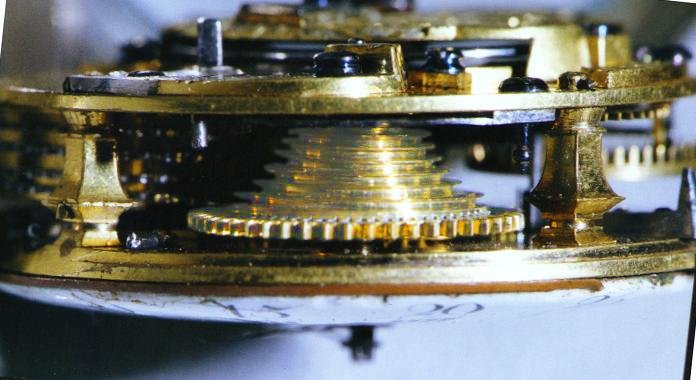
Figure 1. Pocket-watch movement with a fusee. The Wikimedia Commons description attributes it to Johan Lindquist of Stockholm in 1760. Photograph by Gervald Frykman. This is the version from Wikimedia Commons in which the fusee area has been brightened. The photographer’s public-domain dedication and reuse permission are stated on the file description page. No further changes were made for this publication.

Volume II. Modelling oscillations and measuring the sound of a watch#
Volume II starts with the motion of the balance, which rotates back and forth, and the balance spring (article in Japanese), which returns it towards its starting orientation. In a model where the restoring torque is proportional to the angle of rotation, the period of one complete oscillation is proportional to the square root of the ratio of the balance’s moment of inertia to the spring constant of the balance spring. The moment of inertia measures resistance to changes in rotational motion. For a given mass, it grows when material is placed farther from the axis. Chapter VII explains isochronism as the independence of the period from the amplitude in this model. The later section on rate adjustment explains that, in an actual watch, the unwinding of the mainspring and the transmission through the gears change the amplitude, and deviations from isochronism show up as gains or losses in time. 2 4
The chapter on the lever escapement (article in Japanese) examines the ticking of a watch as the combination of short impulses when teeth and other parts come into contact. A microphone signal is recorded over time, and the intervals between peaks are compared with events such as the release of a tooth or the collision of parts. Chapter XI includes schematic and measured traces and explains how overlapping vibrations can make individual sounds difficult to distinguish. 2
The chapter on adjustment deals with changes in the properties of the balance and spring with temperature, and rate variations due to position and other factors. The later treatment of pendulum clocks covers mercury compensation and the gridiron pendulum, both used to limit changes in the period with temperature, as well as compensation for changes in atmospheric pressure. 2
Bibliographic details and later references#
| Item | Details |
|---|---|
| Original title and author | Théorie générale de l’horlogerie, Léopold Defossez |
| Publisher | Chambre suisse de l’horlogerie, La Chaux-de-Fonds |
| Language and volumes | French, two volumes |
| Volume I | 1950. XVIII pages of front matter and 316 pages of text and other material |
| Volume II | 1952. 577 pages |
The volume details and page counts were checked against the original title pages and tables of contents and a catalogue describing physical copies. The copy consulted for Volume II is marked as the second printing of the first edition. Its colophon gives 10 May 1952 as the printing date. 1 2 5
The book was also cited in later research on precision gears. The EPFL doctoral thesis Étude des engrenages de microtechnique lists Volume I in its references. The Bibliothèque nationale de France catalogue record for the 2011 edition of Traité de construction horlogère (article in Japanese) lists Defossez’s work, included on the accompanying disc, as a separate title. The author’s name, place of publication and the 1950 and 1952 volume dates are useful when looking for the original two volumes. 6 7
References#
The following online sources were checked on 21 November 2026.
- Léopold Defossez, Théorie générale de l’horlogerie, vol. I, Chambre suisse de l’horlogerie, 1950. Title page, front matter, pp. 142–146 and contents. Text as displayed in the public scan.
2. Léopold Defossez, Théorie générale de l’horlogerie, vol. II, Chambre suisse de l’horlogerie, 1952. Title page, colophon, Chapter VII, pp. 11–16, Chapter XI, pp. 254–257, pp. 442–443 and contents at the end of the volume. Text as displayed in the public scan.
3. Johann Boillat, 100 ans de contribution au service de l’industrie horlogère suisse (1924–2024), Bulletin SSC, no. 96, 2023, p. 41. Includes Eugène Jaquet’s letter dated 25 June 1924.
4. Ilan Vardi, “Mathématiques et horlogerie”, Watch Around, no. 20, autumn 2015–winter 2016. Explanation of linear oscillation and isochronism.
5. Antiquorum, Lot 281: Lot of 9 horological books, Geneva, 12 April 2003. Publication years and page counts of the two volumes.
6. Quentin Theurillat-Bonjour, Étude des engrenages de microtechnique, doctoral thesis, 2016. Bibliography, item 14.
7. Bibliothèque nationale de France, Traité de construction horlogère, 2011 edition, catalogue record FRBNF42473870, first subsidiary entry for accompanying material.