This article was translated from Japanese using AI. Read the Japanese original
In Traité de l’horlogerie, méchanique et pratique, a French technical work of 1741, Antoine Thiout explains the tools used to make clocks and watches and how the parts fit together and operate. His subjects range from tools and machine tools to pendulum drives and mechanisms that announce time by sound. The book documents the workshop labour behind the finished timepieces. 1 (preface and general contents)
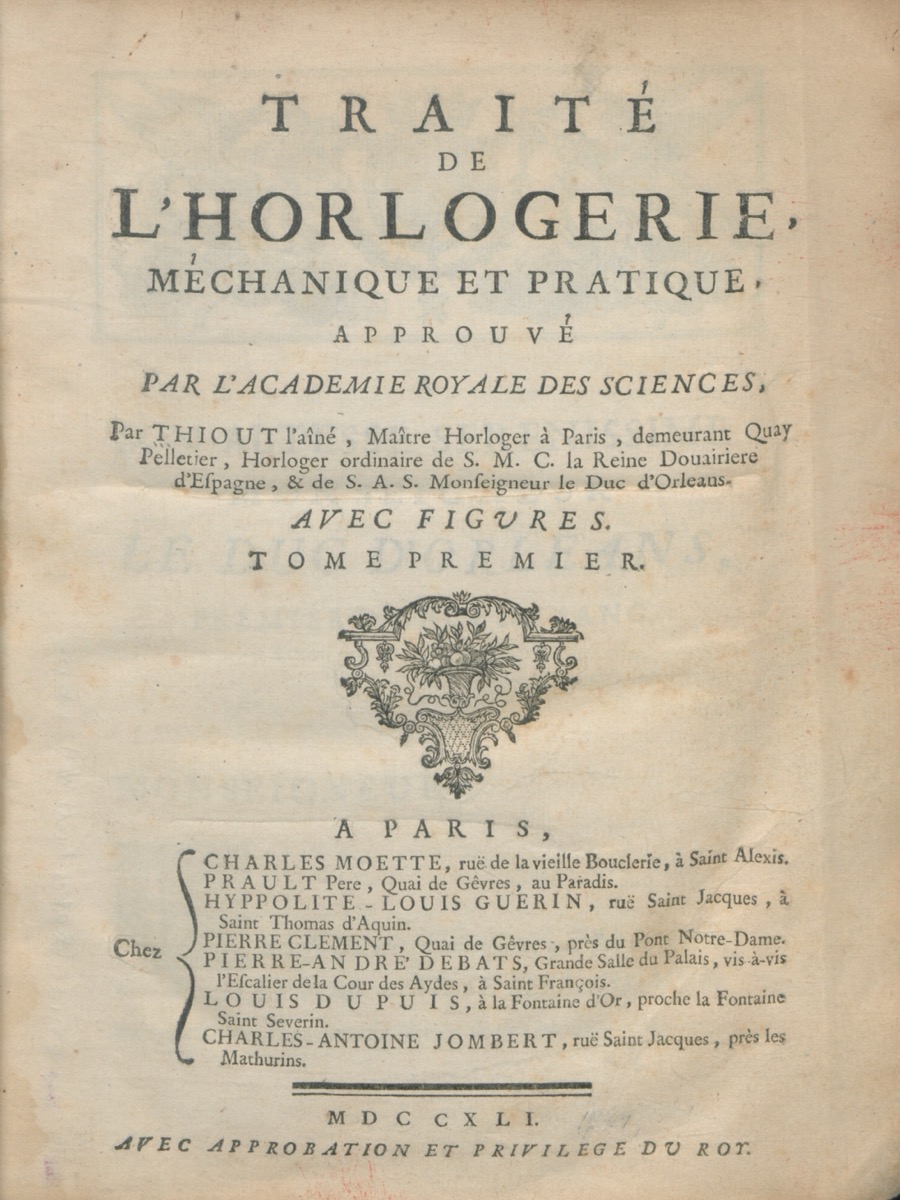
Figure 1. Title page of volume 1, 1741. Author Antoine Thiout l’aîné. Collection and image courtesy of the Metropolitan Museum of Art, Thomas J. Watson Library, record 146.9 T34. Source Met collection page. Public domain, Met Open Access. Resized to 1,200 pixels high, with no cropping or colour changes.
Bibliographic details and the two volumes#
| Item | Details |
|---|---|
| Original title | Traité de l’horlogerie, méchanique et pratique, approuvé par l’Académie royale des sciences |
| Author | Antoine Thiout l’aîné (1692–1767) |
| Publication | Paris, 1741 |
| Publishers | Charles Moette, Prault père, Hyppolite-Louis Guerin, Pierre Clement, Pierre-André Debats, Louis Dupuis and Charles-Antoine Jombert |
| Language and volumes | French, two volumes |
| Text and plates | 400 pages of text across both volumes. Volume 1 has 50 folding plates and volume 2 has 41. |
| Digitised library copy | ETH-Bibliothek Zürich, Rar 10288, DOI 10.3931/e-rara-11046 |
Publisher names follow the title page. The Met catalogue lists two volumes, 400 pages of text and 50 and 41 plates respectively, with 26 preliminary pages. 1 (title page) 2 3
Volume 1 covers terminology for components, tools, machine tools, various escapements and discussions of pendulums and tooth profiles. Volume 2 starts on p. 177 with the construction of a timepiece. The numbering of the plates starts again in each volume. References therefore need the volume, page, plate and figure numbers. 1 (general contents and vol. 2, p. 177)
Publishing craftspeople’s experience#
The title page identifies Thiout as a Paris clockmaker to the Queen Dowager of Spain and the Duke of Orléans. The preface sets out his aim of explaining how parts are built and work, their strengths and weaknesses, the names of tools and methods used by craftspeople, and relating these to the principles of geometry, statics and mechanics. 1 (title page and preface)
Thiout says he collected mechanisms from other makers as well as his own and named their designers where he knew them. He also includes obsolete mechanisms to save readers the time of making designs that had already failed and because even a flawed mechanism could suggest a new idea. 1 (preface)
For repeaters and escapements, he explains the first design in detail and then concentrates on what changes in subsequent examples. Comparing the illustrations with the preceding explanations follows the way the book is organised. 1 (preface)
Examples from tools to mechanisms#
Workshop tools for making parts#
The tools and machines section of volume 1 begins with hammers, anvils, files, lathes and compasses, then turns to machines for dividing and cutting wheels and pinions and a fusee-cutting engine. A pinion is a small gear that meshes with a wheel, and a fusee uses the changing working radius of a cone-shaped part to even out variations in mainspring force. The contents list a wheel-cutting engine by Sully, showing that Thiout drew on more than one workshop. 1 (vol. 1 contents, entries for pp. 30–89)
The section shows how accuracy depends on work that precedes final adjustment. Making uniform teeth, supporting arbors and checking the dimensions of parts call for dedicated tools and machinery.
Working out gear ratios#
Volume 2 opens by relating wheels to arbors, pivots at their ends and pinions. On p. 178 a 36-tooth wheel drives a four-leaf pinion, which makes nine revolutions for each revolution of the wheel. As the meshing advances tooth by tooth, the example shows that the ratio of speeds is inverse to the ratio of tooth counts. 1 (vol. 2, pp. 177–178)
In the next example, a 64-tooth wheel drives an eight-leaf pinion, and a 48-tooth wheel on the same arbor as that pinion drives a six-leaf pinion. For one revolution of the first wheel, the second makes 64 ÷ 8 = 8 turns and the third makes 8 × 48 ÷ 6 = 64. These values agree with the table in the text. In a clock, the gear ratios work with the escapement and pendulum period to drive the hands. 1 (vol. 2, p. 178)
Amant’s pinwheel escapement#
An escapement releases the gears in steps in time with a pendulum or another oscillator and supplies power to sustain the motion. Page 112 of volume 1 describes Amant’s design with pins arranged on one face of a flat wheel. The pins act on two pallet surfaces in alternation. The wheel does not recoil while locked, so the seconds hand does not move backwards. 1 (vol. 1, p. 112, plate 44, fig. 38)
The Met’s description of its Mantel clock (“Pendule Uranie”), made by the Lepaute brothers around 1764–1770, also cites this passage. It explains that the clock uses Amant’s original design, while Jean-André Lepaute later published an improvement. The 1741 description, the later proposal and the surviving mechanism document different stages of the design’s history. 4
A safeguard before striking#
Volume 2 discusses repeaters, which sound the time on demand. In the tout-ou-rien, or all-or-nothing, example, striking begins only after the cord has been pulled far enough. The restraint on the hammer side releases when the rack, a toothed part that reads the time, has travelled as far as the position set by the snail, a stepped cam. 1 (vol. 2, pp. 218–223)
Waiting until the mechanism has read the full information prevents an incomplete pull from producing an incomplete count. 1 (vol. 2, p. 223)
Later use and limits#
In his 2022 study of Benjamin Martin’s table clock, Guy Boney compares an escapement that works with a small amplitude to fig. 33 of plate 44 in Thiout’s first volume. He considers the possibility that Martin read the book. Direct evidence of his reading remains unverified. 5 (p. 371)
The book lets readers compare illustrations and text to investigate techniques and mechanisms known in 1741. Its coverage has limits acknowledged by Thiout, and its attributions and assessments reflect his own era.
Access to the digitised edition and scope#
ETH Library in Zürich provides both volumes on e-rara. The Met provides a title-page image and bibliographic details for volume 1. Useful search terms include Thiout l’aîné and the older spelling méchanique. This article covers the 1741 edition. Print quality, textual fidelity and the availability of translations in later publications remain unverified here. 2 3
The portions examined were the title page, preface and general contents, the discussion around p. 112 in volume 1, and pp. 177–178 and the relevant repeater passages in volume 2. Technical validation of every chapter was outside the scope.
References#
- Antoine Thiout l’aîné, Traité de l’horlogerie, méchanique et pratique, 1741. Original volume 1, original volume 2. Getty Research Institute copy. The relevant passages are identified in each section. Accessed 13 November 2026.
2. ETH-Bibliothek Zürich, Rar 10288, bibliographic record and both digitised volumes on e-rara. Accessed 13 November 2026.
3. The Metropolitan Museum of Art, Thomas J. Watson Library, Traité de l’horlogerie, 146.9 T34. Accessed 13 November 2026.
4. The Metropolitan Museum of Art, Mantel clock (“Pendule Uranie”), 29.180.2. The escapement description and note 12. Accessed 13 November 2026.
5. Guy Boney, “Benjamin Martin’s ‘Table clock upon a new construction’”, Antiquarian Horology, September 2022, pp. 363–373, especially p. 371. Accessed 13 November 2026.