This article was translated from Japanese using AI. Read the Japanese original
For a train crew, it matters that everyone’s watches show the same time. For someone cooking, a timer that shows how many minutes have passed since the food went on the heat is useful. Ichirō Oda’s Tokei to ningen — sono wontsu to gijutsu (Timepieces and People — Needs and Technology) traces the history and technology of timepieces through such everyday and workplace needs. This account draws on Shōkabō’s description and public table of contents, with related sources for the context of railway and radio-controlled timepieces. 1 2
From natural changes to portable timepieces#
Chapter 1 moves from instruments that use the Sun’s shadow, water or similar clues to tell time to mechanical, quartz and atomic timekeepers. Its discussion of mechanical timepieces explains how the mainspring made them portable and how water resistance and automatic winding made wristwatches easier to use. Alongside accuracy, where a timepiece can be used and how much daily care it needs help explain changes in timekeeping technology. 1
According to the description in CiNii Books, Oda travels between the past and present with a fictional time machine called the PS, connecting timepieces to people’s lives. A study of sundials as teaching material in the Hokkaido University of Education’s bulletin lists the book as one of its references on timepieces. 2 4
Railway watches and kitchen timers#
Chapter 2 brings together railway watches and sports timing, kitchen timers, metronomes for music practice and clocks for board games. Railway staff synchronise their watches, cooks measure a set duration, and a metronome spaces beats evenly. The setting determines what needs to be known: the time of day, elapsed time or the interval between beats. 1
The Duluth & Iron Range Rail Road’s 1915 rules give an example of synchronising railway watches in the United States. Conductors and engineers were generally required to compare their watches with the designated standard clock before departure and record the time of the comparison. Watches used by train and engine crews were inspected every three months, with weekly comparisons with standard time in front of an inspector between inspections. The illustrated Grade 992 is also a railway pocket watch by Hamilton. Its 1919 catalogue shows a dial with large hour numerals and a minute scale around the outside. 3 5
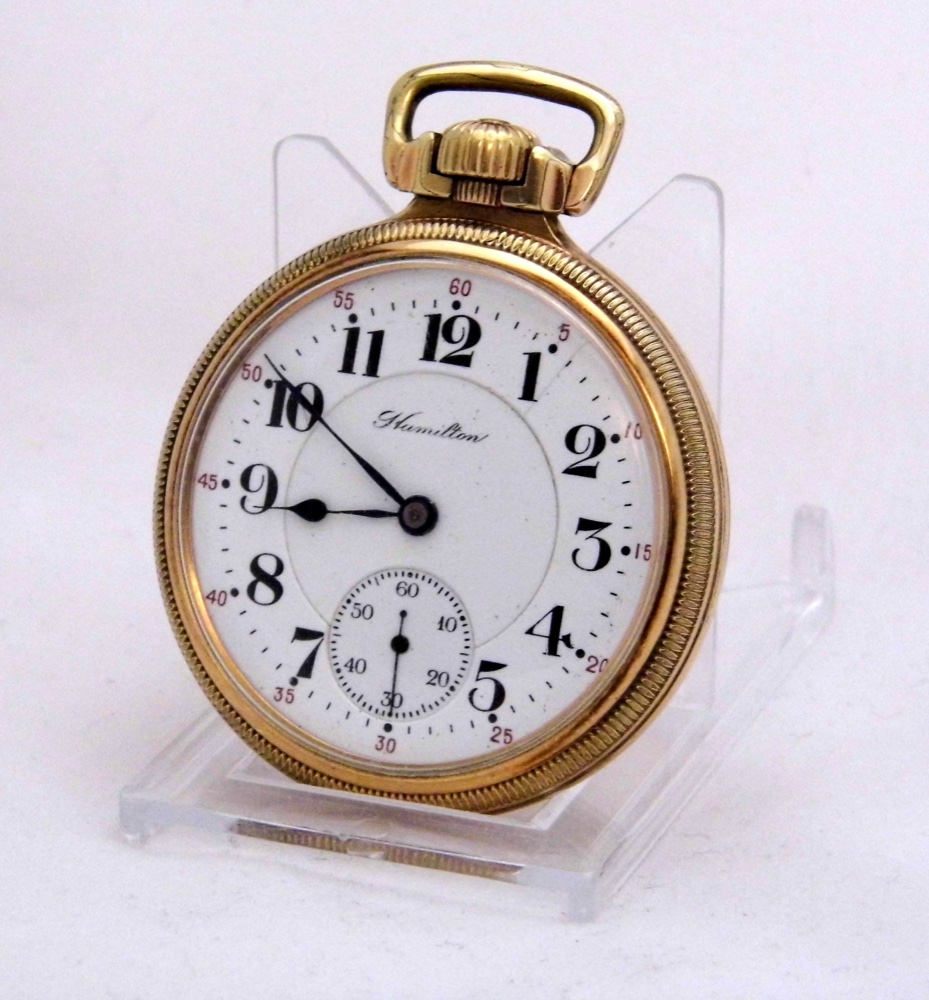
Figure 1. Hamilton Grade 992 railway pocket watch, dated to about 1918 in the Wikimedia Commons description. Photograph by Joe Haupt. Source: Wikimedia Commons. Terms: CC BY-SA 2.0. Reduced in size and recompressed as JPEG.

Timepieces that receive the time#
Chapter 3 covers connecting timepieces to communications networks, correcting the time by radio and generating electricity from sunlight or body heat. On 10 June 1999, the month before publication, transmission of a 40 kHz long-wave standard time signal began from Mount Ōtakadoya in Fukushima Prefecture. The National Institute of Information and Communications Technology (NICT) explains that the signal contains codes for the hours, minutes and other information. Compatible clocks and watches use the received information to set themselves automatically. Checking a railway watch against a standard clock and receiving the radio signal at home both bring a local display into line with a shared time. 1 6 7
The final chapter broadens the discussion from how people use time in their lives to time in space and the revival of mechanical watches. The book starts with the history of timepieces and returns to how people use them to deal with time. 1
Bibliographic details and holdings#
| Item | Details |
|---|---|
| Title | Tokei to ningen — sono wontsu to gijutsu |
| Author and publisher | Ichirō Oda, Shōkabō, Popular Science 207 |
| Publication | July 1999, Japanese |
| ISBN | 4-7853-8707-6 / 978-4-7853-8707-5 |
| Holdings | National Diet Library call number M197-G9, CiNii Books record BA42354444 |
For the same ISBN, the publisher lists 178 pages and the National Diet Library 158. CiNii Books records ix pages of front matter, 158 pages of text and other matter, and one plate. The National Diet Library’s guide lists the digital copy as available on site only. 1 2 8
Oda later supervised the illustrated children’s reference book A Study of Timepieces (article in Japanese) for PHP Institute. In Kōdansha’s The Science of Timekeeping (article in Japanese), he takes the subject as far as optical lattice clocks. This book develops its subjects by how instruments are used. The Science of Timekeeping follows the changes historically, from the discovery of time through mechanical clocks to the birth of the wristwatch. 9 10
References#
- Shōkabō, Timepieces and People — Needs and Technology, bibliographic details, description and full contents. Accessed 20 November 2026.
- CiNii Books, Timepieces and People — Needs and Technology, bibliographic details, holdings and the description supplied by the BOOK database. Accessed 20 November 2026.
- Duluth & Iron Range Rail Road, Employee rules and regulations, 1915, pp. 10–12, rules 1b–3b. Public PDF of material held by the Minnesota Historical Society. Accessed 20 November 2026.
- Tomoya Yunoki, “A study of sundials as teaching material”, 2012, p. 336, note 3. Accessed 20 November 2026.
- Hamilton Watch Company, 1919 product catalogue, p. 24, entry for No. 992. Public NAWCC PDF, accessed 20 November 2026.
- National Astronomical Observatory of Japan, “Long-wave standard time signal begins operating”, Astronomy News, no. 266, 10 June 1999, hosted by AstroArts. Accessed 20 November 2026.
- National Institute of Information and Communications Technology, “Distributing Japan Standard Time”, section on long-wave standard time signal facilities. Accessed 20 November 2026.
- National Diet Library, Timepieces and People — Needs and Technology, bibliographic ID 000002807279, print and digital holdings. Accessed 20 November 2026.
- PHP Institute, A Study of Timepieces, product information and description. Accessed 20 November 2026.
- National Diet Library, The Science of Timekeeping: 5,000 Years of People and Time, publication data and contents and summary supplied by JPRO. Accessed 20 November 2026.