This article was translated from Japanese using AI. Read the Japanese original
Traité des horloges marines is a French technical work by Ferdinand Berthoud (article in Japanese), published in 1773, on the theory, construction, manufacture and testing of marine timekeepers. Its subtitle sets out the aim of using timekeepers to correct charts and determine longitude at sea. 1
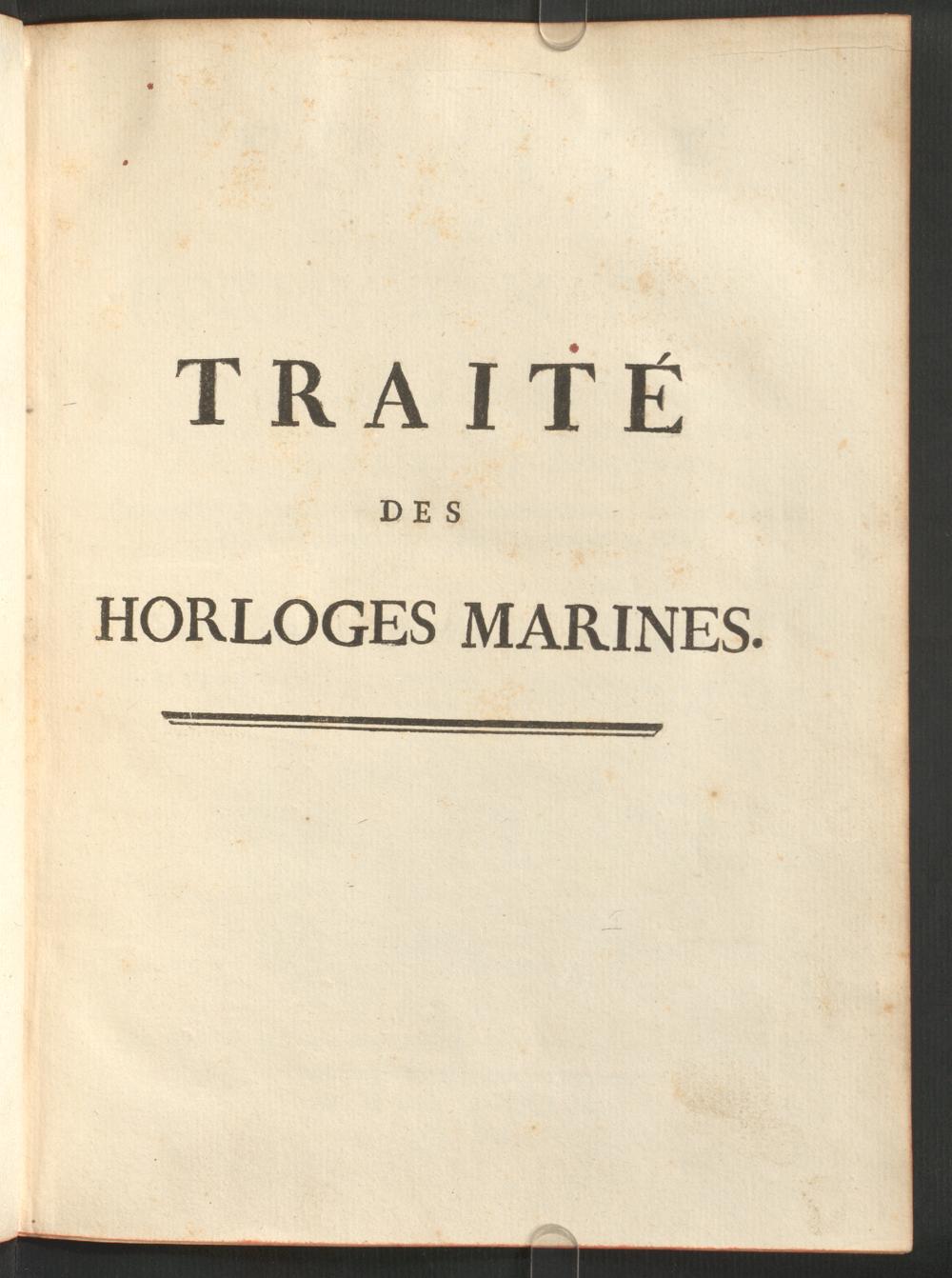
Half-title page. Ferdinand Berthoud, 1773. Zentralbibliothek Zürich, NE 704 | G. Original digitised on e-rara, Public Domain Mark. The image is the half-title page of the digitised original.
Bibliographic details#
| Item | Details |
|---|---|
| Original title | Traité des horloges marines |
| Author | Ferdinand Berthoud |
| Publication | Paris, 1773 |
| Publisher | J. B. G. Musier fils |
| Printer | L. F. Delatour |
| Language | French |
| Format | One volume with 40 pages of front matter, 590 pages of text and 27 folding plates |
| Original consulted for this article | Zentralbibliothek Zürich, NE 704 | G, digitised on e-rara |
These details come from the holding library’s catalogue. The text has four parts. The later pages include an appendix of related documents and additional material. 12
Why navigation requires a timekeeper#
The book addresses how to keep the time of a reference location aboard a ship subject to motion and temperature changes. At the start of the introduction, Berthoud explains that finding longitude at sea means finding the time at a known place at the same instant that the time aboard ship is known. 4
Longitude is east–west position on the Earth. The Earth turns 360 degrees in 24 hours, giving 15 degrees of longitude per hour of time difference and one degree per four minutes. Observations of the Sun or other celestial objects can establish local time at sea. Comparing it with the time at a reference location gives the east–west angle from that location. 5
For example, four minutes of error in the comparison yields one degree of error in longitude. This follows from the relationship above and illustrates why navigators needed to know the timekeeper’s gain or loss over a long voyage as well as keeping it running.
From theory through manufacture to testing#
The detailed contents on Cnum show a progression from how the mechanisms work to making and testing them. The four parts are divisions of a single volume. 12
| Part and opening page | Question | Examples of topics |
|---|---|---|
| Part 1, p. 1 | What disturbs a timekeeper’s accuracy? | Friction and oil, balance and balance spring, isochronism, temperature compensation, escapements and mounting aboard ship |
| Part 2, p. 118 | What mechanisms addressed those problems? | Construction and dimensions of numbered marine timekeepers, tests and improvements |
| Part 3, p. 370 | How are the parts made? | Tools, wheel cutting, working on arbors, making balance springs and assembly |
| Part 4, p. 460 | How is a finished timekeeper’s accuracy checked? | Comparison with a reference clock, tests at different temperatures and in different positions, and adjustment |
The balance is an oscillating wheel. The balance spring is the fine spring that returns it after it turns. Isochronism means that the time for a complete oscillation remains constant as the amplitude changes. Temperature compensation counteracts the effect that temperature-driven changes in a component have on timekeeping. These concepts explain why the book treats oil, friction, power and mounting alongside the mechanisms themselves. 2
An example of investigating loss after a voyage#
Part 2 records the rate, or gain and loss over time, of timekeeper No. 6 in trials at sea and then takes up possible reasons it lost time. The account of No. 8 also has entries on experiments and improvements after the voyage. The chapters follow the process of using the timekeeper, investigating the error and correcting it. 2
Part 4 includes tests of the effects of heat and cold with temperature compensation disabled, and comparisons between a timekeeper on its mounting and one set on a bench. The tests try to isolate causes by varying the conditions separately. 2
The relationship to the Essai and background to publication#
The Essai sur l’horlogerie of 1763 covers everyday, astronomical and marine horology broadly. The Traité is a separate work focused on precision timekeepers for navigation. The Essai explains the workings of timepieces more generally, while the Traité addresses designing and testing instruments to keep time aboard ship. 123
According to the Metropolitan Museum of Art’s account, Berthoud was appointed clockmaker and mechanic to the King and Navy in 1770. In 1773 he was charged with making four marine timekeepers a year and supervising the timekeepers for the Navy. The book documents a period when marine timekeeping was a matter of state. 6
The appendix contains reports of the Academy of Sciences, documents about a trip to London, reports on sea trials and instructions for installing and using the timekeepers aboard ship. Berthoud compiled these records. 2
Viewing the original#
The Zentralbibliothek Zürich copy on e-rara provides page images of the original. The detailed contents on Cnum give headings and opening pages for parts, chapters and sections. 12
This article covers the work published in 1773. When consulting later supplements or reprints, check the year of publication, contents and presence of plates for the item in question.
Sources and scope#
The article draws on the holding library’s catalogue and half-title page, the detailed contents on Cnum and the beginning of the introduction (p. ix), and accounts by a British museum and an American art museum. The descriptions of mechanisms and tests follow the table of contents. Assessment of the complete text and independent evaluation of individual timekeepers were outside the scope.
Where to buy#
The link is for the French-language facsimile published by Hachette Livre BnF in 2016 (ISBN 9782011341983). The print quality and reproduction of the folding plates remain unverified here.
View the facsimile of *Traité des horloges marines* on Amazon (advertisement)As an Amazon Associate, My Horology Notebook earns from qualifying purchases. Check the linked page for prices, availability and delivery conditions.
Sources#
- Zentralbibliothek Zürich / e-rara, Traité des horloges marines (1773) (bibliographic record, holdings, terms of use and half-title page, accessed 16 October 2026).
2. Conservatoire national des arts et métiers / Cnum, detailed contents of Traité des horloges marines (structure, opening pages and appendix, accessed 16 October 2026).
3. ETH-Bibliothek Zürich / e-rara, Essai sur l’horlogerie (1763) (bibliographic record for the comparison, accessed 16 October 2026).
4. Cnum, Traité des horloges marines, Introduction, p. ix (French original. Definition of the longitude problem and note at the start of the introduction. The OCR contains errors, so this article draws on the substance of a short passage, accessed 16 October 2026).
5. Royal Museums Greenwich, “What is longitude?” (English. Comparison of local time and time at a reference location, and the relationships between 24 hours and 360 degrees and between four minutes and one degree, accessed 16 October 2026).
6. The Metropolitan Museum of Art, Longcase astronomical regulator, 1982.60.50 (English. Berthoud’s 1770 appointment and his 1773 responsibility for manufacture and supervision, accessed 16 October 2026).