This article was translated from Japanese using AI. Read the Japanese original
Jacques Allexandre’s Traité général des horloges, published in French in 1734, treats sundials, water clocks and geared clocks within a single scheme. It explains clock construction and calculations and ends with an introduction to and critique of earlier works. A central technical question is how to bring the time marked by a machine into agreement with the time indicated by the Sun. 1
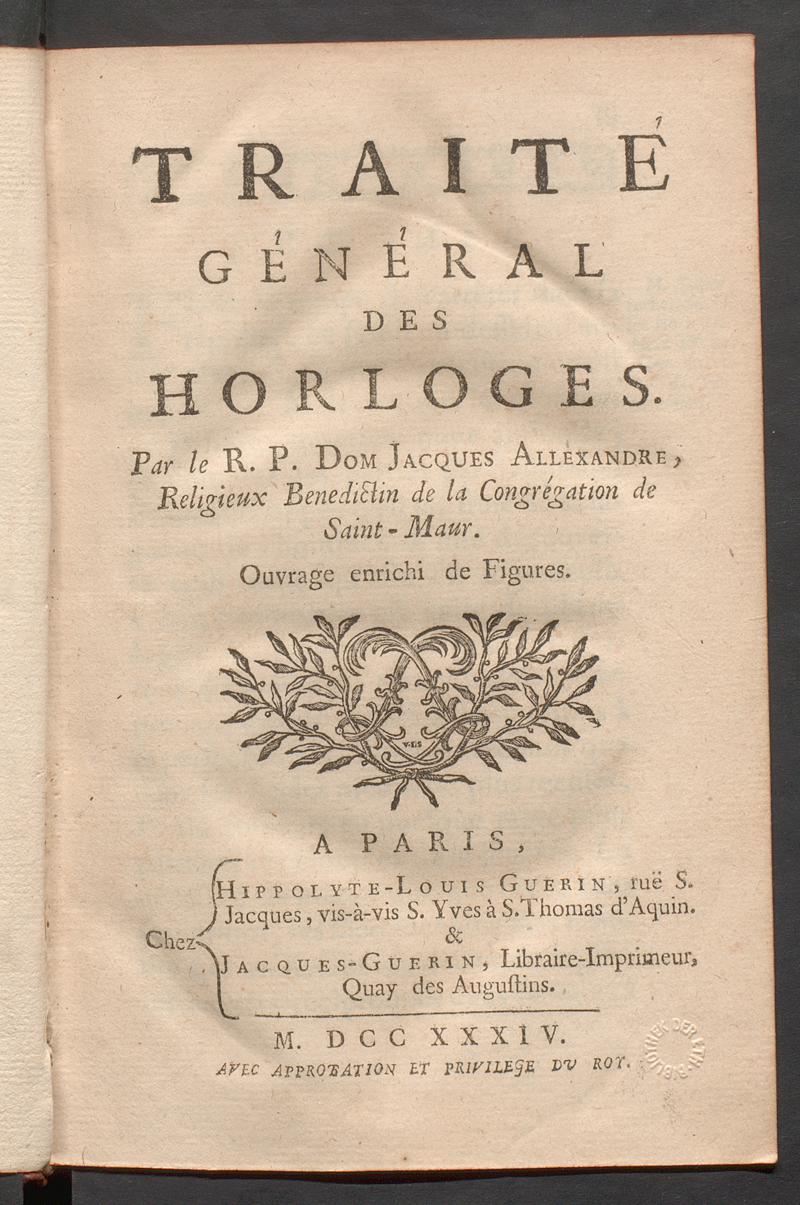
Figure 1. Title page of the 1734 edition. Author, Jacques Allexandre. Publishers, Hippolyte-Louis Guerin and Jacques Guerin. Held and provided by ETH-Bibliothek Zürich, Rar 2052. The supplied image was retrieved at 800 pixels wide without cropping or colour adjustment. Copy at e-rara Public Domain Mark 1.0
Bibliography and edition#
| Item | Details |
|---|---|
| Original title | Traité général des horloges |
| Author | Jacques Allexandre (library authority form Jacques Alexandre, 1653–1734) |
| Publication | Paris, Hippolyte-Louis Guerin and Jacques Guerin, 1734 |
| Language | French |
| Copy discussed | 1734 edition held at ETH-Bibliothek Zürich, shelfmark Rar 2052 |
| Physical description | VIII preliminary pages, 387 pages of text and other matter. The ETH catalogue records 26 folding copperplates and a height of about 20 cm |
| Persistent identifier | DOI 10.3931/e-rara-14928 |
The title page spells the surname Allexandre with two l’s, while catalogues sometimes use Alexandre. Both spellings are useful when searching. The title page also describes the book as richly illustrated. 1 2
Catalogues count plates and fold-out tables differently. The Braidense Library, for example, separately lists a table between pp. 32 and 37 and distinguishes the Roman-numeral plate numbering from the actual number of plates. Checking the completeness of an individual copy requires checking its fold-out tables, plates including those with subsidiary numbering, and any missing matter, as well as the page count. The specifications here follow the catalogue for the ETH copy and may differ for other surviving copies. 2 3
A technical book with a historical account#
The author was a Benedictine monk of the Congregation of Saint Maur, as stated on the title page. In the preface he says his aim is to describe the origins and development of clocks, the people who improved them and the contents of previous works. He adds that some of his criticisms of existing techniques are conjectures. 1 (preface)
His historical interest shapes the opening sections on calendars and divisions of the day. Before classifying clocks, he explains systems that divide daylight and night into twelve parts each, count hours from sunset or start at midnight. This places clock dials in historical context, as displays of different divisions of time across places and periods. 1 (pp. 1–10)
The preliminary pages also record the publication process. The superior general of the congregation granted permission to print on 12 May 1726, Godin gave censorship approval on 26 February 1733, and the title page is dated 1734. These dates concern different steps in the process. 1 (pp. vii–viii)
At the end of the introduction the author says he wants to establish horology as a learned art as well as a mechanical craft. His account of manufacture therefore draws on astronomy, arithmetic and the history of the literature. 1 (pp. 26–27)
What the book covers#
The book contains two introductory sections and nine chapters. Chapter one covers sundials, chapter two water clocks, chapter three the basics of geared clocks, chapter four clocks that follow the apparent motion of the Sun, chapter five planetary motion, chapters six and seven domestic clocks and pocket watches, chapter eight repeaters, and chapter nine the literature. 1 (pp. 11–27 and the opening of each chapter)
Sundials and water clocks#
The sundial chapter centres on finding hour lines with calculations and trigonometric tables. On a horizontal dial, the relationship between the direction of the shadow and the time changes with latitude. Allexandre considers horizontal and vertical sundials and dials on walls set at an angle to the cardinal directions, and also describes transferring the calculated scale to a wall. The chapter connects the calculations to installation. 1 (pp. 28–30)
In the water clock chapter he describes an internally compartmented cylinder suspended from a cord. Water passing through a small hole into the next compartment shifts the weight distribution, causing the cylinder to turn and slowly descend. Its position is read against a scale of hours. He associates it with Charles Vailly and says it was made at Sens in 1690, while noting a similar device in Martinelli’s work. 1 (pp. 73–77)
Separate sections deal with making the container, its partitions, soldering, the properties of water and marking the scale. The book thus gives the water clock a full technical treatment in its own right. 1 (chapter two)
Learning the principles of gears and pendulums from large clocks#
Chapter three defines clock components and then describes pendulums and gear trains. A train is a series of meshing gears that transfer rotary motion and power. The ratio of a wheel’s teeth to those of the smaller gear, the pinion, governs the relationship between their rotations. 1 (p. 88 onwards)
Allexandre divides clocks into three sizes, public turret clocks, domestic clocks and timepieces carried on the person. Turret clocks provide the basis for explaining the other two groups. He proceeds from shared mechanisms to constructions suited to different uses. 1 (p. 109)
The fusee in chapter six is an example. It uses the changing radius of a cone-shaped part carrying a chain or cord to compensate for changes in the force of the mainspring. When the spring is strong, it pulls at the small end. As it weakens, it pulls at the large end. The book also describes using weights to determine the required radii and testing whether the completed fusee provides an even action. 1 (pp. 220–225)
The chapter shows how clocks were designed and tested at the time.
Adjusting the pendulum to follow the Sun#
A clock beating at regular intervals and a sundial do not agree throughout the year. The book distinguishes mean solar time, with equal intervals, and apparent solar time based on the Sun’s actual apparent position. Their difference is the equation of time. 1 (pp. 20–22 and 142–145)
In chapter four the aim is to make the clock itself follow the time shown by the Sun, beyond displaying the difference on a separate hand. The author describes automatically lengthening or shortening the pendulum to change its period in step with seasonal irregularities in the Sun’s apparent motion. Here the period is deliberately variable. For readers at the time, the choice of sundial or mechanical clock as a reference had practical consequences. 1 (pp. 142–145)
Allexandre says he submitted the proposal to the Academy of Sciences in 1698. He reproduces a certificate signed by Fontenelle stating that Varignon read it at the meeting of 12 April 1698. 1 (pp. 143–144)
Planetary displays and repeaters#
Chapter five describes geared mechanisms that indicate the positions of planets with pointers. It opens with a clock attributed to Oronce Finé and discusses tooth counts, periods of rotation and the number of parts. Approximating celestial periods with gear ratios was another use for horological calculations. 1 (p. 165 onwards)
The repeater in chapter eight sounds the time on demand. A part comes to rest against a stepped cam called a snail, and the depth of the step determines how far the part can move and how many strikes will sound. The author discusses the hour and quarter snails separately and proceeds from a large domestic clock to a pocket watch, where the parts must fit into a small space. 1 (pp. 263–274)
He also describes the tout-ou-rien, or all-or-nothing mechanism, which keeps the striking from starting until the control has moved far enough. This prevents incomplete operation from producing the wrong number of strikes. 1 (pp. 270–274)
Reading the bibliography#
Chapter nine is a long bibliographic survey. It groups publications on sundials, water clocks and geared clocks separately. In the section on geared clocks, the author gives extracts from earlier works and adds observations and criticism. An index of authors mentioned in the text follows. 1 (chapter nine)
Allexandre’s claims need to be distinguished from those of his sources. The passages covering Galileo, Huygens, Sully and Derham, for instance, are his selections and accounts of their work. Attributions such as the invention of the mechanical clock to Gerbert should be read in the context of the historical scholarship of Allexandre’s day. 1 (pp. 15–16 and chapter nine)
The book documents horology up to 1734 and shows how an author of the period organised earlier literature and identified problems in it.
Surviving copies and later citations#
France’s collective catalogue, the CCFr, lists an incomplete manuscript based on the book with 180 leaves and copies of 13 plates. The manuscript documents how the work circulated through copying by hand. 4
A study analysing brass in clock mechanisms, published in 2026, also includes the book in its references. The citation alone does not establish experimental verification of the book’s technical explanations as a whole. 5
Access and scope#
The ETH-Bibliothek Zürich copy is available through e-rara as images, a PDF and OCR text. The eighteenth-century French includes older spellings and units, gear calculations and part labels on the plates. The OCR contains errors. For names, numbers and labels, consult the page images. 1 2
This article draws on the title page, preface and permissions, introduction, and the relevant sections of the 1734 edition on sundials, water clocks, geared clocks, apparent solar time, planetary displays, the fusee, repeaters and bibliography. Recalculating all the gear tables, testing whether every plate depicts a buildable mechanism and comparing all modern reprints and translations are beyond its scope. Later facsimiles can differ in editing and physical format from the first edition.
References#
- Jacques Allexandre, Traité général des horloges, Paris, Hippolyte-Louis Guerin & Jacques Guerin, 1734. ETH-Bibliothek Zürich, Rar 2052. Original and digital copy and OCR text. Page numbers refer to the printed original. Accessed 13 November 2026.
2. ETH-Bibliothek Zürich, Catalogue record and terms of use for Traité général des horloges. Publication details, author authority, physical description, holdings and Public Domain Mark. Accessed 13 November 2026.
3. Biblioteca Nazionale Braidense, catalogue record LO1E009235. Description of the folding table and plates. Accessed 13 November 2026.
4. Bibliothèque nationale de France, CCFr, MS. 298, Principe d’horlogerie tiré du R.P. Allexandre. Catalogue record of the incomplete manuscript copy. Accessed 13 November 2026.
5. Augustin Gomand, The selective use of high-quality brass for making clocks in the 17th century, and evidence for a specific Parisian workshop, Historical Metallurgy, 56(1), pp. 37–69, 2026. Public abstract and references consulted. DOI 10.54841/hm.681. Accessed 13 November 2026.