This article was translated from Japanese using AI. Read the Japanese original
Taizaburo Tsukada’s Wadokei traces how clocks were made and used in Japan when the length of an hour differed between day and night. Tōhō Shoin published it in 1960. The table of contents made available by the National Diet Library covers clocks brought from abroad, production and division of labour in the Edo period, mechanisms of lantern and pillar clocks, and timepieces from around the Meiji calendar reform. 1
Adapting clocks to the length of an hour#
After introducing Japanese systems of time, the book moves on to types of clocks and how they work. In the unequal-hour system used in the Edo period, the day from dawn to dusk and the night from dusk to the following dawn were each divided into six equal parts. In summer a daytime hour was longer than a night-time hour. Alongside the varying lengths of day and night through the four seasons, the contents list bell towers that sounded the time and the 24 solar terms used to structure the calendar. 1 2
The section on lantern clocks moves from the case and dial to the power source, gear train and striking work. One design uses two foliots, known as nichō tenpu. A foliot (tenpu, written 天符 or 天府) is a horizontal bar with weights that oscillates to regulate the rate at which the gears advance. In a mechanism described by Masanao Yokoyama in the horological society’s journal, the clock has separate day and night foliots and automatically switches between them every six hours of the unequal-hour system. 1 2
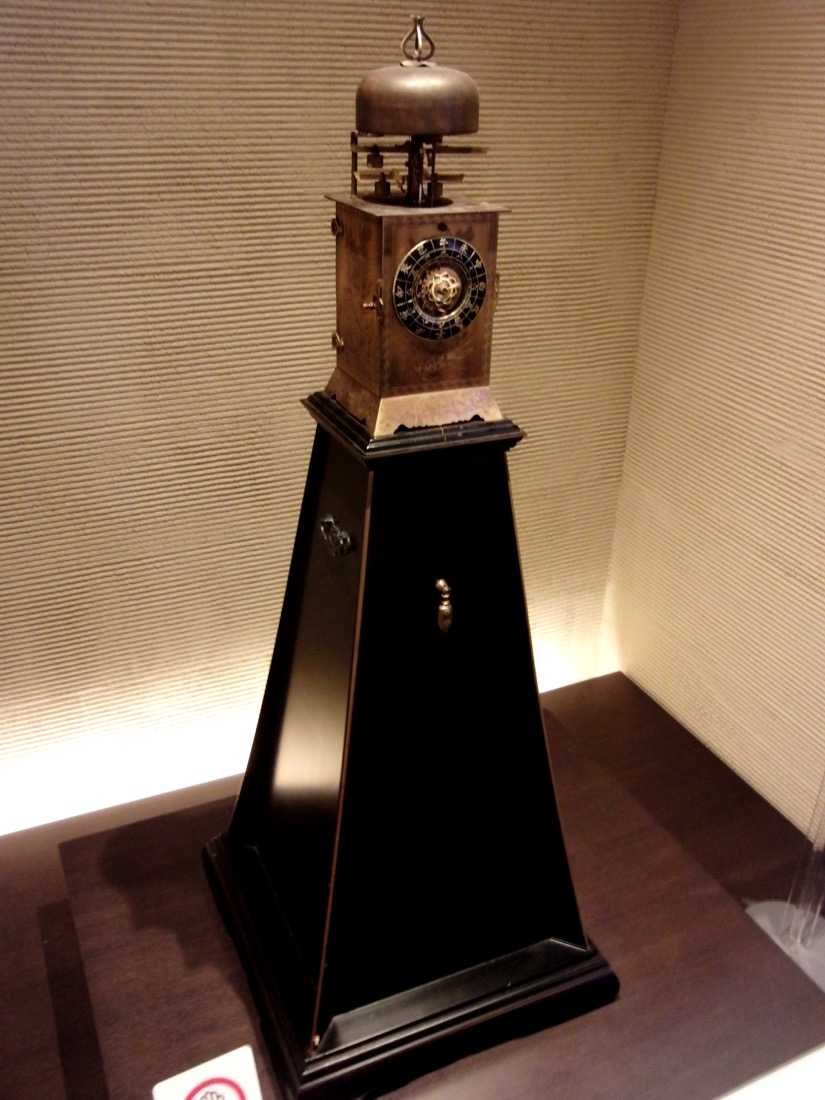
A double-foliot lantern clock from the middle Edo period, photographed at the National Museum of Nature and Science by Momotarou2012. Source: Wikimedia Commons. The photograph is licensed under CC BY-SA 3.0 and was reduced to 1,100 pixels in height. The framing and colour were retained. The resized version uses the same licence.

The scale could also be adapted to the seasons. In the section on pillar clocks, the book lists types of displays on a long, narrow scale, including movable markers and interchangeable scale plates. In the movable-marker type, small markers are moved to change the spacing of an hour on the scale. Comparing clocks that switch between foliots with those whose scales are rearranged shows how unequal hours shaped both the mechanisms and the way they were read. 1 2
The makers and the survival of their clocks#
The chapter on production includes the division of labour, clock prices, and places and makers in the Edo period. A clock estimate by Tōkichi Kunohe (九戸藤吉) and Hisashige Tanaka’s Myriad Year Clock appear in the same chapter, giving insight into both the transaction documented in the estimate and a surviving mechanism. The chapter on the Meiji calendar reform lists Yukichi Fukuzawa’s Kairekiben, as well as converted clocks, hybrid clocks and Western-made pocket watches with Japanese-style indications. It provides a starting point for studying timepieces during the change in the time system. 1
Tsukada was also interested in how collections reached later generations. In the afterword quoted by Hideo Kuboki, Tsukada reports having heard that the Mody clock collection in Kobe burned during wartime bombing and expresses the hope that the report was mistaken. Kuboki also examines Kobe’s city history and the preface to another catalogue to trace what happened to the collection during the war. 3
From a Mingei magazine to a book#
Tsukada was involved in the Mingei folk crafts movement and later directed the Tochigi Prefectural Museum of Fine Arts. In issue 86 of the Japan Folk Crafts Association’s Kōgei, from April 1938, he discusses the introduction and making of Japanese clocks, time systems, the calendar and mechanisms. According to the Shinmura Izuru Memorial Foundation’s catalogue, the special issue contains 55 tipped-in photographs of Japanese clocks. Sōetsu Yanagi wrote the foreword to the 1960 Wadokei. 1 4 5 6
Shiryōsha had already included a book of the same title by Tsukada in its Tokei sōsho series in 1950. When searching a library catalogue, distinguish the Shiryōsha volume of 1950 from the Tōhō Shoin volume of 1960 by publisher and year. One English-language work that cites the Tōhō Shoin edition is Ashley Strachan’s account of Edo-period clocks. 1 7 8
Bibliographic details and access#
| Item | Details |
|---|---|
| Title and author | Wadokei, Taizaburo Tsukada (1897–1985) |
| Publisher | Tōhō Shoin, Tokyo, 1960 |
| Format | Japanese, 250 pages and plates, 22 cm |
| National Diet Library | Bibliographic ID 000001015960, call number 535.2-Tu683w |
National Diet Library Search has the contents and print holdings. The digital copy is eligible for transmission to libraries and individuals. For the place of Japanese clocks in everyday life, see the article on Wadokei — advanced technology of the Edo period. 1
References#
- National Diet Library, Wadokei, Taizaburo Tsukada, Tōhō Shoin, 1960. Bibliographic details, public contents and access categories. Accessed 20 November 2026.
- Masanao Yokoyama, “The pursuit of clock accuracy before quartz: the accuracy of Japanese clocks”, Micromechatronics, vol. 63, no. 220, 2019, pp. 39–41, especially sections 3.1–3.2. Accessed 20 November 2026.
- Hideo Kuboki, “The fate of the former Kishū Tokugawa family copy of The Tale of Genji”, Chūko Bungaku, no. 85, 2010. Section on the Mody collection and note 29. Accessed 20 November 2026.
- Thomas J. Watson Library, Metropolitan Museum of Art, tables of contents of Kōgei, no. 86. Accessed 20 November 2026.
- Shinmura Izuru Memorial Foundation, Chōzan Bunko catalogue, limited editions, Kōgei, no. 86. Accessed 20 November 2026.
- Tochigi Prefectural Museum of Fine Arts, “Collection exhibition: The world of Sumio Kawakami”, 2021. Exhibition notes and chronology. Accessed 20 November 2026.
- International Research Center for Japanese Studies, library catalogue of new acquisitions, entry 1812. Accessed 20 November 2026.
- Ashley Strachan, Time of the Tokugawa Period, Japan-Insights, 2017, p. 13. Accessed 20 November 2026.