This article was translated from Japanese using AI. Read the Japanese original
Hoshimi Uchida’s The Development of the Clock and Watch Industry traces how Japan built an industry making Western-style timepieces from the Meiji through the Taishō era. Against the background of European and American manufacturing techniques, it examines Nagoya wall clocks, the pocket watches of Osaka Timepiece Manufacturing and Seikosha in Tokyo. The cases share questions about who made the parts, where they were assembled, and how machinery and skills were brought in from abroad. 1 2 3
From workshops to mass-production factories#
According to a contemporary review, Part 1 covers production in Western Europe and the United States, Part 2 takes up Nagoya and Osaka, and Part 3 examines Seikosha. The European examples include places such as Geneva, where craftspeople specialised in making parts and assemblers brought their work together into finished timepieces. The American case focuses on using machine tools to make repeated runs of parts with the same dimensions. Greater interchangeability reduced the need to file and fit individual parts during assembly and repair. 3 4 5
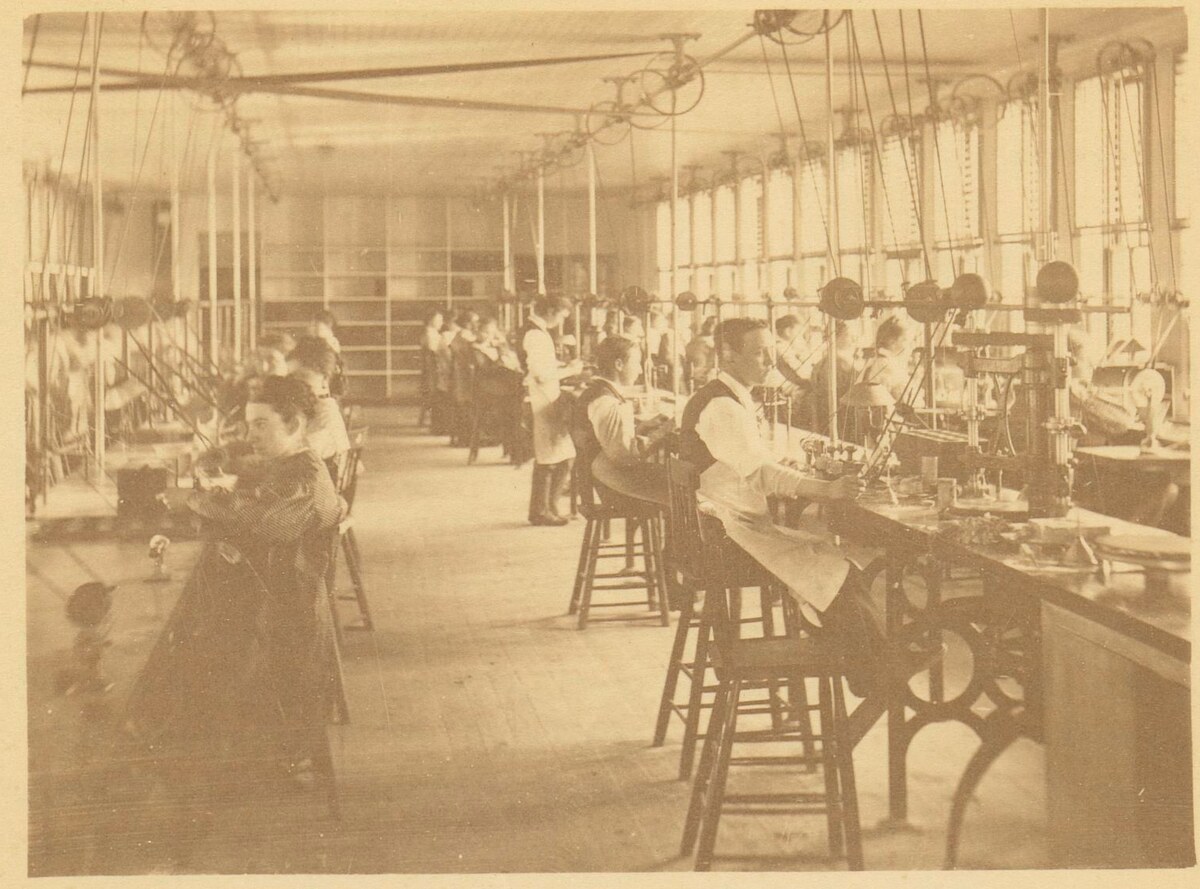
Figure 1. Pinion finishing room at the American Watch Company in Waltham, Massachusetts, dated from around 1874 to no later than 1879. Photograph by Thomas R. Lewis, in the collection of the Rijksmuseum. Source Wikimedia Commons, CC0 1.0. Cropped to the top photograph on the right-hand page and resized.

Different ways of making timepieces in Nagoya, Osaka and Tokyo#
In Nagoya, factories producing parts and wooden cases clustered around makers of complete wall clocks. A review describes how the book connects the division of labour, including cottage industry, with production of affordable wall clocks. According to the Seiko Museum, Jiseisha, the predecessor of Hayashi Clock, began making wall clocks in Nagoya in 1887. In a 2002 paper, Uchida also explains how dealers used the sales networks and customer trust they had built selling imported timepieces to market their own products. 3 4 6 7
Osaka Timepiece Manufacturing was founded in 1889. It made wall clocks before attempting to produce pocket watches, recruiting technicians from the United States and acquiring special-purpose machine tools. Making a pocket watch calls for precision. The holes that support a pinion’s arbor, for example, must be machined so the pinion turns in the correct position. Uchida’s paper explains the machinery and tooling this required and the time and skill needed to assemble and regulate the watches. 4 5 6 7
In Tokyo, Kintarō Hattori founded Seikosha in 1892 and began making wall clocks. Its first pocket watch, the Timekeeper of 1895, had a cylinder escapement that controlled the advance of the wheels in step with the oscillations of the balance. The review’s discussion of the Seikosha section highlights how the company gradually brought part production in-house and how shop-floor skills remained important as the number of machine tools increased. The account follows both the introduction of machinery and the organisation needed to make watches with it on a sustained basis. 3 4 6 8
A book that grew out of company history research#
In his review, Sakae Tsunoyama, author of A Social History of Clocks, explains that the book grew out of a research collaboration organised by the Japan Business History Institute in connection with the preparation of Hattori Seiko’s company history. Tsunoyama highlights the book’s treatment of manufacturing technology and production organisation together. He also asks what kinds of information about time buyers needed. In a later paper, Uchida used Meiji-era trade statistics and other sources to estimate how timepieces spread among households and individuals. Read together, the two studies trace how timepieces came to be made and used. 3 7
Bibliographic details and access#
| Item | Details |
|---|---|
| Author | Hoshimi Uchida |
| Planning and editing | Japan Business History Institute and Seiko Institute of Horology |
| Publication | Hattori Seiko, June 1985 |
| Format | Japanese, 494 pages, 22 cm |
| National Diet Library | Bibliographic ID 000001772966, call no. DL456-11 |
| CiNii Books | NCID BN01376288 |
The National Diet Library provides its digitised copy through its transmission services for libraries and individuals. The library’s catalogue gives the terms for individual access, while CiNii Books lists holdings of the print edition. The same author’s History of the Japanese Clock and Watch Industry series covers individual cases in English. Volume 1 deals with Osaka Timepiece Manufacturing, volume 2 with Nagoya wall clocks, and volume 3 with Seikosha from 1892 to 1923. 1 9 10 11
References#
- National Diet Library, “The Development of the Clock and Watch Industry.” Bibliographic record for the 1985 edition, holdings and terms of digital access.
- Seiko Museum Ginza, “The Development of the Clock and Watch Industry.” The copy in the collection and an introduction to its contents.
- Sakae Tsunoyama, “Tokei Kogyo no Hattatsu,” Japanese Yearbook on Business History 4, 1988 (J-STAGE bibliographic record), pp. 188–191. Review of origins, structure, production technology and management.
- Konosuke Odaka, “Hoshimi Uchida, The Development of the Clock and Watch Industry,” The Economic Review, vol. 38, no. 2, 1987, pp. 186–188. Review of the issues and cases in each part.
- Pierre-Yves Donzé, “The Watchmaking Enterprises and the Growth of a Special-purpose Machine Tool Industry in Japan (1890–1960),” Osaka Economic Papers 60(1), 2010, pp. 20–34. Early procurement and in-house manufacture of special-purpose machine tools.
- Seiko Museum Ginza, “Development of Japan’s Clock and Watch Industry Centred on Seikosha” (English version). Manufacturing and distribution in Nagoya, Osaka and Seikosha.
- Hoshimi Uchida, “The Spread of Timepieces in the Meiji Period,” Japan Review 14, 2002, pp. 173–192. In particular, pp. 185–187 on domestic production, pp. 188–190 on estimates of adoption, and pp. 191–192 for source notes.
- Seiko Museum Ginza, “Timekeeper.” Collection entry for the 1895 watch and its escapement.
- National Institute of Informatics, CiNii Books, “The Development of the Clock and Watch Industry.” Bibliographic details and holdings of the Japanese edition.
- National Diet Library, “History of the Japanese Clock and Watch Industry.” Bibliographic details of the English-language series.
- National Institute of Informatics, CiNii Books, “Evolution of Seiko, 1892–1923.” Bibliographic details of volume 3 of the English-language series.
Online sources accessed 20 November 2026.