The Watch Escapement, how to read and adjust its action#
This article was translated from Japanese using AI. Read the Japanese original
Henry B. Fried’s The Watch Escapement is an English-language technical book on examining, adjusting and repairing the escapements of portable timepieces. It was published in 1959, and the title of the 1974 second edition specifies lever and cylinder escapements. The two types use different parts to lock the teeth and transmit impulses to the balance. Fried’s replies to repair questions and later citations of the book in watchmaking show how it was used. 1 2 3 4
Finding a point of contact in a lever escapement#
A mechanical watch escapement locks and releases the escape-wheel teeth in turn and passes some of the energy to the oscillating balance. In a lever escapement, two pallet stones on the lever receive the teeth alternately, while the lever fork interacts with the impulse jewel on the balance. The lever also carries a guard pin, which works with the safety roller on the balance side to prevent accidental unlocking. 5
Writing in Horological Times in 1988, Fried answered a question about a Hampden watch whose guard pin would not clear the roller on one side. He first suspected the position of the eccentric screw that also limits the lever’s swing. He advised checking next for a bent guard pin or lever and, if the movement was uneven from side to side, inspecting the position of the pallet stones. He explicitly referred readers to his illustrations of the required clearance between the guard pin and safety roller in this book. The example starts with the point of contact and proceeds to check the lever’s stops, the shape of its parts and the points where the teeth leave the pallet stones. 3
How a cylinder escapement locks a tooth on two surfaces#
In a cylinder escapement, a hollow cylinder that rotates with the balance has a cutaway, and the escape-wheel teeth are caught in succession on the outside and inside surfaces. As the balance swings back and forth, an edge of the cutaway moves, transmitting an impulse to the balance when a tooth passes it. The shape and position of the cylinder edges and teeth are involved in both release and impulse. 5
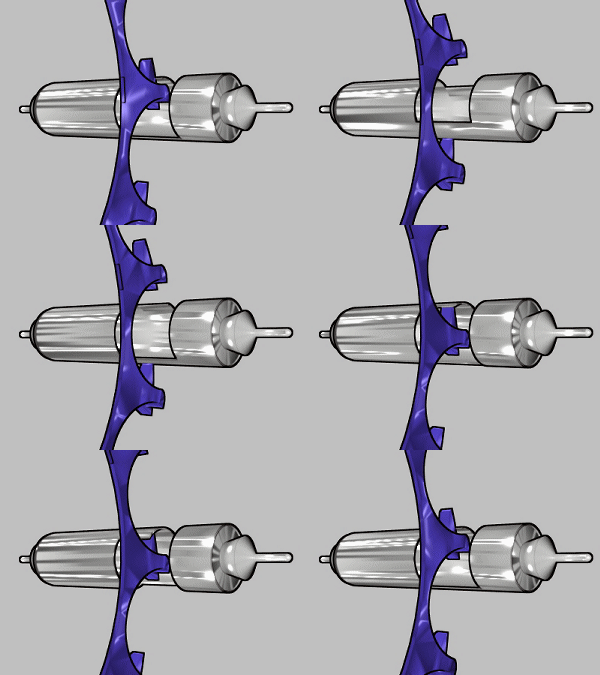
Figure 1. Working model of a cylinder escapement. Created by Adithyamc Gaming. Source: Wikimedia Commons. Licence: CC BY-SA 4.0. The original image is used.

In a 1977 readers’ column, William Stonehill had a French portable clock on his bench and asked where he could find the special supports and dies, the plugs at both ends of the cylinder, and the escape wheel listed in his 1974 edition. The reply pointed to catalogues for Germany, Switzerland and France as examples of sources for Bergeon tools. Repairing older escapements involved finding the necessary tools and replacement parts as well as knowing which components to inspect. 6
From repairing watches to making them#
Fried learned about mechanisms and parts while working for a New York watch-parts supplier and began teaching watchmaking in a New York City school in 1937. In a 1984 readers’ column, he recommended The Watch Escapement and other books to a reader inspired by George Daniels’s Watchmaking to make a watch. He also proposed rearranging the train of an existing American watch to learn about centre distances and gear meshing. 7 8
In 2017 Henrik Korpela cited pages 42–43 of the second edition in a series on Kaj Korpela’s watchmaking. The passage explains how the sizes of the balance, escape wheel and roller, and the space available for the mechanism, affect the dimensions of the lever when designing a Swiss lever escapement. In repair, the book helps readers understand the positions of parts already fitted in a watch. In this design example, it helped determine the sizes of parts still to be fitted. 4
Editions and holdings#
| Publication | Publisher | Pagination and identifiers |
|---|---|---|
| 1959 edition | B. Jadow, Inc. (New York) | x pages of front matter plus 164 pages, LCCN 59015591. Smithsonian Libraries call number TS547 .F89w 1959. 1 9 |
| 1974 second edition | Columbia Communications (New York) | vi pages of front matter plus 191 pages, LCCN 74080842. 2 |
| 1984 paperback record | American Watchmakers Institute | ISBN 9780317170863. AWI Press also listed the book in its March 1984 notice. 8 9 |
Smithsonian Libraries records its holding of the 1959 edition, and Open Library provides bibliographic records for the 1959 edition and the second edition. This account is based on the holding and bibliographic records, Fried’s own replies, the account of a reader who used the 1974 edition and a later article on making a watch. 1 2 3 4 6
Fried’s The Watch Repairer’s Manual (article in Japanese) covers general watch repair, including disassembly and cleaning. W. J. Gazeley’s Clock and Watch Escapements (article in Japanese) covers making and repairing escapements in both portable timepieces and pendulum clocks.
References#
- Smithsonian Libraries, The watch escapement: how to analyze, how to adjust, how to repair (catalogue). 1959 edition, bibliographic ID siris_sil_338097.
2. Open Library / Library of Congress MARC, The watch escapement: how to analyze, how to adjust, how to repair: lever, cylinder. Bibliographic record for the 1974 second edition.
3. Henry B. Fried, “Questions & Answers,” Horological Times, February 1988, p. 8. Reply about a Hampden watch.
4. Henrik Korpela, “Making a Watch from Conception to Finished Product with Kaj Korpela, Part Four,” Horological Times, April 2017, pp. 22–23, especially p. 23 and note 4.
5. The Keystone, ed., Watch and Clock Escapements, 1904. Chapter I, “The Detached Lever Escapement,” and Chapter II, “The Cylinder Escapement.” Background on the mechanisms.
6. William Stonehill’s question and its reply, Horological Times, June 1977, pp. 49–50.
7. “A Family History As Told By Henry B. Fried,” Horological Times, May 1996, pp. 18–21. His work for a watch-parts supplier and as a teacher.
8. Henry B. Fried’s reply to a reader, and AWI Press publication notice, Horological Times, March 1984, pp. 6, 40.
9. Open Library / Library of Congress MARC, The watch escapement (1959 publication and list of editions).
Sources accessed on 21 November 2026.