This article was translated from Japanese using AI. Read the Japanese original
What if that set of hands went with this dial? What if the case were a little smaller and just the seconds hand were orange?
Looking at a watch, you sometimes find yourself thinking of one little change. Seiko modding is a way to follow that thought by actually swapping parts. Mod is short for modification. The term covers everything from changing a Seiko you already own to building a watch from a movement and aftermarket parts.1 2
You might start by looking for something you like among ready-made watches and end up thinking about hand shapes or the position of a window in the dial. Little by little, you start looking at a watch the way someone building one would.
It started with a slightly misaligned scale#
In an interview with parts retailer namokiMODS, Matt says he bought a Seiko SKX009 in 2018 with no plans to modify it. What bothered him was the slight misalignment of the chapter ring, the graduated ring around the outside of the dial.1
He looked up how to fix it, bought the tools and tried aligning it. It worked, and he says he was hooked on modding from there. He enjoys turning an idea into an actual watch and making the watches other people imagine.1
Before there was a grand design, there was a little detail he wished were different. It is an easy way to see the appeal.
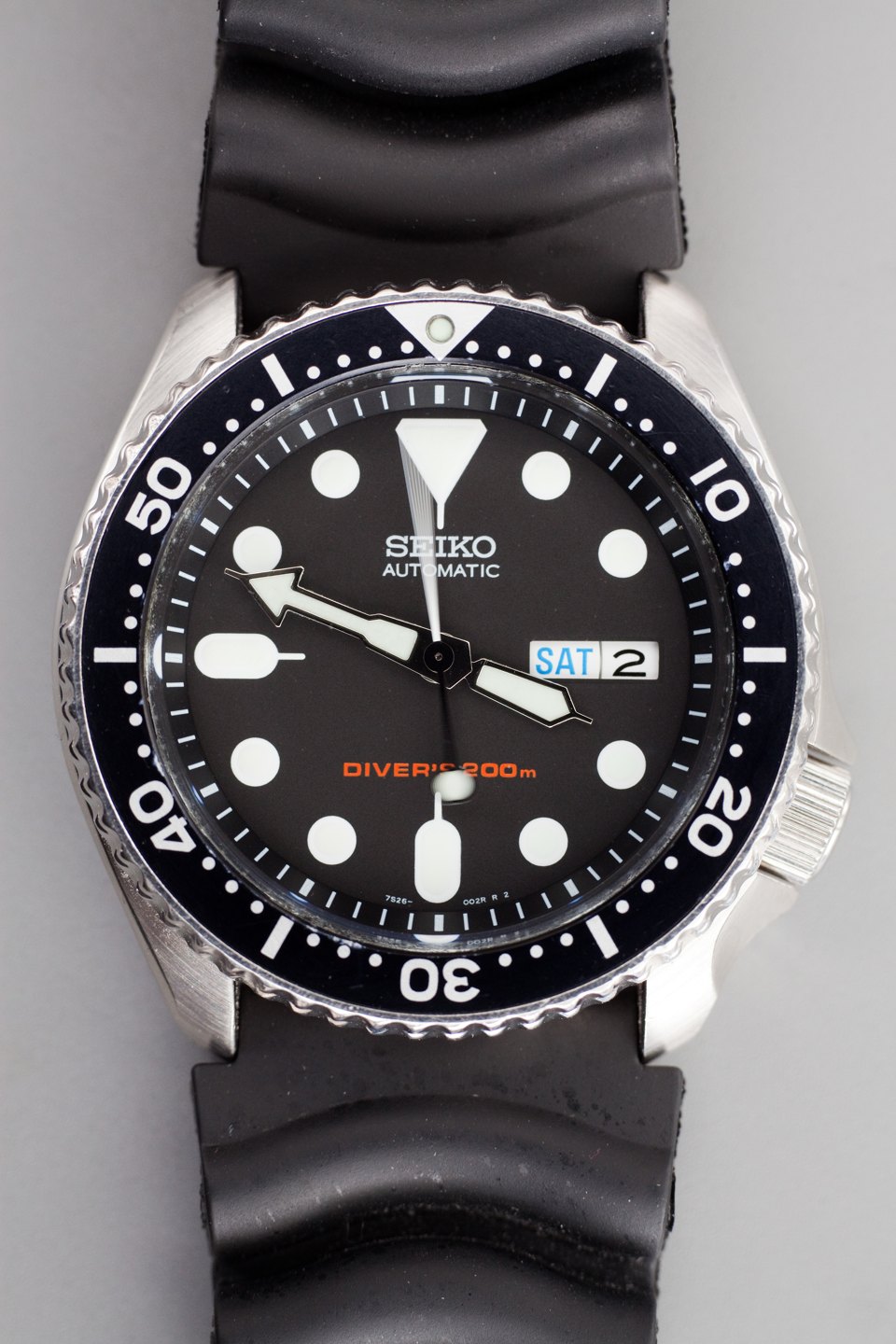
Figure 1. A Seiko SKX007, with the chapter ring just outside the dial and the rotating bezel beyond it. The photo shows where the parts sit on an SKX007. Matt modified an SKX009. Photograph by Ashley Pomeroy, May 2, 2015. Source: Wikimedia Commons, “Seiko SKX007.jpg”. Licence: CC BY-SA 4.0. Resized and recompressed as JPEG. The reproduced image carries the same licence.

Changing a watch or building one from parts#
You can change the hands on a watch you own. You can replace the bezel insert, the part of the rotating bezel with the markings. You can go as far as changing the dial or crystal. One way to enjoy modding is to start with an existing watch and choose the things you would like to change.1 2
You can also start by gathering a case, a dial, hands and a movement. A build guide from namokiMODS shows how these can be put together using a case set. The resulting watch can be assembled without first buying and taking apart a finished Seiko.2
Both approaches go by “Seiko mod”. When someone shows you a build, ask what watch they started with and what parts they chose. The answers tell you something about how the builder made it their own.
A different movement gives you a different dial#
Explore the parts available and you will come across NH35, NH36 and NH34. These are model numbers for movements, the mechanisms inside watches. Time Module (TMI), a company in the Seiko Group, supplies the NH series. TMI describes its business as designing, developing and producing movements for the global watch industry.3 4 9
The NH35 has three hands for hours, minutes and seconds, plus a date display. The NH36 adds the day of the week. The NH34 has a central GMT hand, so you can design a dial for reading the time in another zone using a 24-hour scale.4
Changing the movement changes the dial windows and the number of hands. Would you prefer a clean dial with just the date, or a practical everyday dial that shows the day of the week too? Choosing a movement already means making choices about how the watch will look.
See the article on the NH35 for its workings and detailed specifications. For now, knowing that the movement gives you a choice of displays makes the parts descriptions easier to follow.
After colour come holes and feet#
Choosing parts you like is only the beginning. They also have to fit together, and this is where watchmaking gets very particular.
Dials, for example, have feet on the back to locate and secure them. NamokiMODS says that its dials are designed around a diameter of 28.5 mm and have feet for both three o’clock and four o’clock crown positions. While choosing a colour or pattern, you also have to consider which way will be up once the dial sits in the case.5
Hand length matters, too. NamokiMODS notes that some combinations of hands on an SKX013 can leave the seconds hand long enough to hit the chapter ring. Hands that look practically identical in a photograph can reach quite different points.5
With a GMT movement, even the hole at the centre of the dial comes into play. Lucius Atelier says its dial for the NH34 has a larger central hole than those for movements such as the NH35. An extra hand needs room for the part that passes underneath it. Once you notice that small hole in the dial, you start thinking about how the watch is stacked in three dimensions.6
A conversation about hand colours can quietly turn into one about lengths, holes and feet. Part of the appeal of modding is learning the dimensions that make the finished look possible.
The name on the dial and the person who built the watch#
How should you read the name “SEIKO” on a dial?
A watch made with an NH-series movement, an aftermarket case and dial owes its existence to those parts and the person who assembled it. Asking about the movement model, where the case and dial came from and who assembled the watch will tell you more about it than a logo alone.2 3
In an official notice dated October 6, 2025, Seiko says it does not authorise modifications to its products and that mod watches are outside its warranty and quality assurance.7
You can enjoy modding by describing what you want and having someone assemble it, as well as by doing the work yourself. The DLW Watches FAQ explains how to choose parts for a particular look and how to ask someone who assembles mod watches to take on a build. Some people enjoy using the tools, and others enjoy deciding what the watch should be.8
When a wish becomes a list of parts#
At first, “I’d like a blue dial” or “I want just the seconds hand to be bright” might be enough. The more you look into it, the more specific it becomes. Should there be a day window? How far should the tips of the hands reach? How will your parts fit inside the case?
You start to notice details you once passed over in finished watches. What would you change on yours? Looking at the watch you wear every day with that question in mind is already a way into Seiko modding.
References#
Sources accessed and checked November 14, 2026. Retailer materials describe the sellers’ own parts and example builds.
- Glen H, namokiMODS, “Why We Mod #007: Matt (@mlswatches)”, April 11, 2021. Matt describes buying and first modifying his SKX009 and discusses design and making.
2. Jeremiah A, namokiMODS, “How to Build a Vintage-Inspired Watch with Seiko Mods”, November 10, 2024. Examples of part swaps and assembly in “Subtle Mod Options” and “Building from Scratch”.
3. Time Module, “About Us”. Movement supply business and the NH series.
4. Time Module, “Mechanical (NH0&NH3) — Products”. Display functions of the NH35, NH36 and NH34.
5. namokiMODS, “Help Center”. Compatibility information in the seller’s Dials, Hands and Movements sections.
6. Lucius Atelier, “Meteorite GMT Dial [For NH34]”. Product description and the retailer’s reply from Adriel on the central holes of NH34 and NH35 dials. The listing showed the product as no longer on sale when checked.
7. Seiko Watch Corporation, “Important Notice regarding Counterfeit and Modified SEIKO watches”, October 6, 2025. Manufacturer notice on authorisation for modifications, warranty and quality assurance.
8. DLW Watches, “FAQ”, §§2.1–2.4. Retailer’s advice on selecting parts and commissioning assembly or modification.
9. Seiko Group Corporation, Notice of the 165th Ordinary General Meeting of Shareholders, dated June 5, 2026, p. 35, “Status of major subsidiaries”. Time Module Ltd.’s place in the group and main line of business.