This article was translated from Japanese using AI. Read the Japanese original
The Citizen Jet, released in October 1961, was a wristwatch that wound its mainspring with a ring turning around the edge of the movement. Citizen’s historical model guide traces the calibre designation from H to 0300. Teeth cut into the inside of the ring drove the winding train, which wound the mainspring in the same direction whichever way the rotor turned. Supporting the ring at the periphery freed the centre from the rotor mounting, allowing Citizen to design a thinner automatic movement.1 2 3
A dedicated automatic movement with direct central seconds#
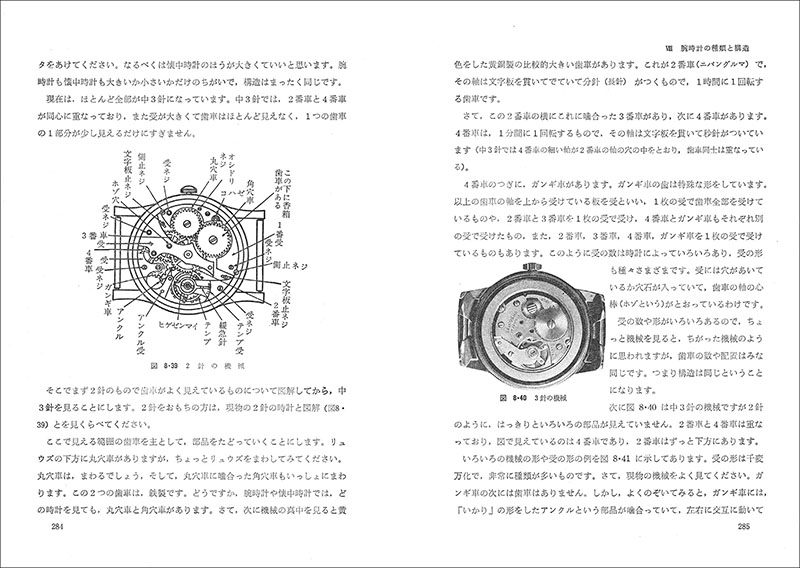
The calibre 3KA in the men’s Auto released by Citizen Watch in May 1958 added an automatic winding module to a hand-wound movement. Its rotor could turn through a full revolution and wind in both directions. For the Jet, Citizen aimed for a thinner movement designed from the start for automatic winding and direct central seconds. In this layout, the seconds hand fits directly onto the arbor of the fourth wheel, which makes one revolution per minute. The three hands share the centre of the dial, so the fourth wheel that drives the seconds hand also sits at the centre.1 4 15
The balance is the oscillator that governs the rate. CITIZEN DESIGN says the Jet’s base movement used a large balance without adjusting screws, advertised at the time as the world’s largest of its type. The finished watch cost ¥7,500 to ¥13,800 at launch. Japan’s industrial technology history database records a 1961 production example at Citizen Watch, under item no. 108810991029 and model Cal. 0301 (H).1 2 5
One surviving watch documented by a collector is a 21-jewel Jet with case reference JT15803. The owner identifies its movement as calibre 0310 and dates it to August 1962 from the serial number inside the caseback. Photographs of the same watch show its gold-coloured plated case, acrylic crystal and ring-shaped rotor with the caseback removed.12
Peripheral ball bearings and internal teeth#
The Jet rotor is a ring with a weighted section. When wrist motion changes the case’s orientation, the offset centre of mass causes the ring to rotate relative to the case. A ball bearing around the ring takes the load, and teeth on the inside of the ring drive a winding pinion. The Japan Clock & Watch Association survey identifies two advantages. The rotor load is distributed across the bridge, and dispensing with the central hub of a sector-shaped rotor lets the movement be made thinner.2 3 6
A teardown of the later Autodater Seven (calibre 4102) shows the bearing’s outer race fixed to a weight with internal teeth. Steel balls sit between the outer and inner races, and the fixed ring is screwed to the movement bridge at its lugs. Photographs with the automatic winding assembly removed show where the going train and the train that transmits rotation from the ring to the barrel connect. The bearing at the periphery supports the ring, and the internal teeth transmit its rotation to the winding train.6
Both rotor directions turn the ratchet wheel the same way#
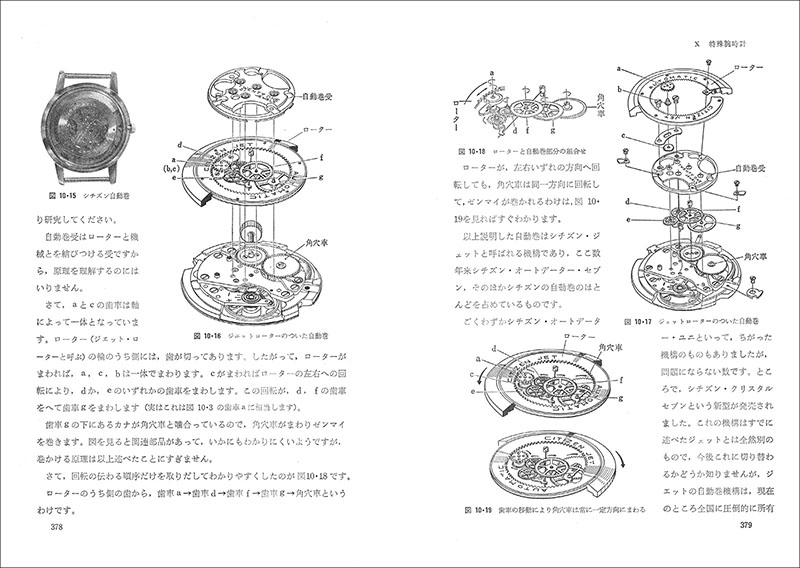
Hideo Kunitomo and Masahiro Satō’s An Accessible Guide to Modern Horology shows the Jet automatic winding system in exploded and transmission drawings. The gear driven by the internal teeth engages one of two paths depending on which way the rotor turns. The paths converge at a downstream wheel. A pinion below the final wheel meshes with the ratchet wheel. In both states in fig. 10-19, the arrow on the ratchet wheel points in the same direction. The ratchet wheel turns the barrel arbor, winding the mainspring attached to it.3
Each time the ring reverses, a different path takes over. The train converts rotations in either direction into the same winding motion, so both directions of rotor motion caused by the wrist do useful work. The ball bearing supports the rotor to make the movement thinner, and the winding train turns the ratchet wheel consistently in one direction.2 3
A contemporary peripheral-rotor design appears in CH322325A, filed in Switzerland by Paul Gosteli in 1955. The drawings show internal ring teeth turning a pinion and two winding wheels used according to the direction of the weight. Peripheral support can therefore be combined with internal teeth and gearing to make use of both directions of rotation.13
Later models with date and day#
In January 1962 Citizen released the Autodater (calibre 1100), adding a date mechanism to the Jet. Citizen describes the Super Autodater (calibre 1150), released in May 1963, as offering greater accuracy and improved movement finishing. The Autodater Seven (calibre 4101) added the day of the week in May 1964. Citizen’s design archive shows a 1965 example with the sound of a Jet rotor, a rounded plastic crystal and a day display in kanji.7 8 9 14
The Crystal Seven, released in December 1965, carried on the name and the day and date indications. Calibre 5200 used a clutch-wheel system to wind in both directions. Citizen says that placing the gear train and automatic winding mechanism on the same plane made it thinner. The 1968 technical book also records that the Crystal Seven used a different winding mechanism from the Jet family. The peripheral ring and the Crystal Seven’s arrangement were two designs Citizen used to make an automatic movement thinner.3 8 10
Timeline#
| Date | Event |
|---|---|
| May 1958 | Citizen releases the men’s Auto with the 3KA.4 |
| October 1961 | The Jet is released with a peripheral ball-bearing rotor.1 |
| January 1962 | The date-equipped Autodater is released.7 |
| May 1963 | The Super Autodater with calibre 1150 is released.7 |
| May 1964 | The Autodater Seven is released with day and date.8 9 |
| December 1965 | The Crystal Seven with calibre 5200 is released.10 |
| 1968 | An Accessible Guide to Modern Horology illustrates the Jet winding paths.3 |
| 2008 | The Japan Clock & Watch Association completes a survey record for the 1961 Jet at Citizen Watch.2 |
| 2024 | A reprint of the book and a teardown of a later movement are published.3 6 11 |
References#
- Citizen Watch, Jet, historical model guide. Release, price, calibre and the aim of reducing thickness. Accessed November 20, 2026.
2. Japan Clock & Watch Association survey, National Museum of Nature and Science, Citizen Jet wristwatch, Cal. 0301 (H), industrial technology history database, record 108810991029, survey dated September 25, 2008. Accessed November 20, 2026.
3. Hideo Kunitomo and Masahiro Satō, Wakariyasui saishin tokeigaku (An Accessible Guide to Modern Horology), Seibundō Shinkōsha, 1968. Pp. 378–379 in the public reprint sample, figs. 10-15 to 10-19. Accessed November 20, 2026.
4. Citizen Watch, Auto, historical model guide. 3KA, hand-wound movement and automatic winding module, and release date. Accessed November 20, 2026.
5. Ryuji Tonobori, “Uncompromising Craftsmanship”, CITIZEN DESIGN, “The Lineage of Seven”. Calibre 0300 and the contemporary claim about the large balance. Accessed November 20, 2026.
6. Martin, “Perpetually peripheral: The Citizen Jet Autodater 7”, Adventures in Amateur Watch Fettling, March 29, 2024. Teardown, bearing and assembly photographs of a later model. Accessed November 20, 2026.
7. Citizen Watch, Super Autodater, historical model guide. The 1962 Autodater and 1963 calibre 1150. Accessed November 20, 2026.
8. CITIZEN DESIGN, Uncompromising Craftsmanship (Japanese edition). Development of the Autodater Seven and Crystal Seven. Reference 5 is the English version. Accessed November 20, 2026.
9. Citizen Watch, Autodater Seven, historical model guide. Release date and day and date displays. Accessed November 20, 2026.
10. Citizen Watch, Crystal Seven, historical model guide. Release date and specifications of calibre 5200. Accessed November 20, 2026.
11. Seibundō Shinkōsha, An Accessible Guide to Modern Horology. Reprint announcement and sample pages. Accessed November 20, 2026.
12. Sweephand, “This Week’s Featured Watch #58 – Jet Automatic, 21j”, April 3, 2014. Owner’s record, case reference and photographs. Accessed November 20, 2026.
13. Paul Gosteli, CH322325A, “Pièce d’horlogerie à remontage automatique par masse oscillante”, filed June 6, 1955, published June 15, 1957. Drawings and claims. Accessed November 20, 2026.
14. Citizen Watch, Autodater, historical model guide. Calibre 1100 and release date. Accessed November 20, 2026.
15. Hideo Kunitomo and Masahiro Satō, Wakariyasui saishin tokeigaku (An Accessible Guide to Modern Horology), Seibundō Shinkōsha, 1968. Pp. 284–285 in the public reprint sample, fig. 8-40 and the three-hand train. Accessed November 20, 2026.