This article was translated from Japanese using AI. Read the Japanese original
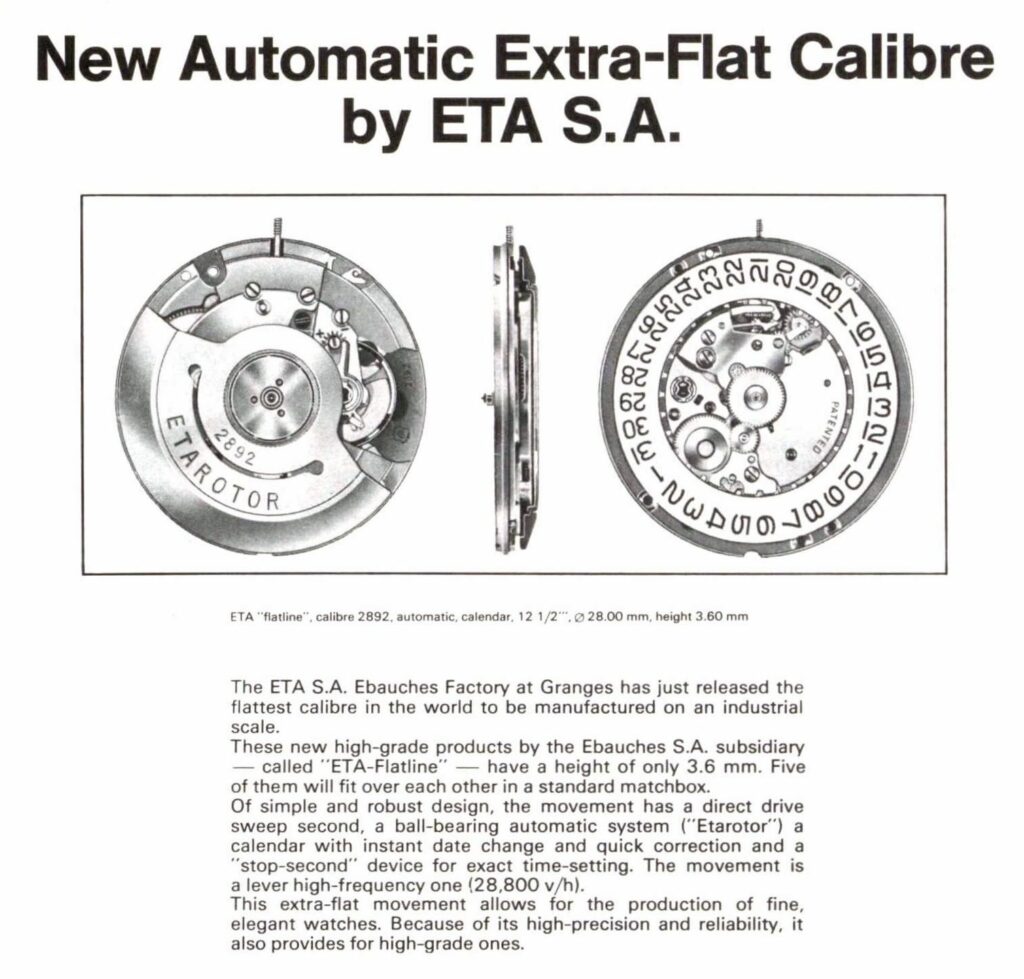
The ETA 2892 series comprises slim automatic movements with central hour, minute and seconds hands and a date display. The 2892 of the 1970s was introduced at 28.00 mm in diameter and 3.60 mm thick. The later 2892-2 and 2892A2 reduced the diameter to 25.60 mm. The current 2892A2 fits bidirectional automatic winding, a quickset date, stop seconds and 28,800 beats per hour into the same thickness. The family’s long development rests on using a slim base movement with different cases and additional functions. 123
Supplying slim movements on an industrial scale#
The trade journal Europa Star introduced the 2892 in 1976 as ETA’s new slim automatic. The photographs show the back with “ETAROTOR” marked on the rotor, a slim side profile, and the dial side with the date indicator around the edge. The text gives a diameter of 28.00 mm, a thickness of 3.60 mm, central seconds, automatic winding with a ball-bearing rotor, a quickset date and stop seconds. It specifies a lever escapement and a rate of 28,800 beats per hour. The article promoted industrial manufacture at this thickness and the possibility of fitting the movement into slim, elegant wristwatches. 1
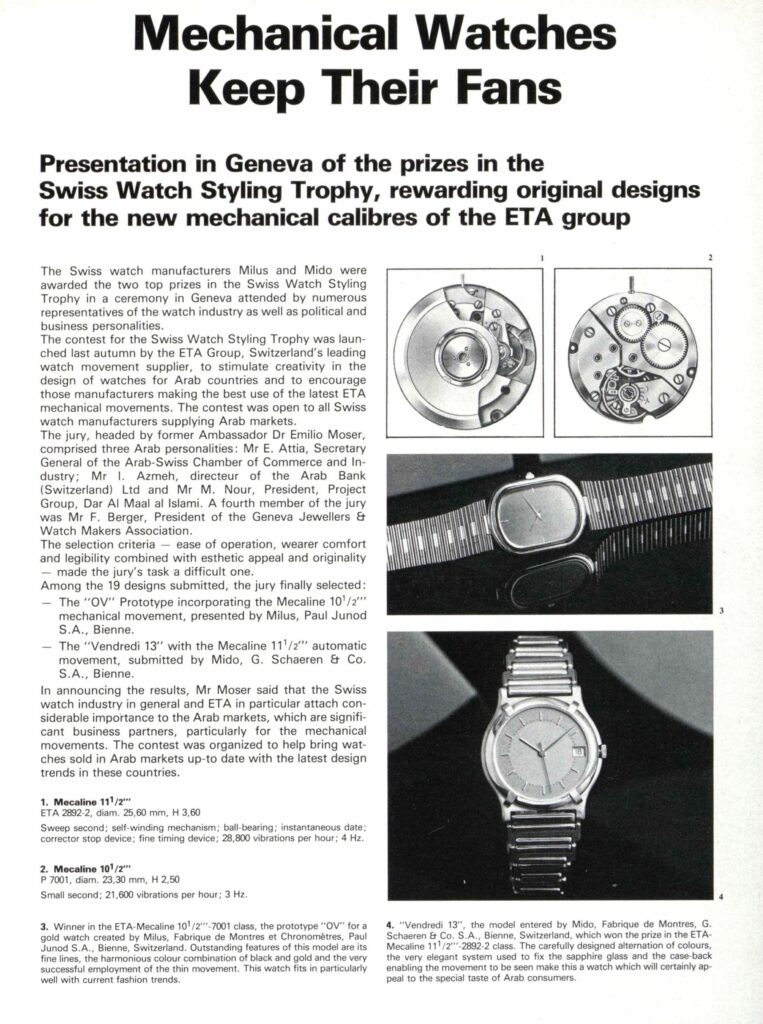
In 1984 the journal reported on the Swiss Watch Styling Trophy, a design competition for mechanical watches using new movements supplied by ETA. One winner was Mido’s “Vendredi 13”, which used the 11½-ligne 2892-2. The published dimensions were 25.60 mm in diameter and 3.60 mm thick. The description discussed the dial and the movement visible through sapphire glass. By then the family was being marketed for the way it could be combined with case design as well as for its thinness. 2
In a 1998 product announcement ETA said the 2892A2 had been successful with high-end watch manufacturers for several years and was used as the base for complicated additional functions. The advertisement also presented options for customers such as rotor shape, gold or rhodium plating, surface patterns and engraving the brand name. A shared movement supplied to other companies could be adapted to the function and appearance of each finished watch. 4
Basic specifications of the 2892A2#
| Item | Specification and date of source |
|---|---|
| Size | 11½ lignes, 25.60 mm in diameter |
| Thickness | 3.60 mm |
| Display | Central hour, minute and seconds hands, date in an aperture |
| Automatic winding | Ball-bearing rotor, bidirectional winding |
| Operation | Quickset date and stop seconds for setting the time |
| Frequency | 28,800 half-oscillations per hour, 4 Hz |
| Jewel count | 21 |
| Regulating system | ETACHRON |
| Power reserve | 42 hours in the 2019 technical communication, typical 50 hours on the product page checked in November 2026 |
| Lift angle | 51 degrees according to the 2019 technical communication |
The figures come from the current product page, the 2016 catalogue and the 2019 technical communication. Power-reserve values are given by source date. The current product page describes a semi-instantaneous date change. 356
For comparison, the 2016 catalogue lists the 2824-2 at 25.60 mm in diameter, 4.60 mm thick, with 25 jewels and 28,800 beats per hour. At the same diameter and frequency, the 2892A2 is 1.00 mm thinner. That difference affects the height available for the dial, hands and case when designing the finished watch. 5
Metering the power and driving the central hands#
Barrel and train#
The 2019 technical communication gives separate assembly stages for the barrel and train, escapement, automatic winding and dial side. The barrel stores mainspring energy and delivers it through the train to the escape wheel. The parts list includes an intermediate wheel, third wheel, seconds wheel and escape wheel, together with the pallet fork and balance. The pallet fork unlocks the escape wheel in time with the oscillations of the balance and balance spring. The train advances in regular steps and the balance receives the energy needed to keep oscillating. 6
A rate of 28,800 half-oscillations per hour gives eight half-oscillations, or four complete oscillations, per second. The central seconds hand advances in these increments. On the dial side, the cannon pinion with driving wheel, minute wheel and hour wheel drive the minute and hour hands. Separate wheels and supports provide for the running of the train and the hour and minute displays. 6
Regulation and shock protection#
ETACHRON is a regulating system that uses a regulator. The exploded view of the balance cock shows the regulator components, stud support and adjustment parts. The upper and lower shock-protection units supporting the balance staff are listed as INCABLOC. The drawing locates the bearings supporting the balance and the parts for attaching and adjusting its spring. 36
In the 1998 advertisement, ETA also describes supplying movements adjusted to chronometer specifications at a customer’s request, with COSC rate certification. The movement’s finish and adjustment could be specified by the watch manufacturer. 4
Converting rotation in both directions into winding#
The automatic winding assembly includes the rotor and its ball bearing, the unit’s frame and lower bridge, reversing wheels and mechanisms, and reduction wheels. Page 16 of the 2019 technical communication shows the parts where the rotor attaches and where the wheels are stacked in an exploded view. The parts list names the intermediate reduction wheel, reduction wheel, reversing wheel, assembled reversing mechanism and auxiliary reversing mechanism separately. 6
Whichever way the rotor turns with wrist movement, the winding side directs power into the direction that winds the mainspring. The reversers handle the direction of rotation. The reduction gears change the relationship between speed and torque and pass power to the barrel winding. The central bearing supports the weight of the rotor, while the surrounding gears transmit its motion. 36
The crown side has the winding stem, winding pinion, sliding pinion, setting lever, yoke and related parts, allowing manual winding and selection of the setting functions. The drawing on the barrel-bridge side shows the crown wheel, intermediate wheel, ratchet wheel and its driving wheel, and the click. These parts pass power from the user’s hand to the barrel. The separate assembly drawings for the automatic winding unit and base movement help trace the two input paths. 6
Date and time setting#
The date indicator sits around the edge on the dial side. The 2019 parts list includes the date driving wheel, intermediate date wheel, date jumper and its retaining plate, and the quickset mechanism. Pages 20–21 show the dial-side assembly and lubrication. In normal operation, power from the train advances the date indicator to its next position, located by the jumper. Quicksetting uses crown operation to advance the date along a separate path. 6
A three-function setting-lever jumper is listed as part of the mechanism that changes the stem position for setting the time. The stop lever is listed as a separate part. Stop seconds in the current product specification stops the movement for setting, allowing it to restart in step with a reference time. 36
Additional indications and finished watches#
ETA’s 2016 catalogue places the 2892A2 in “Mecaline Specialities” alongside calibres for different purposes in the same 25.60 mm size. At 4.10 mm thick, the 2893-2 adds a 24-hour hand or second time zone to the central hours, minutes and seconds. The 2895-2 has small seconds and date and is 4.35 mm thick. The 2897 adds a power-reserve indicator and measures 4.85 mm thick. 5
| Calibre | Indications in the 2016 catalogue | Thickness |
|---|---|---|
| 2892A2 | Three central hands and date | 3.60 mm |
| 2893-1 | Three central hands, date and world time by disc | 4.10 mm |
| 2893-2 | Three central hands, date and 24-hour hand or second time zone | 4.10 mm |
| 2893-3 | Three central hands and world time by disc | 4.10 mm |
| 2895-2 | Hours, minutes, small seconds and date | 4.35 mm |
| 2896 | Three central hands and instantaneous date in a large aperture | 4.85 mm |
| 2897 | Three central hands, date and power reserve | 4.85 mm |
Source 5. The slim three-hand movement was a starting point for options with different numbers and locations of indications. ETA’s 1998 description likewise presents the 2892A2 as a base for complicated additional functions. 4
Sinn’s 1746 Edition F.A.Z. is an example of a finished watch using the movement. The official product information dated November 2025 lists the 2892-A2 with automatic winding, 21 jewels, 28,800 half-oscillations per hour and stop seconds, and gives the indications as hours, minutes and date. Its 42 mm stainless steel case is 9.4 mm thick, with a sapphire display back and rhodium plating on both the hands and the applied indices. The watch illustrates how the thin base movement can inform the dimensions and indications of the finished product. 7
Design details in the servicing documentation#
The technical communication specifies the type and quantity of lubricant by assembly stage as well as the part numbers. Contacts in the train, automatic winding and escapement require different oils or treatments. ETA instructs repairers not to clean certain automatic-winding parts and to replace them when necessary with genuine pre-lubricated parts supplied by ETA. The action of the small winding components depends on how friction is managed. 6
Several parts are marked “Var”, indicating variants. The information after the parts list directs users to the service portal for compatibility and related specifications. The 2892’s use in many finished watches reflects its slim profile and the availability of different delivery specifications, indications, finishes, parts and service information. 46
Timeline#
| Date | Documented development |
|---|---|
| 1976 | Issue 97 of Europa Star introduces the 2892 as a slim automatic, 28.00 mm in diameter and 3.60 mm thick. 1 |
| 1984 | Issue 145 covers Mido’s design competition winner with the 25.60 mm 2892-2. 2 |
| 1998 | ETA’s advertisement says the 2892A2 has been used for years by high-end watch manufacturers and serves as the base for additional functions. 4 |
| 2016 | The Mecaline catalogue lists the 2892A2, 2893 variants, 2895-2, 2896 and 2897. 5 |
| 13 February 2019 | ETA’s technical communication records 21 jewels and 42 hours of power reserve, with diagrams and lists for parts, assembly and lubrication. 6 |
| Checked 15 November 2026 | The ETA product page lists the 2892A2 with a typical 50-hour power reserve. Sinn’s official product information documents use in a finished watch. 37 |
References#
- Europa Star, New Automatic Extra-Flat Calibre by ETA S.A., no. 97, 1976, p. 136. Period article consulted in the image provided by Grail Watch Reference. Accessed 15 November 2026.
2. Europa Star, Mechanical Watches Keep Their Fans, no. 145, 1984, p. 27. Period coverage of the competition. Accessed 15 November 2026.
3. ETA SA, 2892A2 — Mecaline. Current product specification. Accessed 15 November 2026.
4. ETA SA, ETA Mechanical Movements: Two Centuries of Tradition, Europa Star no. 231, 1998, p. 77. Period image of the manufacturer’s advertisement. Accessed 15 November 2026.

5. ETA SA, Collection — Mechanical Movements / Mecaline, 2016, pp. 9 and 17–20. Accessed 15 November 2026.
6. ETA SA, Technical Communication, 11½ ETA 2892A2, CT 2892A2 ESI 398773 15, 13 February 2019. P. 1 for specifications, pp. 3–7 for parts, pp. 8–21 for assembly and lubrication, p. 5 for compatibility, p. 22 for hand heights and p. 24 for the revision history. Accessed 15 November 2026.
7. Sinn Spezialuhren, 1746 Edition F.A.Z. — Product Information, November 2025, pp. 1–3, exterior and technical specifications. Accessed 15 November 2026.