This article was translated from Japanese using AI. Read the Japanese original
The MIYOTA 8215 is an automatic movement with central hour, minute and seconds hands and a date window. Motion of the wearer’s wrist turns the rotor, winding the mainspring. If the watch stops after being left off the wrist, the movement can also be wound by hand at the crown. 1
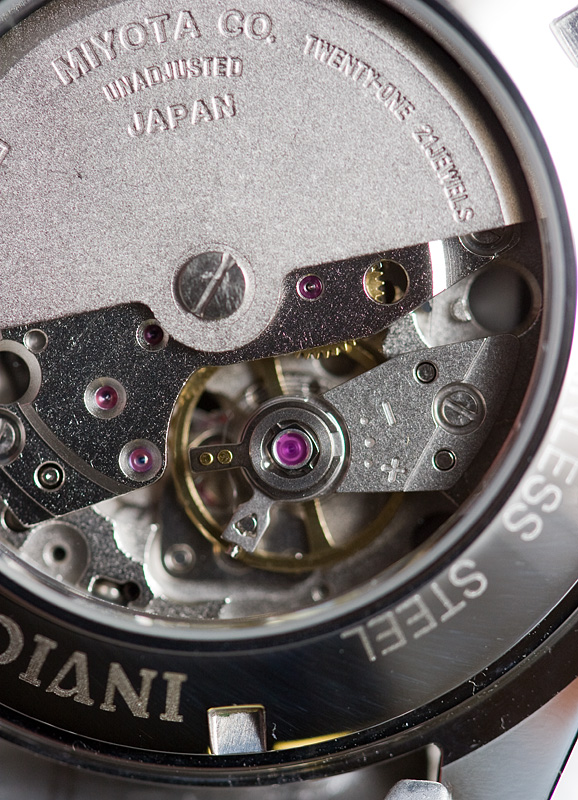
An 8215 fitted to an Invicta 8926. The semicircular part that turns around the central screw is the rotor. Photograph by Rosstomson. Unmodified. Wikimedia Commons (CC BY 3.0).

The 8215 in the 82 series#
In 1975, as quartz watches were becoming widespread, Citizen introduced the 82 series of mechanical movements. When the company first began supplying movements to other firms, it engraved the customer’s watch brand on rotors like the one in the photograph. It later began engraving the name MIYOTA, and in 1986 it introduced the 8205 with day and date displays. The 8215 in the same series has a date-only calendar. 2 3
The position of the date display can be chosen to suit the dial. On the 8215-33E, both the crown and date window are at 3 o’clock. On the 8215-36E, the crown stays at 3 o’clock and the date is shown at 6 o’clock. 1
Dimensions and rate#
| Item | Current 8215 specifications |
|---|---|
| Diameter and thickness | 26.00 mm and 5.67 mm |
| Frequency | 21,600 vibrations per hour (3 Hz) |
| Jewel count | 21 |
| Power reserve at full wind | About 42 hours |
| Daily rate | −20 to +40 seconds |
A frequency of 21,600 vibrations per hour corresponds to three complete oscillations per second of the balance that sets the rate. The manufacturer specifies that the daily rate should be measured 10 to 60 minutes after fully winding the mainspring. To check how the rate varies by position, the watch is measured dial up and with the 6, 9 and 3 o’clock sides facing up in turn. 1 3
Stopping the seconds hand and setting the date#
In early 82 series movements, the seconds hand continued running while the crown was pulled out to set the hour and minute hands. A later modification added a spring that touches the balance and stops its oscillation when the crown is pulled out. On the current 8215, the wearer can pull the crown out two clicks when the seconds hand reaches 12, set the hour and minute hands, and wait. Pushing the crown back in at the time signal restarts the seconds hand from that position. 1 4 5
To advance the date alone, pull the crown out one click and turn it anticlockwise. The instructions advise against quick-setting the date when the watch shows a time between about 9 p.m. and 1 a.m. Doing so may prevent the date from changing the following day. 5
Retail prices for the movement alone#
On 20 November 2026, US supplier All Watch Parts listed a single movement for US$48.95. The retailer described the movement on offer as a version without stop seconds. All Watch Parts product page
In Japan, an 8215 listed as new and equipped with stop seconds sold for ¥6,088 including shipping. The private listing included a winding stem, dial screws and spacer. The transaction was complete when checked on the same date. Mercari sale
References#
- MIYOTA, 8215 product specifications and calendar variants.
- MIYOTA, Cal. 82 Series 50th anniversary, episode 1. Origins of the series and the start of sales to other manufacturers.
- MIYOTA, 8215 and 8205 specification sheet, pp. 1–2. Dimensions, differences in the displays and conditions for measuring rate.
- MIYOTA, The evolution of mechanical movements, section 2. Addition of stop seconds.
- MIYOTA, Cal. 8215 instruction manual, sections B and C. Time setting and quickset date.