This article was translated from Japanese using AI. Read the Japanese original
The NH35 is a mechanical movement supplied by Time Module (TMI) to watch manufacturers. It provides central hour, minute and seconds hands and a date display. In addition to automatic winding through wrist movement, it offers manual winding via the crown, stop seconds for setting the time and a quickset date. TMI lists it as NH35 in its product line and NH35A in its technical documentation. It has 24 jewels, runs at 21,600 beats per hour and measures 5.32 mm thick. It powers wristwatches with a variety of case and dial designs. 12
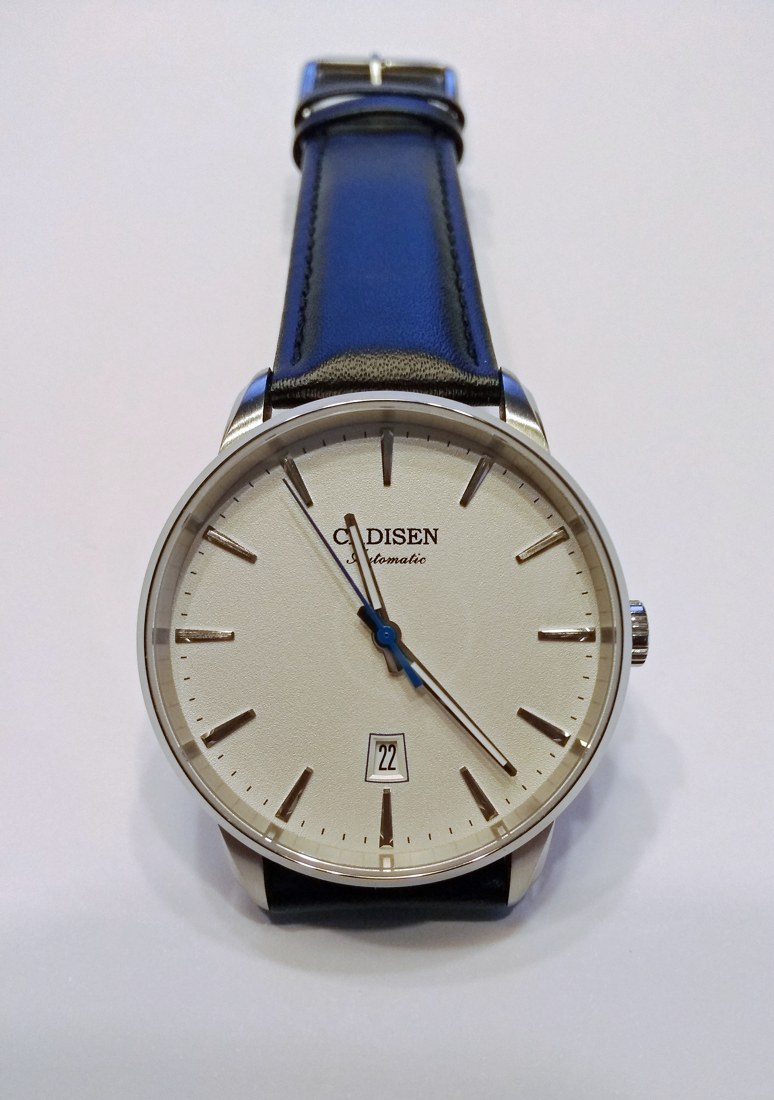
Figure 1. The photographer identifies this Cadisen C8173 as a watch fitted with the NH35A. It has a date window at six o’clock. Photograph by Francis Flinch, 22 November 2020. Source “Cadisen C8173 automatic wristwatch.jpg”, Wikimedia Commons. Licence CC0 1.0. Resized only.

The supplied movement and the finished watch#
The NH35 calibre designation covers the movement itself, without a case or dial. TMI’s current NH series includes the NH35 with date, NH36 with day and date, NH37 with 24-hour display, NH38 and NH39 with open-heart displays, and NH34 with a central GMT hand. Watch manufacturers can select the display functions and combine the movement with their own cases, dials and hands. 12
Watch Movements Archive independently documents an NH35A example and dates production from 2011. It records automatic winding, manual winding, stop seconds and a quickset date. TMI’s specification and drawings revised on 16 November 2022, the technical guide dated 25 June 2025 and the current product line checked on 14 November 2026 document the supplied specifications and servicing information. 234
The Italian brand UNIMATIC provides examples of its use. The company’s official movement reference lists the NH35A for numerous models, including U1-A, U1-DW and U4-A. The Modello Uno U1-BF product description specifies an NH35A, 21,600 beats per hour, a 41-hour power reserve and stop seconds, combined with a stainless-steel case and a distinctive dial. The supplied movement becomes part of a finished watch through the design of the case and display. 56
Dimensions and basic specifications#
TMI’s specifications give the following overview of the NH35A. 123
| Item | NH35A specification |
|---|---|
| Display | Central hour, minute and seconds hands, date |
| Winding | Automatic and manual |
| Movement outside diameter | 27.40 mm |
| Case fitting diameter including spacer | 29.36 mm |
| Thickness | 5.32 mm |
| Jewel count | 24 |
| Frequency | 21,600 beats per hour (3 Hz) |
| Power reserve | Over 41 hours at full wind with dial up |
| Static daily rate | −20 to +40 seconds per day under the conditions below |
| Setting features | Stop seconds and quickset date |
| Country of origin in the current product list | Japan or Malaysia |
The diameter rises to 29.36 mm with the dial-holding spacer fitted around the movement. TMI classifies the size as 12 lignes and gives the actual fitting dimensions in millimetres. Case fit depends on this diameter and on stem height, dial position, hand clearances and the space between the hands and crystal. TMI’s specification illustrates casing, hand fitting, the stem, the dial and the assembly layout. 3
The product-code list checked on 14 November 2026 includes NH35A31J, NH35A31M and NH35A31MN with standard hand height, TYPE M, and NH35A41J and NH35A41MN with high hands, TYPE L. Each listed code has a date disc with black figures on a white background. The J examples are marked JAPAN and 31M is marked MALAYSIA in the remarks. Hand height and display parts can thus be selected to suit the design of the complete watch. 7
From the mainspring to the hands#
The train, escapement and balance#
The mainspring stores energy in the barrel. Rotation passes from the barrel through the centre, third and fourth wheels to the escape wheel. The pallet fork and balance meter the release of that energy. The NH35A parts drawing shows the complete barrel, wheels and pinions, pallet fork, complete balance, bridges and bearings. The fourth wheel drives the central seconds hand. On the dial side, the cannon pinion and hour wheel drive the minute and hour hands. 2
At 21,600 beats per hour, the balance makes six half-oscillations, or three complete oscillations, per second. The train advances at this rhythm and the seconds hand moves in small steps. Shock-protection springs, cap jewels and hole-jewel settings are arranged above and below the balance staff. The 24 jewels in the specification include the stones used in bearings such as these. 12
Bidirectional automatic winding#
The oscillating weight, or rotor, on the back is supported by a ball bearing and turns with wrist movement. The NH35A specification lists bidirectional winding and a one-way clutch. The parts diagram shows the first reduction wheel, a two-armed pawl lever, the second reduction wheel and the ratchet wheel, among other components. Motion from the rotor reaches the pawl lever, and the pawls push and pull to produce rotation in the winding direction. 23
This pawl-lever arrangement follows the principle of the Magic Lever introduced by Seiko in the 1959 Gyro Marvel. Seiko’s chronology describes how it winds the mainspring with both clockwise and counterclockwise rotor movement. The NH35A combines a simple winding mechanism of that lineage with manual winding. 28
To wind manually, turn the crown clockwise in its normal position. TMI’s technical guide and operating instructions give at least 55 crown turns as a guide to a full wind. To start a stopped watch, the instructions also show gently shaking it after winding. 29
Stop seconds and the date mechanism#
Pulling the crown out to the second click sets the watch for time adjustment and engages the stop-seconds mechanism. The technical guide identifies the balance stop lever and diagrams its contact and lubrication points. The seconds hand can be stopped to set the watch against a reference time, then restarted by pushing the crown back in. 2
The dial side contains the date disc, date disc guard, date driving wheel, date jumper and quickset transmission wheel. The train drives the date driving wheel to advance the date, and the jumper locates the disc. With the crown at its first click, turning it counterclockwise quicksets the date. TMI’s instructions prohibit quicksetting between 9 p.m. and 4 a.m., while the date-change mechanism is engaged. When setting the time, check a.m. and p.m. as well. 29
Rate and servicing specifications#
TMI specifies a static daily rate of −20 to +40 seconds per day. The 2022 specification gives a temperature of 23 ± 2 °C. The 2025 technical guide specifies a measurement 10–60 minutes after full winding, when the calendar is inactive. It gives three test positions, dial up, nine o’clock up and six o’clock up, a lift angle of 53 degrees and a minimum measuring time of 20 seconds. After a change of position, allow at least 20 seconds for stabilisation. 23
A separate positional-variation specification sets a difference of less than 60 seconds between the highest and lowest values in the four vertical positions, 12, nine, six and three o’clock up. Power reserve exceeds 41 hours at full wind with the dial up. Rate, positional variation and power reserve are each defined with their own test conditions. 2
The service guide specifies disassembly and assembly in reverse order, where to lubricate, the orientation for installing the rotor and how to remove the stem. The rate adjustment diagram assigns the regulator to rate adjustment, the stud holder to beat adjustment and the regulator pin to setting the clearance to the balance spring. Beat error refers to the difference in timing between the beats on the two sides of the balance’s swing. The diagram identifies a separate adjustment point for each property. 2
The NH35A combines a basic three-hand display with date, bidirectional automatic winding, manual winding and stop seconds, and is supplied with publicly available assembly and servicing documents. With the movement’s component and dimensional information, manufacturers can design different wristwatches around the same mechanism. 135
Timeline#
| Date | Event |
|---|---|
| 1959 | Seiko’s Gyro Marvel adopts the Magic Lever, a precursor of the winding arrangement that uses rotor motion in both directions. 8 |
| 2011 | Watch Movements Archive gives this as the start of NH35A production. 4 |
| 16 November 2022 | Revision date of TMI’s NH35A specification and drawings. 3 |
| 25 June 2025 | Cover date of the TMI technical guide and parts catalogue for the NH34A through NH39A. 2 |
| Checked on 14 November 2026 | TMI’s current list includes the NH35 and its product codes. UNIMATIC’s official documentation lists the movement in several models. 157 |
References#
- Time Module Ltd., Mechanical (NH0 & NH3) — Products. Current product line and specifications for the NH35 and NH series. Accessed 14 November 2026.
2. Time Module Ltd., Technical Guide & Parts Catalogue, Cal. NH3 Series, cover dated 25 June 2025. P. 1 for specifications, pp. 5–12 for parts diagrams and lists, pp. 13–17 for servicing and p. 18 for operation. Accessed 14 November 2026.
3. Time Module Ltd., Watch Movement Specification and Drawing: NH35A, revised 16 November 2022. Specification table and casing, hand fitting, stem, dial and assembly drawings. Accessed 14 November 2026.
4. Andreas Kelz, SII NH35A / TMI NH35A / Seiko 4R35A, Watch Movements Archive, 2025, listing ID 12491. Photographs, observations and production dates. Accessed 14 November 2026.
5. UNIMATIC, Movement reference. List of movements fitted by model. Accessed 14 November 2026.
6. UNIMATIC, Modello Uno U1-BF. Official product description and NH35A, case and dial specifications. Accessed 14 November 2026.
7. Time Module Ltd., Product Code Search: NH35. Hand height, date disc and remarks by product code. Accessed 14 November 2026.
8. Seiko Watch Corporation, Our Heritage, 1959 entry for the Gyro Marvel. Accessed 14 November 2026.
9. Time Module Ltd., Operation, Cal. NH3 Series, Version-02. Time and date setting and winding. Accessed 14 November 2026.