This article was translated from Japanese using AI. Read the Japanese original
The SW200 series is a family of mechanical movements supplied to watchmakers by Switzerland’s Sellita Watch Co S.A. The representative SW200-1 is 4.60 mm thick and has central hour, minute and seconds hands, manual and automatic winding, quick date correction and stop seconds. Watchmakers fit the movement with their own case, dial and hands to create a finished watch. The family evolved from the original SW200 to the SW200-1 with revised gearing and then to the SW200-2 Power+ with a longer power reserve. 123
Origins and supply#
On 7 May 2005, Le Temps reported that Sellita would ship the first of its own SW200 automatic movements that month. Sellita had previously used ETA ébauches, or sets of movement parts for assembly, and was now moving into supplying its own movements. The newspaper reported that the SW200 targeted the part of the mechanical watch market occupied by the ETA 2824 and that production was shared with about 50 subcontractors. 4
Sellita was moving from contract assembly to supplying complete movements. According to the same newspaper, Miguel García acquired the business in the summer of 2003. By 2005 it had an established customer base consisting mainly of independent watch brands. The SW200 supported a division of labour in which watchmakers designed their products and cases while sourcing the movement from a specialist. 4
Specifications of the standard SW200-1#
| Item | Manufacturer’s specification |
|---|---|
| Type | Round self-winding mechanical movement with a lever escapement |
| Display and operation | Three central hands, date window with quick correction, manual winding, stop seconds |
| Case fitting diameter | 25.60 mm, 11½ lignes |
| Overall diameter | 26.00 mm |
| Thickness | 4.60 mm |
| Frequency | 28,800 half-oscillations per hour, 4 Hz |
| Jewels | 26 |
| Power reserve | Minimum 38 hours, typical 41 hours |
| Lift angle | 50 degrees |
| Oscillating weight | Heavy-metal segment, supported by a ball bearing |
| Regulation and shock protection | Fine adjustment and Incabloc shock protection |
The table is based on revision 07 of the SW200-1 technical documentation, dated 2 September 2024. The official 2024–2025 catalogue lists the SW200-1 a with a date and the SW200-1 b without one. The b has the same thickness, frequency, jewel count and typical power reserve. Its crown has two positions, for manual winding and setting the time. 15
From winding to oscillation#
The automatic winding assembly comprises the oscillating weight and its bearing, the reversing wheel and auxiliary reversing wheel, the reduction wheel and the ratchet wheel driving wheel. The mechanism that transfers the rotation generated by wrist movement to the winding system is fitted as a unit above the barrel and train. The SW200-1 assembly diagram shows the order in which the parts are stacked, the screw positions and the lubrication points. 1
The barrel containing the mainspring drives the train. The escape wheel and pallet fork sustain the balance’s oscillation. At 28,800 half-oscillations per hour, the balance makes eight half-oscillations or four complete oscillations per second. The balance bridge carries the stud support, regulator head, index and corrector. The fine adjustment mechanism changes the period of oscillation to regulate gain or loss. 1
The winding stem of the date-equipped a has three positions. The normal position is for running and manual winding, the intermediate position for quick date correction and the fully withdrawn position for setting the time. On the dial side the date driving wheel advances the date indicator and the jumper indexes the display. The stop lever halts the seconds hand during time setting, allowing the watch to be restarted in step with a reference time. 1
Casing and servicing#
The documentation includes casing drawings, hand fitting heights, fixing screws and clamps, and the positions of the dial, stem and crown. The diameter and thickness provide the starting dimensions for designing the exterior. The drawings also guide the arrangement of the hand stack, dial thickness, rotor clearance and relationship between the winding stem and case. 1
The service assembly diagrams distinguish the setting mechanism, base movement, automatic winding system and dial-side mechanism, and specify different oils and greases for each area. Prelubricated parts have specific instructions for cleaning and replacement. The marking “Var.” in the parts list indicates a variant. The calibre designation, applicable part number and supplied part specification are all relevant to servicing. 1
Revised tooth profiles from SW200 to SW200-1#
Sellita’s technical notice No. 05 dates the change from the SW200 to the SW200-1 to 19 August 2008. The consulted notice was revised on 8 April 2013. The three affected parts belong to the automatic winding transmission. They are the reduction wheel pinion, the ratchet wheel driving wheel and pinion, and the ratchet wheel. 2
According to Sellita, the original SW200 used slim tooth profiles based on NIHS 20-25 to transmit power efficiently, but some were damaged by strong shocks. For the SW200-1 Sellita adopted thicker tooth profiles to its own standard, with the stated aim of improving resistance to load while retaining transmission efficiency. 2
For servicing, Sellita specifies replacing the three parts as a set. The other parts are described as interchangeable across the two generations. Here the set replacement preserves the correct mesh between the revised profiles. 2
Notice No. 03, dated 7 February 2013, describes a separate change to the positioning of the SW200-1 pallet bridge. One positioning hole became elongated and the number of fixing screws was reduced from two to one. Sellita specifies that the old and new bridges and mainplates are mutually compatible. The calibre designation stayed the same as component positioning and assembly evolved. 6
Grades and finishes#
The 2024 SW200-1 documentation lists Elaboré, Top and Chronomètre. Elaboré is adjusted in three positions, Top and Chronomètre in five. The positions are defined as dial up, dial down and 6, 9 and 3 o’clock up. 1
| Criterion in the 2024 documentation | Elaboré | Top | Chronomètre |
|---|---|---|---|
| Positions for adjustment | 3 | 5 | 5 |
| Mean rate | 7 ±7 seconds/day | 4 ±4 seconds/day | COSC criteria |
| Maximum difference over all positions | 20 seconds/day | 15 seconds/day | COSC criteria |
| Isochronism criterion | ±15 seconds/day | ±10 seconds/day | COSC criteria |
The mean rate is tested one to three hours after full winding with the calendar out of operation. The isochronism criterion compares the dial-up measurements near full wind and after 24 hours. The recommended stabilisation time is 20 seconds and the recommended measuring time is 40 seconds. The documentation states that 95% of the batch must fall within the specified limits. The watch manufacturer’s adjustment and testing conditions apply when checking the daily rate of the finished watch. 1
Appearance options in the 2024–2025 catalogue include D1 without decoration, D2 with simple decoration, and D4 with decoration, rhodium finishing and blued screws. The bridges and oscillating weight also contribute to the design visible through a caseback. 5
Development of the SW200-2 Power+#
The SW200-2 Power+ was developed from the SW200-1 with a longer typical power reserve of 65 hours. Official product information checked on 14 November 2026 lists a case fitting diameter of 25.60 mm, a thickness of 4.60 mm, 28,800 half-oscillations per hour and 26 jewels. The dimensions and 4 Hz frequency were retained while the internal design was extensively revised. 37
Notice No. 33, revised on 26 August 2026, covers changes to the train tooth profiles, barrel, regulating organ and ébauche. Two locating pins guide the automatic winding assembly and the mainplate was reinforced. The balance has a revised diameter and inertia, and the balance bridge and regulator mechanism were also updated. The longer power reserve is described as the result of changes to the barrel alongside the transmission, regulation and component support. 3
The same notice compares the dimensions of the new barrel arbor square, the corresponding ratchet wheel and changes to the individual train wheels. The escape wheel pinion has a revised tooth profile. The revised escape wheel is being introduced for manufacture and repair of the SW200-1 and is required for servicing the SW200-2. Keeping track of parts by calibre and revision helps service both generations. 3
Use in finished watches#
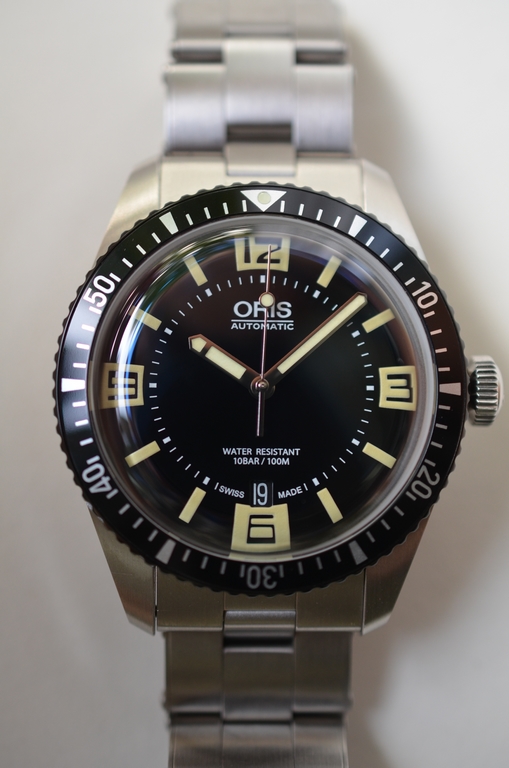
Figure 1. Oris Divers Sixty-Five, ref. 01 733 7707 4064-07 8 20 18, an example of a finished watch with three central hands and a date window at 6 o’clock. Photograph by Wiki Peter Jan, taken on 19 October 2018. Image unchanged. Wikimedia Commons, “Oris Divers Sixtyfive.jpg” CC BY-SA 4.0

Oris lists the pictured watch as using calibre 733, with a case fitting diameter of 25.60 mm, a frequency of 4 Hz and a power reserve of 38 hours. The photograph’s description on Commons identifies the 733 as based on the SW200-1. A 40 mm stainless-steel case houses its three central hands and date window, pairing the movement’s functions with a rotating bezel and a dial with large numerals. 89
The 2026 manual for Christopher Ward’s C63 Sealander Automatic documents its use of the SW200-2 Power+. The company specifies a decorated Elaboré grade, a rotor engraved with its twin-flags emblem, 26 jewels, 4 Hz, a power reserve of 60–65 hours and a daily rate of −5 to +12 seconds. It identifies the generation of movement alongside the finished watch’s performance and decoration. 10
The SW200 series supplies an automatic movement alongside casing drawings, grade specifications and servicing documentation. From the original SW200’s first deliveries through the SW200-1’s tooth profiles and improved component location to the SW200-2’s longer running time, the series shows how the internal mechanism continues to change while supporting a wide variety of watch designs. 234
Chronology#
| Date | Event |
|---|---|
| Summer 2003 | García acquires Sellita’s business, according to Le Temps. 4 |
| May 2005 | The report of 7 May announces the first SW200 deliveries. 4 |
| August 2008 | Technical notice No. 05 gives 19 August as the date of the tooth profile change from SW200 to SW200-1. 2 |
| February 2013 | Notice No. 03 of 7 February explains improvements to pallet bridge location and its screw arrangement. 6 |
| April 2013 | Notice No. 05, revised on 8 April, describes the tooth profiles and specifies replacement of three parts together. 2 |
| September 2024 | SW200-1 technical documentation, rev. 07, dated 2 September, lists a minimum 38-hour and typical 41-hour power reserve and specifications by grade. 1 |
| August 2026 | Notice No. 33, revised on 26 August, compares changes to the SW200-2 train, barrel and regulating organ, among others. 3 |
| November 2026 | The official information checked on 14 November lists a typical 65-hour power reserve for the SW200-2 Power+. The C63 manual also gives specifications for the fitted movement. 710 |
References#
- Sellita Watch Co S.A., Technical documentation: SW200-1, revision 07, 2 September 2024, pp. 3–7, 10–20 and 28. Accessed 14 November 2026.
- Sellita Watch Co S.A., Specific Information No. 05: Evolution SW200 → SW200-1, dated 19 August 2008, revised 8 April 2013, two pages. Made available by Cousins UK. Accessed 14 November 2026.
- Sellita Watch Co S.A., Specific Information No. 33: Evolution SW200-1 → SW200-2, revised 26 August 2026, eight pages. Accessed 14 November 2026.
- Michel Jeannot / BIPH, “Sellita commence à livrer ses premiers mouvements”, Le Temps, 7 May 2005. Accessed 14 November 2026.
- Sellita Watch Co S.A., Catalogue 2024–2025, English edition, pp. 11–14. Accessed 14 November 2026.
- Sellita Watch Co S.A., Specific Information No. 03: Pallet Bridge SW200-1, 7 February 2013. Made available by Cousins UK. Accessed 14 November 2026.
- Sellita Watch Co S.A., SW200-2 Power+ launch announcement and official movement list, checked 14 November 2026.
- Oris, “Divers Sixty-Five — 01 733 7707 4064-07 8 20 18”, official product information. Accessed 14 November 2026.
- Wiki Peter Jan, “Oris Divers Sixtyfive.jpg”, photograph and description, taken 19 October 2018, Wikimedia Commons. Accessed 14 November 2026.
- Christopher Ward, C63 Sealander Automatic, 2026 manual, PDF pp. 3–4. Accessed 14 November 2026.