This article was translated from Japanese using AI. Read the Japanese original
The Chinese Standard Movement is a common mechanical wristwatch design adopted by many Chinese watch factories in the 1970s. The Chinese name 统一机芯 is shortened to 统机, or Tongji. The basic design is a three-hand, hand-wound movement, and factories developed variants with different jewel counts and displays. Making a common movement across the country helped increase the supply of wristwatches and made them easier to repair. 12
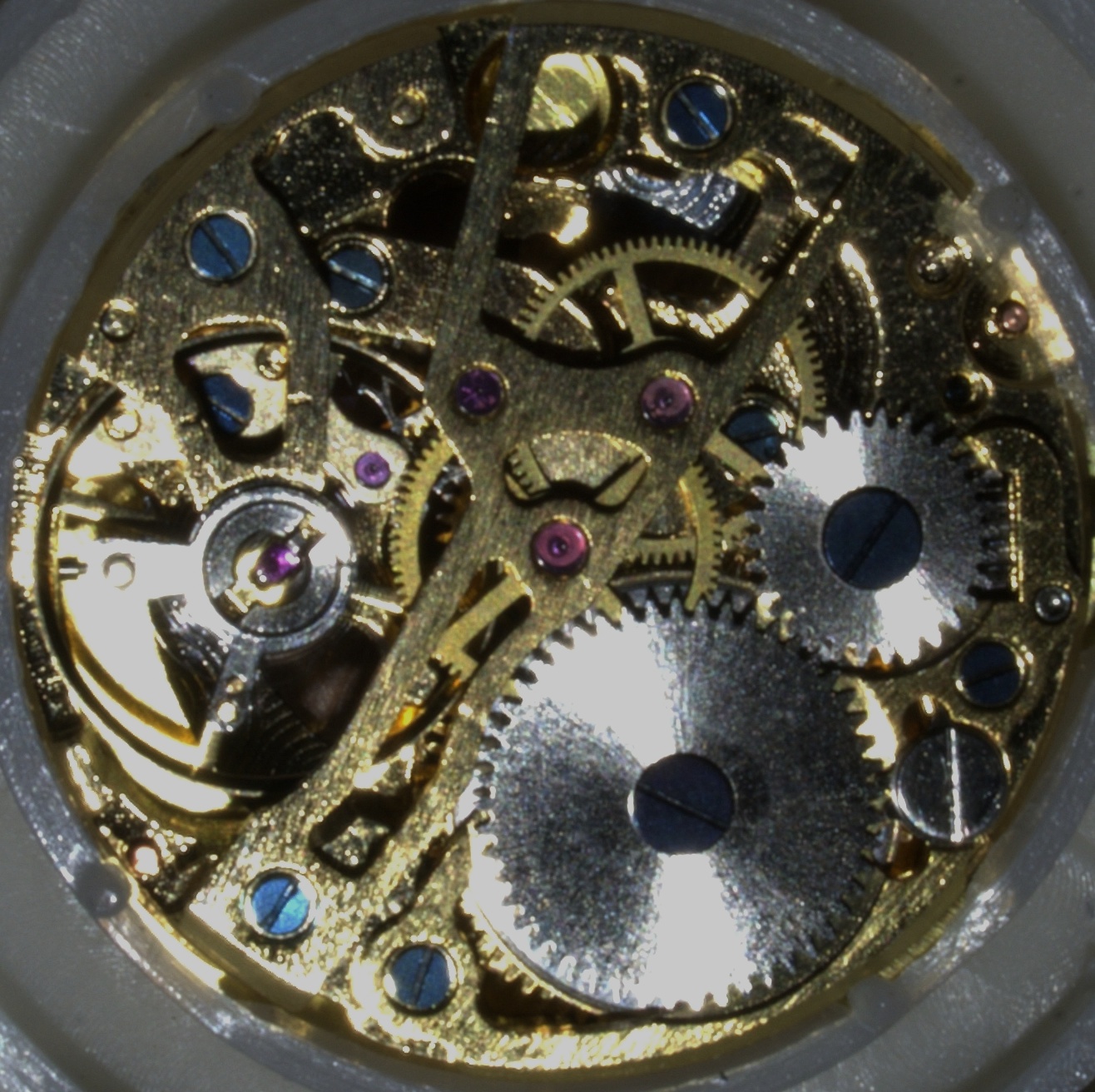
Figure 1. Standard Movement.jpg, an example of the Chinese Standard Movement. The balance is at lower left, and gears and bridges are visible from the centre to the right. Photograph by Horst Günther Burkhardt III, 24 September 2008. Source Wikimedia Commons. Licence CC BY-SA 3.0. Reproduced unchanged.

A design shared by factories in different cities#
A history published by the China Horologe Association records that the Ministry of Light Industry set up a national design group in 1970 for a standard men’s wristwatch movement. The aim was to move from separate factory designs to a common movement that kept accurate time, had a simple construction and lent itself to manufacturing and repair. 2
Regional factories participated in the joint design. The horology section of the Shandong provincial gazetteer records that Qingdao Watch Factory joined the design work in 1970. It describes a design with relatively few parts, component interchangeability and a daily rate within ±30 seconds. It also records an award at the 1978 National Science Conference. The daily rate reflects the gazetteer’s account of the design and products of the period. 3
Another article hosted by the China Horologe Association dates completion of the drawings to 1971. Taken together, the accounts place the start of the national design effort in 1970 and the completion of drawings in 1971. The second account says that Tianjin’s ST5 developed alongside the standard movement, showing that local designs continued. 4
From a hand-wound three-hand movement to variants#
The Watch Movements Archive, which documents surviving examples, describes the basic Chinese Standard Movement as hand-wound with 17 jewels and no date. A crown-wound movement with central hours, minutes and seconds provided a base for adding a date display or automatic winding. 1
The date movement recorded by the archive measures 12 lignes and has a Swiss lever escapement, centre seconds and a rate of 21,600 half-oscillations per hour. That is six half-oscillations per second, or three full oscillations per second (3 Hz). The date display is on the dial side and fits inside the case with the timekeeping train and regulator. 1
| Feature | Details documented in surviving examples |
|---|---|
| Winding | The basic form is hand-wound by the crown. |
| Display | Central hours, minutes and seconds. Some variants add a date. |
| Escapement | Swiss lever in the date example. |
| Frequency | 21,600 half-oscillations per hour, or 3 Hz, in the same example. |
| Jewels | 17 in the basic form and 19 in the Shanghai repair example. |
| Variants | Date, automatic, and automatic with date. |
The figures correspond to the specific movements in the archive and the repair account. Jewel counts and additional functions vary among factory variants. 15
Following the motion through the bridges and gears#
The Shanghai 7120 that watch repairer Christian disassembled in 2012 is a 19-jewel Tongji. The article identifies the two extra jewels at the barrel. Its photographs show the removal of the balance cock, followed by the train bridge, escape-wheel bridge and pallet bridge. 5
The barrel supplies energy from the wound mainspring and the train transmits it to the escapement. The pallet fork and escape wheel transfer energy in small steps in time with the oscillating balance, regulating the advance of the train. The disassembly shows how separate bridges support the main parts. With the dial removed, a spring that holds the date ring in position is also visible, showing the placement of the calendar on the dial side. 5
Common parts and factory variants#
Interchangeable parts helped factories work together and made repairs easier. The calendars and automatic winding mechanisms added later included factory-specific designs. The Watch Movements Archive notes that parts in these independently added devices are not interchangeable between movements from different factories. 1
The archive shows photographs of surviving automatic movements with rotors and lists versions with and without a date separately. Its overview gives a range of 17 to 40 jewels for automatic variants. For any one movement, check the jewel count against its markings and construction. 67
The Shanghai 7120 repair shows how one local variant used 19 jewels and a calendar. The 7120 is the model name of the Shanghai watch in that account. Tongji refers to the wider common design and its variants. 5
What surviving movements document#
A common design made it possible to build the same basic mechanism in large numbers and use it in finished watches assembled in different places. The record of Qingdao’s participation and the Shanghai teardown document the design at two scales, from national industrial planning to individual gears, bridges and bearing jewels. 35
Surviving movements also show differences in manufacture and specifications. In an October 2025 account of a visit to Beijing, collector Ron Good reports that a watch given to him by watchmaker Xu Yaonan was marked 17 jewels on its dial but held a 20-jewel Tongji. This example shows why dial markings should be checked against the movement. 8
The Watch Movements Archive records published in 2024 document examples with date, automatic winding, and both functions. The Tongji’s history runs from shared design in the 1970s through additions made by individual factories to the repair and collection of surviving movements. The movements make industrial standardisation visible in actual objects. 167
Timeline#
| Year | Event |
|---|---|
| 1970 | The Ministry of Light Industry organises a national design effort. Qingdao Watch Factory takes part. 23 |
| 1971 | An article hosted by the China Horologe Association dates completion of the drawings to this year. 4 |
| 1978 | The Shandong gazetteer records an award at the National Science Conference. 3 |
| 2012 | Christian documents the disassembly of a 19-jewel Tongji in a Shanghai 7120. 5 |
| 2024 | The Watch Movements Archive publishes records of date, automatic and other variants. 167 |
| 2025 | Ron Good reports on a surviving 20-jewel Tongji in Beijing. 8 |
References#
All sources accessed 14 November 2026.
- Andreas Kelz, Chinese Standard Movement (统机 Tongji) Date, Watch Movements Archive, 28 January 2024. Photographs, classification, specifications and variants.
- Bai Yingze (白映泽), “70 Years of Fashion: ‘Your Watch Looks Great!’ A Phrase That Runs Through China’s History of Wearing Watches”, hosted by the China Horologe Association, 27 August 2019, originally published by Tencent Fashion. Background to the national design effort.
- Shandong provincial gazetteer, “Clocks and Watches,” Science and Technology volume, public archive. Preserved copy of the former provincial database. Qingdao’s participation, assessment of the movement and the award.
- Yinghao Production (瀛昊制作), “A Dongfeng More Than 40 Years Old and the Story of Its Movement”, hosted by the China Horologe Association, 12 July 2018, originally published by 六塊表. Completion of the drawings in 1971 and parallel development of the ST5.
- Christian, Shanghai Shoubiao Chang 7120 – Part 1: Teardown, Watch Guy, 27 January 2012. Photographs of the 19-jewel movement, barrel area, train and date mechanism.
- Andreas Kelz, Chinese Standard Movement (统机 Tongji) Automatic, 28 January 2024. Surviving example of an automatic variant.
- Andreas Kelz, Chinese Standard Movement (统机 Tongji) Automatic + Date, 13 June 2024. Surviving example of an automatic variant with date.
- Ron Good, 2025 Oct 27 with Xu Yaonan, AMCHPR, 2025. Report on a 20-jewel movement seen during a visit to Beijing.