This article was translated from Japanese using AI. Read the Japanese original
What is the centre of oscillation?#
In a pendulum whose mass is distributed through a rod and bob, the centre of oscillation marks the length of a simple pendulum with the same period. It is also spelled center of oscillation. The French is centre d’oscillation, and Huygens’s Latin term was centrum oscillationis. If a uniform slender rod hangs from one end, for example, its centre of mass is halfway along the rod and its centre of oscillation is two-thirds of its length from the pivot. 1 2
The centre of mass describes how a body’s weight balances, and the centre of oscillation concerns the time needed for a full swing back and forth. Measuring from the pivot to the centre of a clock pendulum’s bob leaves out the mass of the rod and the size of the bob. The centre of oscillation accounts for the mass distribution in one equivalent length. 1 2
The term here relates to the gravity-driven physical pendulum. It differs from the midpoint of a balance’s angular swing and from the geometrical centre of a clock part. It depends on the body, the suspension axis and the direction of swing. 1
A point mass and an extended pendulum#
An ideal simple pendulum has a point mass on the end of a massless string of fixed length. A real pendulum has a rod with mass and a disk or spherical bob that rotates with it. Treating such a pendulum as a rigid body with fixed internal distances gives a compound, or physical, pendulum. Huygens distinguished the two in Part IV, Definitions III and IV of Horologium Oscillatorium. 1
The centre of oscillation lies on a line perpendicular to the suspension axis through the centre of mass. When the pendulum hangs at rest in stable equilibrium, it lies below the centre of mass on the line from the pivot. It can lie outside the body and needs no physical mark or screw. Definition IX in Part IV places it at the distance from the axis equal to the length of a simple pendulum with the same period. 1
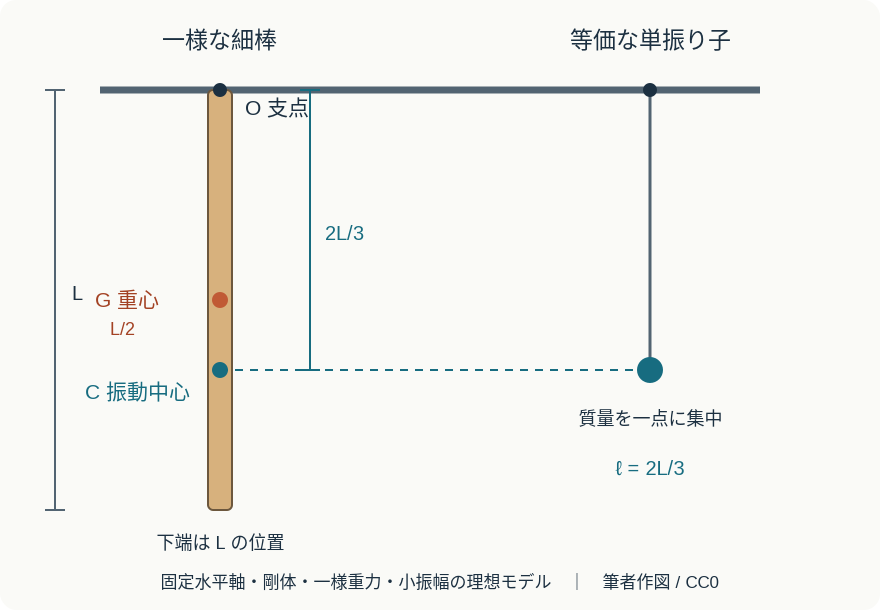
Figure 1. Uniform slender rod suspended at one end. The rod on the left has length L and the simple pendulum at right has length 2L/3, giving equal small-amplitude periods. The lower end of the rod, centre of mass G and centre of oscillation C are at different positions. Diagram by the author, 2026, unchanged. For the equation see 2. CC0 1.0
Calculating equivalent length#
Assume a fixed horizontal axis, a rigid pendulum and uniform gravity. The model neglects air resistance, bearing friction, suspension-spring elasticity and force from the escapement. The distance from pivot O to centre of mass G is \( d>0 \), the total mass \( M \) and the moment of inertia about the pivot axis \( I_O \). The moment of inertia measures resistance to a change in angular speed and increases as mass is placed farther from the axis. 2 3
With \( \theta \) the angle in radians from the downward equilibrium position, \( t \) time and \( g \) gravitational acceleration, the gravitational torque gives the following equation.
At a small amplitude, use \( \sin\theta\simeq\theta \) to obtain the period of one complete oscillation.
Comparing this with the small-amplitude period \( T_0=2\pi\sqrt{\ell/g} \) of a simple pendulum gives the length with the same period.
This equivalent length \( \ell \) is the distance from pivot O to centre of oscillation C. If mass is in kg, distance in m, moment of inertia in kg m² and gravitational acceleration in m/s², the length is in m and the period in s. Since \( T_0 \) denotes a complete oscillation, a seconds pendulum that takes one second to swing each way has a period of about two seconds. 2 3
Why it lies below the centre of mass#
Write the moment of inertia about an axis through the centre of mass parallel to the suspension axis as \( I_G=Mk^2 \). The length \( k \) is the radius of gyration, which describes how mass is spread. The parallel-axis theorem gives the relation below.
The distance from the centre of mass to the centre of oscillation is therefore \( k^2/d \). The spread of the rigid body’s mass about its axis places the centre of oscillation below the centre of mass. The modern notation for moment of inertia expresses Huygens’s geometrical argument. 1 3
Moving the pivot towards the centre of mass need not speed up the swing. Reducing \( d \) also reduces the restoring gravitational torque and increases \( k^2/d \). If the pivot passes through the centre of mass, \( d=0 \), gravity gives no restoring torque in this model and the period equation above does not apply. 2
Comparing a rod and a sphere#
For a uniform slender rod of length \( L \) suspended at one end, \( I_O=ML^2/3 \) and \( d=L/2 \), giving \( \ell=2L/3 \). For a 1 m rod, the centre of mass is 0.5 m from the pivot, the end is 1 m away and the equivalent length is about 0.667 m. 1 2
As another example, rigidly fix a uniform sphere of radius \( R \) to the end of a rod of negligible mass. Let \( d \) be the distance to the sphere’s centre. If the sphere rotates with the rod, its moment of inertia about its centre of mass is \( 2MR^2/5 \). The equivalent length is then as follows.
This applies the parallel-axis relation to the sphere. With \( d=1.000\,\mathrm{m} \) and \( R=0.050\,\mathrm{m} \), the equivalent length is 1.001 m, or 1 mm below the centre. A sphere on a flexible string may rotate independently of the string, in which case the assumptions behind the equation need to be checked. 1 3
Interchanging pivot and centre of oscillation#
A key property is reversibility. Turn the body upside down and suspend it about an axis through the original centre of oscillation, parallel to the original axis. The original pivot becomes the new centre of oscillation, with the same period at the same small amplitude. Huygens described this reciprocal relationship in Part IV, Proposition XX. 1
In the equations above, the new distance from pivot to centre of mass is \( d'=k^2/d \), giving this new equivalent length.
For a uniform rod, inverting it and suspending it from the point 2L/3 from the original end gives the same period as suspension from that end. Reversibility made it possible to find equivalent length by comparing periods without measuring the full mass distribution. 2 4
Kater’s reversible pendulum#
Henry Kater made a pendulum with two knife edges on opposite sides of its centre of mass and used a movable weight to bring the periods about the two axes into agreement. At the start of his 1818 paper, he describes the difficulty of making a rod of uniform density and shape before turning to reversibility. He carried out the experiments in 1817, and the paper was read at the Royal Society on 29 January 1818 and published that year. 4 5
For two pivots on opposite sides of the centre of mass at distances \( d_1,d_2 \), the condition for equal small-amplitude periods is the relation below.
If \( d_1\ne d_2 \), then \( d_1d_2=k^2 \) and the separation \( D=d_1+d_2 \) equals the equivalent length. If the pivots are equidistant from the centre of mass, equal periods alone do not give that result. The university laboratory manual specifies that the two distances must be sufficiently different. 3
Under these conditions, the period and pivot spacing give \( g=4\pi^2D/T_0^2 \). Matching two periods lets the experimenter measure the distance between pivots directly, without locating the centre of oscillation by calculating the exact centre of mass and density of every part. Precision experiments apply further corrections for differences between the periods and effects of knife edges, temperature and air. 3 4
The reversible pendulum was proposed before Kater. A Smithsonian study discusses de Prony’s unpublished proposal and Bohnenberger’s 1811 publication separately from the making and testing of Kater’s apparatus. 6
Effects on clock adjustment and measurement#
One reason Huygens investigated the centre of oscillation was to adjust a clock with a movable weight in addition to the main bob. Moving the extra weight changes both the distance to the centre of mass and the moment of inertia. The shift in the centre of mass alone cannot determine the new period. Part IV of Horologium Oscillatorium opens with both adjusting clocks and defining a standard length. 1
Even an ideal pendulum moving in a circular arc has a longer period at larger amplitudes for a given equivalent length. Comparing two pendulums therefore requires matching the amplitude conditions. 3
In a real pendulum, thermal expansion of the rod and changes in mass distribution, elasticity of the suspension, motion of the support, buoyancy and air resistance, and escapement forces all matter. A measurement pendulum on rigid knife edges has a different pivot model from a clock pendulum on a thin suspension spring. Kater’s original paper includes corrections for temperature and buoyancy. Later gravity measurements examined the effects of supports and air in greater detail. 4 6
Temperature compensation with a mercury pendulum or gridiron pendulum combines the expansion of parts to limit changes in the equivalent length that sets the period. A cycloidal pendulum addresses a separate problem, the relationship between amplitude and period.
Relationship to the centre of percussion#
For the same rigid body, pivot and planar motion, consider a short impulse perpendicular to the line joining the pivot and centre of mass. The place where it produces no impulsive reaction at the pivot in that direction is also at \( I_O/(Md) \). This is the centre of percussion. Its position coincides with the centre of oscillation under the ideal conditions. One concerns the gravitational period and the other the response to an impulse. Gravity and bearing loads still act. 2
From early studies to the present#
| Period | Documented developments |
|---|---|
| Mid-seventeenth century | Mersenne poses the problem of finding a simple pendulum with the same period as an extended pendulum. Huygens describes it as an earlier problem at the start of Part IV. 1 |
| November–December 1664 | Huygens’s proposal involving a spherical pendulum’s centre of oscillation and a standard of length is presented and tested at the Royal Society. The record distinguishes the letter’s drawing, meeting and experiment. 7 |
| 1673 | Part IV of Horologium Oscillatorium treats the centre systematically, with the definition in Definition IX and reversibility in Proposition XX. 1 |
| Late eighteenth century to 1811 | De Prony makes an unpublished proposal, and Bohnenberger publishes an account of measurement by a reversible pendulum in 1811. 6 |
| 1817–1818 | Kater makes and tests his apparatus and publishes the method and results in 1818. 4 5 |
| Nineteenth century | Studies of gravity measurements consider reversible pendulum corrections for the support, buoyancy and amplitude. 6 |
| 1983 and 2018 | The definition of the metre moves to a basis in the speed of light and its wording is later revised. The modern standard is independent of the length of a seconds pendulum. 8 |
| Present | University physics demonstrations and laboratories use the concept to connect mass distribution, equivalent length and gravity measurements. 2 3 |
The centre of oscillation is a mechanics concept for comparing pendulums. It connects time measurement to the mass distribution of the full body. A real clock’s period also depends on materials, the pivot and amplitude.
References#
1. Christiaan Huygens, Horologium Oscillatorium (1673), Pars quarta, Definitions III, IV and IX, Propositions XVII–XXII, pp. 330–333 for the sphere. Reproduced in Œuvres complètes, XVIII (1934), pp. 242–359. Latin text and French translation at DBNL.
2. University of California, Santa Barbara, Lecture Demonstration 28.38, “Center of percussion”. Physical pendulum equation of motion, equivalent length, uniform rod and reversibility.
3. Medford Webster, Bob Patchin, Michael Turner, John Wikswo and Jim Waters, Kater’s Pendulum, 1988, revised 12 September 2003, pp. 1–4, equations 1–15. Mechanical derivation. PDF hosted by the University of Pisa.
4. Henry Kater, An Account of Experiments for Determining the Length of the Pendulum Vibrating Seconds in the Latitude of London, 1818, offprint pp. 1–3 and 30–32. ETH-Bibliothek, Rar 15265, PDF pp. 10–12 and 39–41. Original and persistent link.
5. Royal Society Archives, PT/12/4, Kater’s manuscript record. Distinguishes the July 1817 manuscript, reading on 29 January 1818 and publication in 1818.
6. Victor F. Lenzen and Robert P. Multhauf, “Development of Gravity Pendulums in the 19th Century,” United States National Museum Bulletin 240, Paper 44, Smithsonian Institution, 1966, especially pp. 304–305 and 314–320. Full transcription at Project Gutenberg.
7. Royal Society Picture Library, “Determining the centre of oscillation”, LBO/1/78, p. 227. Drawing and meeting in November 1664 and experiment in December. The image is not reproduced here.
8. Bureau International des Poids et Mesures, “Historical perspective: Unit of length, metre”. Definitions of 1983 and 2018.
Online sources accessed on 7 November 2026.