This article was translated from Japanese using AI. Read the Japanese original
What is the centre of percussion?#
The centre of percussion is the point where a brief sideways blow to an object free to rotate about a pivot produces no impulse at the pivot in the direction of the blow, under idealised conditions. It is also spelled center of percussion in English and is called centre de percussion in French. Its position depends on the pivot, direction of impact and mass distribution. 1 2
In horology, the term is used when locating the point where the locking part of a detent escapement hits its banking stop on returning. It is also related to the centre of oscillation, which gives the length of a simple pendulum with the same period. Both concepts describe the motion of the whole object. They can refer to points where there is no material, and no mark on a part is required. 1 3
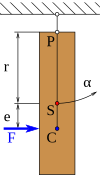
Diagram showing pivot P, centre of mass S and force F applied at the centre of percussion C. Creator: Alva2004. Source: Wikimedia Commons. Licence: CC BY-SA 4.0. Unmodified.

Impact and the reaction at the pivot#
A blow delivered sideways to a bar extending from a pivot tends to translate the whole bar and rotate it about its centre of mass. Because the pivot constrains the bar, it generally exerts a brief reaction force. A blow at the right point makes the effects of rigid-body translation and rotation balance at the pivot, giving zero reaction impulse in the direction of the blow. In a Harvard University demonstration, a suspended bar is struck at this point and at another point to compare what happens at the pivot. 2
The result applies at the instant of impact. Gravity and bearing loads still act, and zero reaction impulse does not mean that the energy of the blow disappears. Real objects deform, and contact lasts for a finite time and involves friction and vibration. 2
What determines the position#
Let M be the mass, d the distance from the pivot to the centre of mass and I the moment of inertia about the pivot. In a plane-motion model, strike the line joining the pivot and centre of mass at right angles to that line. The distance from the pivot to the centre of percussion is I / (M d). The moment of inertia depends on the mass and on how far each part lies from the pivot. Knowing the centre of mass alone does not locate the centre of percussion. 1
For example, a slender uniform bar pivoted at one end has its centre of mass halfway along its length. Its centre of percussion is two-thirds of its length from the pivot. Adding mass to the tip or moving the pivot changes the result. 1 2
Relationship to the centre of oscillation#
When the same rigid body swings through a small angle under gravity, one can calculate the length of a simple pendulum with all its mass at one point and the same period. The point that distance from the pivot is the centre of oscillation. In the model above, the distance is also I / (M d), so the centre of oscillation and centre of percussion coincide. A University of California, Santa Barbara demonstration derives the relationship by comparing the periods of a pivoted object and a simple pendulum. 1
Under the same idealised conditions, interchanging the pivot and centre of oscillation leaves the small-amplitude period unchanged. The two points are said to be conjugate. For a clock pendulum, this helps distinguish the measured distance to the centre of the bob from the equivalent simple-pendulum length. A real clock’s rate also depends on flexing of the suspension spring, air resistance and amplitude, so the simple expression alone is insufficient. 1
Christiaan Huygens treated the centre of oscillation in his theory of the pendulum clock. A 1664 drawing held by the Royal Society shows a proposal to determine the centre of oscillation of a sphere on a fine thread and use it to establish a universal standard of length. The editors of Huygens’s collected works explain the relationship between the impact problem and the centre of oscillation, and note that in Horologium Oscillatorium he used the latter term. 4 5
The chronometer detent#
In a detent escapement (article in Japanese), the unlocking jewel on the balance moves the passing spring and lifts the detent’s locking jewel clear of an escape-wheel tooth. The detent then returns to a stop, called the banking, which sets its position so it can catch the wheel again. The banking position determines both the limit of travel and the behaviour of the detent as it returns. 3
In his account of the chronometer escapement, Claudius Saunier stressed locating the banking at the centre of percussion. He writes that when correctly placed, the banking arrests the detent on impact. If it is away from the theoretical point, the detent can tremble and engage the escape-wheel tooth while its pressure against the banking varies. He notes that the length of the detent and the distribution of material in its moving parts affect the position of the centre. 3
Jürgensen’s recommendation, reported in the same book, was to place the banking screw as close as possible to the centre of percussion. In Moinet’s example, the screw and locking jewel sit about a quarter of the detent’s length from its end, as an approximation of the centre of percussion. 3
Saunier also suggests starting from a position calculated from measured dimensions and using a magnifier to look for trembling after impact. He recommends checking with the movement in different positions, including horizontal and vertical. The support for the stop would wear at the contact point if it lacked resilience, he argues, and vibrate on each impact if it were too thin. He leaves the choice of dimensions to experience. 3
The spring detent Saunier describes is elastic, with geometry and contact conditions different from those of a simple rigid pendulum. The ideal model helps explain the placement. Actual adjustment still depends on the elasticity of the finished part, contact with the banking and the relationship between the locking jewel and tooth. 3
References#
1. University of California, Santa Barbara, “28.38 — Center of percussion”, demonstration notes (accessed 3 November 2026).
2. Harvard Natural Sciences Lecture Demonstrations, “Center of Percussion”, demonstration notes (accessed 3 November 2026).
3. Claudius Saunier, Treatise on Modern Horology, English translation, chronometer escapement, §§ 806–807 and 842–844, printed pp. 479 and 496–497, PDF (accessed 3 November 2026).
4. Royal Society Picture Library, “Determining the centre of oscillation”, copy of a 1664 letter, LBO/1/78, catalogue description (accessed 3 November 2026).
5. Christiaan Huygens, Œuvres complètes, vol. XVI, “Travaux divers de statique et de dynamique de 1659 à 1666”, editors’ commentary, DBNL text (accessed 3 November 2026).