Chronometers and Their Tests#
This article was translated from Japanese using AI. Read the Japanese original
A chronometer is a timepiece intended to keep time precisely. The term applies both to portable precision timekeepers used in navigation and to modern wristwatch movements that have passed prescribed tests. Its meaning varies by period and system. To understand what was measured, by whom and under what conditions, check the particular test. A chronograph measures elapsed time, and a watch can be both a chronograph and a chronometer. 1 2 9
From marine timekeepers to testing#
Finding longitude at sea requires the difference between the local time at the point of observation and the time at a reference location. With one rotation of the Earth taken as 24 hours, a time difference of one hour corresponds to 15 degrees of longitude. A clock that kept reference time through a long voyage made this comparison practical. Its error affected the calculated longitude, so it was important to compare it against a reference and establish its rate before sailing. 3
At the request of the Board of Longitude, the Greenwich Observatory tested John Harrison’s H4 in 1766. 10 The observatory also took on the administration of chronometers for the Navy, and in 1821 Astronomer Royal John Pond was appointed to supervise them. Measurements at the observatory provided a basis for comparing individual rates and selecting instruments for navigation. 4
Comparisons at regular intervals show how much a timepiece gains or loses against reference time and how that changes. A timepiece that always gains at the same rate can be corrected if that rate is known. When the rate itself varies with position or temperature, future errors are harder to predict from earlier measurements. This is why testing looks at variation as well as average rate. 5
Observatory competitions and certification#
From 1872 to 1968 the Geneva Observatory judged chronometer adjustment competitions intended to compare the precision achieved by watchmakers. The university still holds the competition records. By comparing watches against reference time obtained from observations, the observatory also became a place where watchmakers’ regulating skills were assessed. 6
The Neuchâtel Observatory also determined and distributed time and tested timepieces. It linked time signals derived from astronomical observations to the measurement of timepiece rates. 11
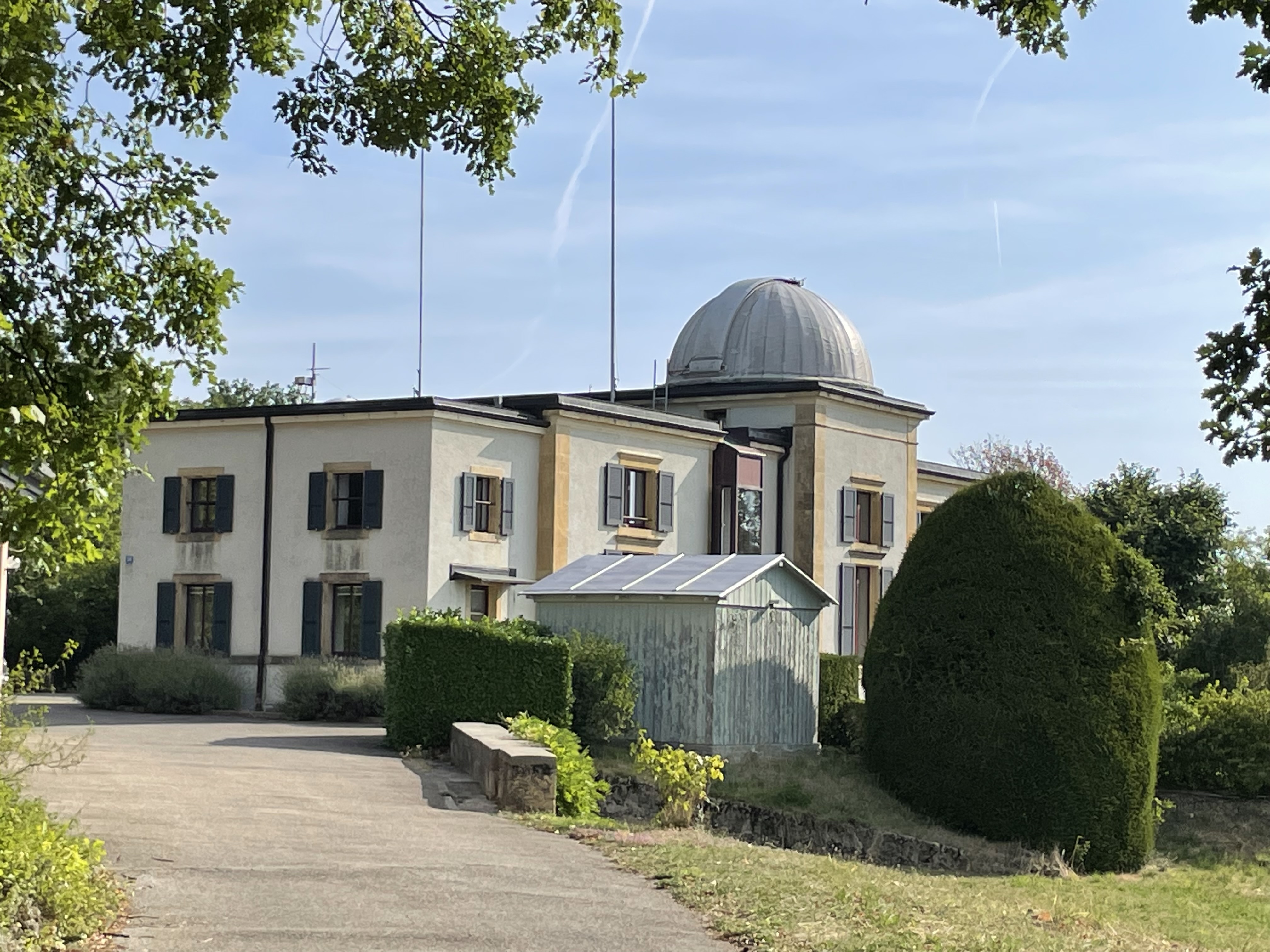
Main building of the Neuchâtel Cantonal Observatory, photographed in 2022. Photograph by OPAN. Source Wikimedia Commons. Licence CC0 1.0. Reproduced unchanged.

Competition rankings compare the entries with one another. Certification checks whether an entry meets prescribed criteria.
The Swiss official chronometer testing institute, COSC, was founded in 1973. Testing bodies and standards vary by country and period. When reading a certificate, check the issuing body, the item tested, the standard and the date of testing. 7
Modern mechanical wristwatch tests#
ISO 3159 covers wrist chronometers with a balance and balance spring. 8 For wristwatch movements with a balance and balance spring, the Geneva Chronometric Observatory lists 15 days of testing in five positions and at 8, 23 and 38 °C. Changes of position affect bearing loads and friction, and temperature affects springs and other parts. Testing across these conditions reveals variations that a single environment would miss. 5
The seven main criteria listed by the observatory are mean daily rate, mean variation in rates, greatest variation in rates, difference between horizontal and vertical positions, greatest deviation, variation with temperature and resumption of the rate after testing. The mean daily rate criterion is −4 to +6 seconds per day. This range applies to the average of the specified measurements. Check the applicable conditions for smaller movements or other categories. 5
For example, a watch that gains three seconds against a reference clock on each of two days has a mean daily rate of +3 seconds and little variation. A watch that loses five seconds on the first day and gains 11 on the second has the same mean of +3 seconds, with a much larger day-to-day change. The calculation illustrates the difference between average rate and stability.
Finished watches and accuracy in use#
Master Chronometer certification by the Swiss Federal Institute of Metrology (METAS) applies to Swiss Made mechanical watches. Alongside the movement’s compliance with chronometer criteria, it evaluates the finished watch in different positions, at different temperatures, under magnetic exposure and at different states of wind. It also tests power reserve and water resistance. METAS audits the manufacturer’s test programme and carries out on-site sampling. 8
Certification documents performance under the test conditions. A wearer’s activities, where and how the watch rests, temperature, magnetism, state of wind, and changes from use and servicing all vary. The rate in actual use also helps to assess the condition of the individual watch.
Timeline#
| Date | Event |
|---|---|
| 1766 | Harrison’s H4 is tested at Greenwich Observatory. 10 |
| 1821 | Pond is appointed to supervise Navy chronometers. 4 |
| 1872–1968 | The Geneva Observatory judges chronometer adjustment competitions. 6 |
| 1973 | COSC is founded. 7 |
| Present | Mechanical movements and finished watches are tested under their respective systems. 5 8 |
References#
1. National Association of Watch and Clock Collectors, “Marine Chronometers.” Overview (accessed 4 November 2026).
2. Geneva Chronometric Observatory, “Certified Chronometer.” Test description (accessed 4 November 2026).
3. Smithsonian National Museum of American History, “Chronometer.” Collection item and explanation of longitude (accessed 4 November 2026).
4. Royal Museums Greenwich, “History of the Royal Observatory and the Astronomers Royal.” Research guide (accessed 4 November 2026).
5. Geneva Chronometric Observatory, “Certified Chronometer,” test conditions and seven criteria. Text (accessed 4 November 2026).
6. University of Geneva, “The Chronometry Service at the Geneva Observatory.” Competitions and records (accessed 4 November 2026).
7. Geneva Chronometric Observatory, “Geneva.” History of chronometry in Geneva (accessed 4 November 2026).
8. Federal Institute of Metrology METAS, “Watch certification.” Certification requirements (accessed 4 November 2026).
9. Fondation de la Haute Horlogerie, “Chronograph.” Definition and mechanism (accessed 4 November 2026).
10. Royal Museums Greenwich, “Longitude found,” section “Testing continues at the Royal Observatory.” Testing H4 (accessed 4 November 2026).
11. Université de Neuchâtel, Institut d’histoire, “L’Observatoire cantonal de Neuchâtel (1858–1948).” Research overview (accessed 4 November 2026).