This article was translated from Japanese using AI. Read the Japanese original
A product traded before a watch is finished#
An ébauche, also spelled ebauche in English, is a watch movement supplied in an unfinished state for completion later. Ébauches have linked factories that make frames and wheels with businesses that fit the regulating organ, adjust the movement and finish a watch with a dial and a case. 1 2
The contents depend on the period and definition. The Fondation Haute Horlogerie (FHH) describes the older ébauche, used up to around 1850, as comprising plates, bridges, fusee and barrel, and says it was called a blanc. Its modern definition describes a movement, with or without jewels, that lacks a regulating organ, mainspring, dial and hands. Another name is blanc-roulant. 1
The 1984 AFNOR definition, recorded in the Office québécois de la langue française terminology database, emphasises how the parts are supplied, as a set of unassembled movement components sold in that state. To understand what changed hands, consider both the parts included and how far assembly had progressed. 3
From the mainplate to a complete movement#
Preparing the frame and train#
The mainplate forms the movement’s foundation, and bridges support parts above it. Wheels and other components fit inside this frame. In his study of Geneva watchmaking, Nicolas Georges Beaud describes historical ébauche production as making the frame of plates and bridges and mechanisms such as winding and setting. Specialist operations included cutting out, drilling, threading, milling, cutting teeth and polishing. 4
In Beaud’s account, an ébauche brute is a rough ébauche without a train. During finissage, workers pair wheels with pinions, form the teeth and fit the train in the frame. The escapement is then added, followed by adjustment, rechecking and casing. In this historical division of labour, what remained for the recipient to do depended on how far the ébauche had been worked. 4
| Part or operation | Role in manufacture and supply |
|---|---|
| Mainplate and bridges | Form the movement frame and support its mechanisms. |
| Train, winding and setting mechanisms | Provided according to the stage of machining and assembly of the ébauche. |
| Regulating organ and mainspring | Added later under the FHH’s modern definition of an ébauche. |
| Adjustment and inspection | Part of finishing a watch after its mechanisms have been assembled. |
| Dial, hands and case | Complete the display and exterior. The FHH excludes the dial and hands from its definition of an ébauche. |
The table compares the FHH definition with Beaud’s account of the manufacturing sequence. 1 4
Bringing specialist components together#
Escapement parts also have a unit of specialist supply. The FHH defines an assortiment as a set of three parts, the escape wheel, pallet fork and roller. It says that specialist firms generally supply lever escapement sets to watchmakers. Adding specialist parts and the regulating organ to an ébauche’s frame and train brings it closer to a complete movement. 5
An ébauche is a stage in manufacture and trade. Its name states no level of accuracy. For a complete watch, the relevant details include its regulating organ and how it was assembled, adjusted and tested. The FHH’s account of établissage starts with receipt and inspection of parts, then goes on to assembly, adjustment, fitting the dial and hands, casing, final inspection, packaging and shipping. 2
Ébauches in the établissage system#
Établissage is a manufacturing system in which parts are brought together to make watches or movements. The ébauche provided a way to transfer the basic mechanism as a unit. 1 2
Audemars Piguet describes the system as part of its own history. According to the company, family-run workshops made specialist parts in the nineteenth-century Vallée de Joux. Jules Louis Audemars and Edward Auguste Piguet worked as établisseurs, coordinating dozens of local workshops. They supervised adjustment, finishing, assembly and final testing as part of completing each watch. Bringing several workshops’ work together in one timepiece was an important manufacturing role in itself. 6
The company says it has developed into an integrated manufacture while continuing to value collaboration between specialists inside and outside the company. Looking at ébauches highlights how much of the parts manufacture a factory took on and how the parts were then brought together into a finished product. 6
From ébauche factories to industrial groups#
Fontainemelon and specialisation#
ETA’s official history says that four watchmakers set up the first ébauche workshop and business in its lineage in 1793 at Fontainemelon in the Neuchâtel region. The site gave rise to the later Fabrique d’horlogerie de Fontainemelon (FHF). 7 8
As ébauche supply became industrial, finished-watch makers could use specialist factories’ products, and the factories could concentrate on movements for particular uses. ETA says the companies later grouped under Ebauches SA specialised in categories such as simple men’s watches, chronographs and small women’s watches, allowing the group to supply a broad range. 7
Ebauches SA in 1926 and ASUAG in 1931#
According to the Historical Dictionary of Switzerland, A. Schild SA, FHF and A. Michel SA founded Ebauches SA in Neuchâtel in 1926 as a holding company for ébauches and watch parts. The French public heritage inventory dates the founding to 27 December and records that the ETA ébauche operation, separated from Eterna, joined the group in 1932. 8 9
Ebauches SA joined ASUAG in 1931. The Historical Dictionary of Switzerland says the company opposed exports of chablons, or unassembled movement parts, to prevent watches bearing Swiss markings from being manufactured abroad. Ébauche supply was both a parts business and a matter of industrial policy, involving decisions about where watchmaking operations would remain. 8
According to the same dictionary, in 1968–1969 Ebauches had 23 subsidiaries in Switzerland, three abroad and about 10,000 employees. Competition remained within the group, and a major wave of mergers started in 1978. ETA took over operations in 1982 and ASUAG and SSIH merged in 1983. ETA’s history dates the consolidation of the ébauche factories into one company to 1985. 7 8
Ébauches in surviving objects#
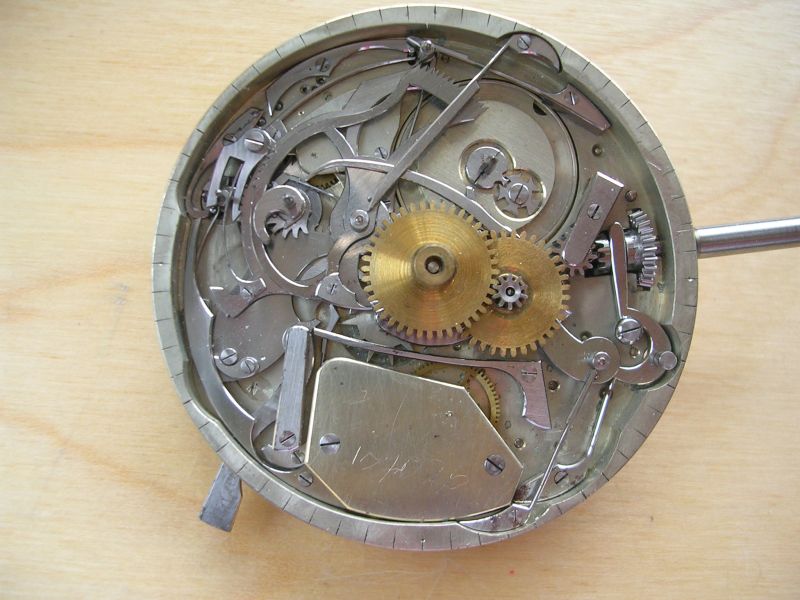
Figure 1. Movement described by the Commons file as an ébauche for a minute repeater from around 1900, probably made in Switzerland. Photograph by Jjcasalo, titled “Minute repeater movement 2”. No changes. Wikimedia Commons CC BY-SA 3.0

The term ébauche also applies to unfinished mechanisms for complicated watches. The photographer identifies the example illustrated here as a minute repeater ébauche from around 1900. A striking mechanism is already fitted to the base movement. The date and country of manufacture come from the file description. 10
Another example is an ETA 2873 mechanical movement listed in the Bourgogne-Franche-Comté regional heritage inventory. The inventory dates it to the 1970s or 1980s and describes an ETA 2873 ébauche fitted with a lever escapement and Incabloc shock protection. The mainplate bears the ETA mark below the balance, and the oscillating weight is also marked with the calibre designation. 9
Such records connect the supplied ébauche with the mechanisms fitted to it and the marks that remain after completion. They show how movement production was divided among firms, something the name on a watch dial may not reveal.
A continuing role#
ETA’s official company profile, checked in November 2026, describes the development and manufacture of quartz, mechanical and Swatch movements. A business descended from ébauche factories has expanded into complete movements and electronic watches. 7
The term ébauche conveys the relationship between specialist factories that make mainplates and trains and the firms that fit regulating organs and exterior parts to complete the watch. The early blanc, the set of unassembled parts and the movement without a regulating organ show how a division of labour persisted through changes in machining and supply.
Chronology#
| Period | Documented event or usage |
|---|---|
| 1793 | ETA’s history dates its originating ébauche workshop in Fontainemelon to this year. 7 |
| Up to around 1850 | The FHH describes the older ébauche of plates, bridges, fusee and barrel as a blanc. 1 |
| Nineteenth century | An établissage network of specialist workshops in the Vallée de Joux underpins Audemars Piguet’s production. 6 |
| c. 1900 | Date assigned to the illustrated minute repeater ébauche in its Commons file description. 10 |
| 27 December 1926 | A. Schild, FHF and A. Michel form Ebauches SA. 8 9 |
| 1931 | Ebauches SA joins ASUAG. 8 |
| 1932 | Eterna’s ébauche division becomes independent as ETA and joins Ebauches SA. 9 |
| 1968–1969 | Ebauches reaches 26 subsidiaries in Switzerland and abroad and about 10,000 employees. 8 |
| 1978–1985 | Mergers and operational integration consolidate the factories around ETA. 7 8 |
| 1984 | The AFNOR definition describes an ébauche as parts sold unassembled. 3 |
| Checked in November 2026 | FHH glossary and ETA company profile covering mechanical, quartz and other movement production. 1 7 |
References#
- Fondation Haute Horlogerie, “Ébauche”, glossary, undated. Entry. Accessed 13 November 2026.
- Fondation Haute Horlogerie, “Établissage”, glossary, undated. Entry. Accessed 13 November 2026.
- Association française de normalisation, “ébauche”, 1984, in Office québécois de la langue française, Grand dictionnaire terminologique. Definition. Accessed 13 November 2026.
- Nicolas Georges Beaud, La mécanisation de l’horlogerie genevoise (1750–1914), master’s thesis, University of Geneva, 2023. Annex 2, pp. 120–121 (PDF pp. 122–123), manufacturing sequence. PDF. Accessed 13 November 2026.
- Fondation Haute Horlogerie, “Assortiment”, glossary, undated. Entry. Accessed 13 November 2026.
- Audemars Piguet, “Watchmaking Savoir-faire”, company manufacturing history and skills, undated. Text. Accessed 13 November 2026.
- ETA SA, “History”, official company history and profile, undated. Text. Accessed 13 November 2026.
- German Vogt, translated by Eva Maier, “Ebauches”, Dictionnaire historique de la Suisse, revised 2 July 2009. Entry. Accessed 13 November 2026.
- Laurent Poupard, “Mécanisme d’horloge (mouvement de montre mécanique ETA 2873)”, Région Bourgogne-Franche-Comté, Inventaire du patrimoine, IM25005286, surveyed in 2014 and revised in 2015, pp. 1–2. PDF. Accessed 13 November 2026.
- Jjcasalo, “Minute repeater movement 2.jpg”, own photograph, 3 December 2005 (EXIF), Wikimedia Commons file description and rights. File page. Accessed 13 November 2026.