This article was translated from Japanese using AI. Read the Japanese original
What “11½’’’” means#
The ligne is a traditional French unit of length, also called a ligne in English, used to indicate the size of watch movements. One ligne is about 2.256 mm. Symbols include ''', ‴ and L. For example, 11½''' is read as eleven and a half lignes. The British Horological Institute’s teaching material describes it as indicating the maximum diameter of the mainplate for round movements and the maximum length and width for rectangular ones.1
Current product literature sometimes gives a traditional size designation alongside dimensions in millimetres. ETA’s 2016 collection of mechanical movements lists a diameter of 25.60 mm in the 11½''' group and 36.60 mm in the 16½''' group. The ligne gives readers an idea of the scale of the movement, and the millimetre figures give its design dimensions.2
From a base-twelve unit to millimetres#
Origin and conversion#
Horopedia describes the ligne as a unit of medieval origin equal to one twelfth of a pouce. It gives a value of 2.255 mm for the horological ligne. The BHI uses the approximate figure of 2.256 mm. The Auckland Museum record for a measuring instrument reproduced on Wikimedia Commons gives 2.255883 mm for the old French unit. The calculations here use the convenient approximation of 2.256 mm.1 3 4
Let n be a length in lignes and d the same length in millimetres. Using that approximation gives the following conversion.
d ≈ 2.256 × n
| Lignes | Converted length (approx. mm) |
|---|---|
| 1 | 2.256 |
| 8¾ | 19.740 |
| 11½ | 25.944 |
| 12½ | 28.200 |
| 16½ | 37.224 |
To convert a length in millimetres to lignes, divide by 2.256. The table gives direct conversions between the units. The following examples show why the nominal size in a product catalogue should be read alongside the actual dimensions.
Nominal sizes and product dimensions#
Comparing the size groups in ETA’s 2016 catalogue with the calculated values shows how the two relate.2
| ETA size designation | Catalogue diameter | Difference (catalogue value minus conversion) |
|---|---|---|
| 7¾’'' | 17.20 mm | approx. −0.284 mm |
| 8¾’'' | 19.40 mm | approx. −0.340 mm |
| 10½’'' | 23.30 mm | approx. −0.388 mm |
| 11½’'' | 25.60 mm | approx. −0.344 mm |
| 16½’'' | 36.60 mm | approx. −0.624 mm |
The differences were calculated from the catalogue values for this article. ETA’s figures in lignes serve as traditional size designations, while the conversion formula does not reproduce the exact diameter of each movement. For example, use the specified value of 25.60 mm when planning how to fit an 11½’’’ movement. The difference of about 0.34 mm is larger than the rounding difference between factors of 2.255 and 2.256, so carrying the factor to more decimal places would not remove it.
Reading diameter and thickness together#
Movements in the same ligne group can differ in thickness and display functions. In ETA’s catalogue the 11½’’’ ETA 2801-2 is 3.35 mm thick, while the ETA 2824-2 is 4.60 mm thick. The ligne gives the size of the movement in plan. Thickness and function give a fuller picture of the product.2
Japan’s MIYOTA also lists the size of calibre 9015 as 11½’’’ and the height as 3.90 mm on its official product page. Its movement search, checked on November 13, 2026, includes the small rectangular sizes 5½×6¾''' and 6¾×8''', and round sizes such as 8¾''' and 11½'''. These categories help users find movements by size across both mechanical and quartz ranges.5 6
Fitting a movement to a case requires knowing its diameter and thickness, the winding stem position, and the mounting dimensions for the dial and hands. The size in lignes gives an initial indication of the movement’s footprint. The diameter, mounting dimensions and height in the manufacturer’s drawing allow a more specific comparison within a size group.1 5
The douzième and a gauge for small thicknesses#
The ligne also survives in instruments for watch repair. A douzième is one twelfth of a ligne, about 0.188 mm with the conversion used here. A gauge dated to about 1890 by the Detroit Historical Society grips an object between two short jaws, and its long arm at the other end indicates thickness on a curved scale. The collection record gives its range as 0–72 douzièmes, or 0–6 lignes.7
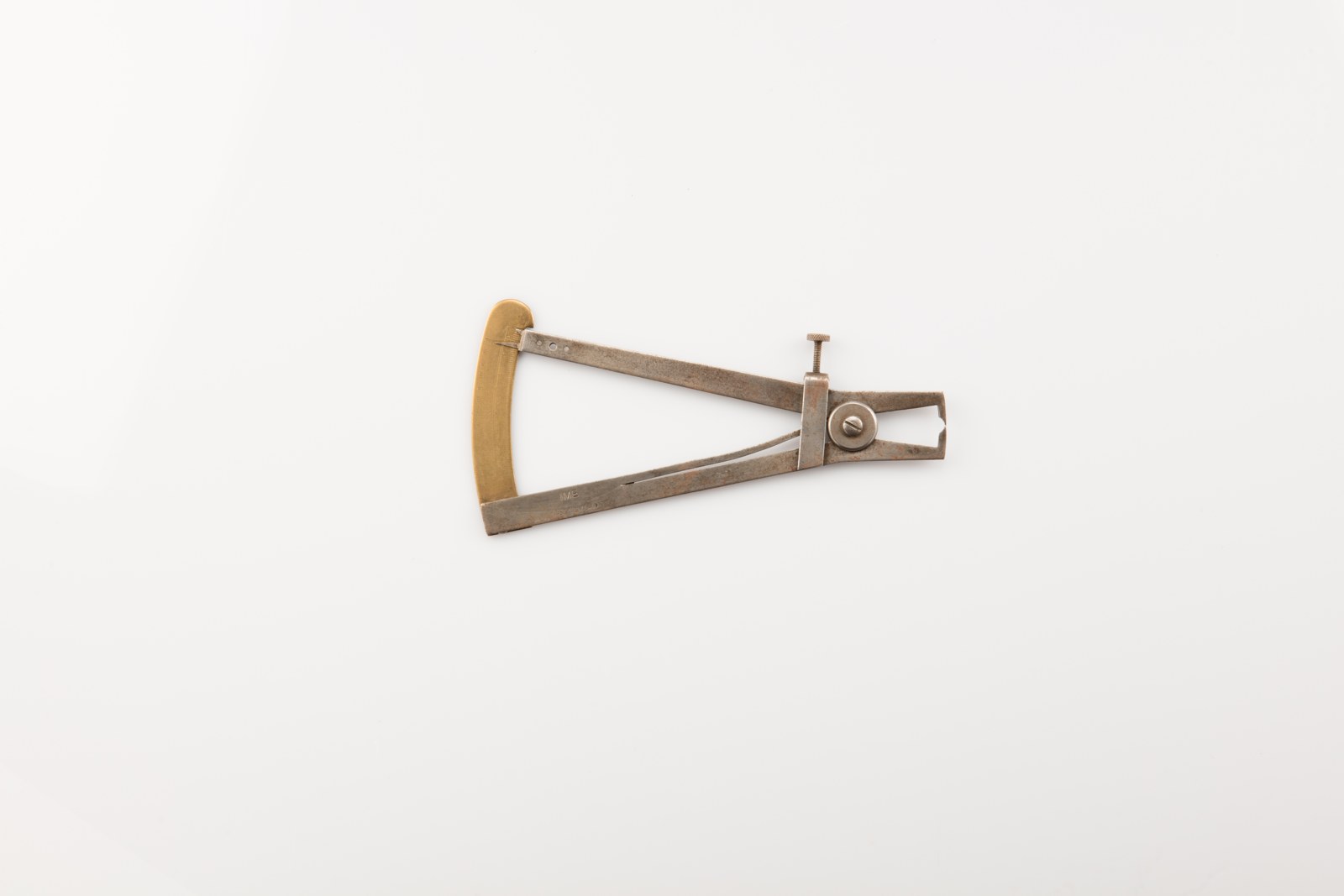
Figure 1. A combined dixième and douzième gauge in the Auckland Museum collection. The collection record dates it to about 1950 and describes it as measuring tenths of a millimetre and twelfths of a ligne. Photograph by Bong Errazo, Auckland Museum. Source: Wikimedia Commons, 2004.44.24. Licence: CC BY 4.0. Resized to 1,600 pixels on the longer side and recompressed as JPEG, with no cropping or colour changes.

Paul N. Hasluck’s The Watch Jobber’s Handybook, second revised edition (1889), describes a douzième gauge on p. 83 and shows it in fig. 44. It was used to measure the thickness of watch parts, especially plates. Hasluck explains that the opening of the jaws is measured as the length of a chord, whereas the pointer moves along a uniformly divided arc. The scale therefore cannot correspond perfectly at all openings. Watchmakers of the period were aware of how instrument geometry affected the reading as well as how the units converted.8
The gauge pictured is made of steel and brass, with two scales on its curved section. Its twelfths of a ligne and tenths of a millimetre show how one traditional unit and the metric system could both be used at the same workbench.4
The ligne in watchmaking today#
The BHI teaching material explains that in the second half of the twentieth century manufacturers and suppliers shifted to dimensions given mainly in millimetres, sometimes listing both units. Horopedia likewise describes the millimetre as the standard in present-day watchmaking, with micrometres for smaller dimensions and tolerances. The ligne continues to be used as a movement size designation.1 3
Gauges in historical repair books, manufacturers’ size groups and current product pages show how use of the ligne shifted from measuring parts to naming movement sizes. Conversion is useful when reading older documents, while work with current products calls for reading the size alongside the specified millimetre dimensions.
Timeline#
| Date or period | Recorded use or event |
|---|---|
| Medieval origins | Horopedia describes the ligne as an old unit equal to one twelfth of a pouce.3 |
| 1889 | Hasluck’s second revised edition describes and illustrates a douzième gauge for measuring the thickness of plates and other parts on p. 83, fig. 44.8 |
| c. 1890 | The Detroit Historical Society dates its 72-douzième, or 6-ligne, gauge to around this time.7 |
| c. 1950 | The Auckland Museum dates the pictured gauge with metric and ligne scales to around this time.4 |
| Late twentieth century | The BHI describes manufacturers and suppliers switching to millimetres or displaying both units.1 |
| 2016 | ETA’s mechanical movement catalogue lists size groups in lignes alongside diameters in millimetres.2 |
| Checked November 2026 | MIYOTA’s official site lists 9015 as 11½’’’ and lets users search movements by ligne size.5 6 |
References#
- British Horological Institute, Technician Grade Distance Learning Course, Lesson 4, version 3.0, ©2022, p. 10 (dimensions of watch cases and movements). PDF. Accessed November 13, 2026.
- ETA SA, Collection mouvements mécaniques / Mechanical Movements, 2016, pp. 2–3 and 8–10, among others (size groups and individual calibres). PDF. Accessed November 13, 2026.
- Horopedia, “Les longueurs et les angles”, undated, section “Unités en horlogerie”. Article. Accessed November 13, 2026.
- Auckland Museum, “Gauge”, collection 2004.44.24. Collection record, photograph and rights information on Wikimedia Commons. File description. Accessed November 13, 2026.
- Citizen Watch / MIYOTA, “9015 Premium Mechanical”, current product page. Accessed November 13, 2026.
- Citizen Watch / MIYOTA, “Movements”, product search and size filters. Accessed November 13, 2026.
- Detroit Historical Society, “Gauge”, accession 1973.102.002. Collection record. Accessed November 13, 2026.
- Paul N. Hasluck, The Watch Jobber’s Handybook, second edition, revised, Crosby Lockwood and Son, 1889, p. 83, fig. 44. Digitised edition. Accessed November 13, 2026.