This article was translated from Japanese using AI. Read the Japanese original
Reading the Earth’s orientation on a clock#
Sidereal time expresses in hours, minutes and seconds how far west of the observer’s meridian the vernal equinox lies on the celestial sphere. It increases with the Earth’s rotation and completes one cycle in 24 sidereal hours. An ordinary clock counts days tied to the Sun. Sidereal time tells us what right ascension is crossing the meridian. 1 2
The orientation of the Earth’s rotation axis changes through precession and nutation. A definition usable for all stars needs a celestial equator and an origin on it. Traditional sidereal time uses the vernal equinox, one of the intersections of the ecliptic and celestial equator. There is no visible marker at that point. 1
An observatory’s sidereal clock displayed this angle on a dial. Comparing the clock with the stars established the Earth’s orientation and allowed mean solar time to be calculated. This relationship made astronomical observations a reference for time signals and precision clocks. 3
Why a sidereal day is about four minutes shorter#
The Earth rotates as it orbits the Sun. Between one solar meridian transit and the next at a given place, the Earth must turn a little more than one rotation because the orbit has changed the direction of the Sun. The direction of distant stars changes much less. The stars therefore complete an apparent circuit before the Sun does. 3 4
The comparison is between one day averaged over actual solar days of changing length and one cycle of mean sidereal time. Sidereal time advances approximately 1.0027379 times as fast as mean solar time. The two conversions express the same relationship in different units. 2 4
| Interval | Length in the other time system |
|---|---|
| 24 sidereal hours | About 23 hours 56 minutes 4.1 seconds of mean solar time |
| 24 mean solar hours | About 24 hours 3 minutes 56.6 seconds of sidereal time |
The first divides 86,400 by 1.0027379 and the second multiplies 86,400 by the same factor. The dial completes a circuit in 24 hours, but that circuit takes less time in ordinary hours.
This ratio is an approximation over short periods. The period is not fixed forever in SI seconds, because the rotation rate itself changes and the origin of sidereal time moves. The US Naval Observatory explains that the mean sidereal day, which includes precession, is about 0.008 seconds shorter than the rotation period defined by the modern Earth Rotation Angle. 5
Right ascension, hour angle and longitude#
A star’s right ascension at transit gives the time#
Right ascension measures a body’s position eastwards along the celestial equator from the vernal equinox. Hour angle is measured westwards from the observer’s meridian to the body. With 15 degrees converted to one hour, and quantities for the same equator, origin and date, the relationship is as follows. 3
Here H is hour angle, θlocal is local sidereal time and α is right ascension, all expressed in time units. The angle can also be expressed between −12 and +12 hours, with negative values before transit and positive afterwards. At upper meridian transit H = 0, so the body’s right ascension equals local sidereal time.
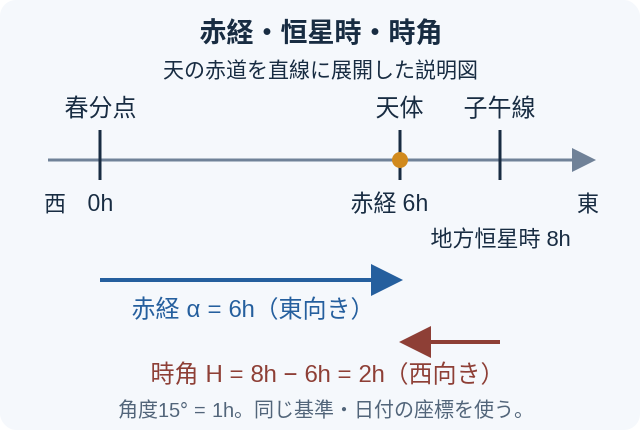
Figure 1. Explanatory diagram with the celestial equator laid out in a line. From a place where local sidereal time is eight hours, a body at six hours right ascension has a westward hour angle of two hours. Diagram by this site. It represents no particular observation or sky at a specific date and time. Principle from 3.
For example, if local apparent sidereal time is eight hours and the body’s apparent right ascension is six hours, the hour angle is two hours, or 30 degrees. The body is west of the meridian after upper transit. Bodies with the same right ascension differ in altitude according to declination. Sidereal time alone therefore does not give altitude. For precise directions, a catalogue right ascension at another epoch cannot simply be subtracted from apparent sidereal time at observation. 3 6
Local sidereal time advances eastwards#
Greenwich sidereal time refers to the Greenwich meridian, while local sidereal time refers to the observer’s meridian. If longitude λ is in degrees, positive east and negative west, the relation including conversion to time units is as follows. 2
θG is Greenwich sidereal time. At 135 degrees east, local sidereal time is nine sidereal hours ahead of Greenwich sidereal time. The offset converts the longitude angle into time units. Time-zone rules and Japan Standard Time play no part in this conversion.
When observation provides local sidereal time and Greenwich sidereal time is known for the same instant, the difference gives longitude. Conversely, at an observatory with known longitude, a star’s meridian transit can reveal the difference in the clock reading. Time and position observations use the same geometry in opposite directions. 1
Mean and apparent sidereal time#
Precession is the long-term change in the direction of the Earth’s rotation axis, and nutation is the periodic variation superimposed on it. Mean sidereal time uses the mean equator and equinox, while apparent sidereal time uses the true equator and equinox including nutation. At Greenwich these are GMST, Greenwich Mean Sidereal Time, and GAST, Greenwich Apparent Sidereal Time. 1 6
EqEq is the equation of the equinoxes and is expressed here in the same time units as the other two quantities. The similarly named equation of time is the difference between apparent and mean solar time. When using apparent sidereal time, the body’s right ascension also has to use a compatible definition. 2 6
“Mean” identifies the model of the reference equator and equinox. Setting a clock adjusted to mean sidereal time directly by individual stars without allowing for nutation would mix differences between the time system and celestial coordinates into the inferred clock error.
How observatories used it#
A precision clock between observations#
Because the equinox itself is invisible, observers timed the meridian transits of stars with known positions. Comparing the clock’s transit reading with the star’s position after the necessary corrections gave the clock error. Stellar observations established the time reference and a clock, such as a pendulum regulator, carried time continuously between observations. 3
An example is William Hardy’s eight-day sidereal regulator at Greenwich, made around 1811. The movement was installed in a stone compartment in 1850, and Dent added electrical contacts connected to a chronograph in 1854. The clock beats and the observer’s push-button record of the transit could then be compared on the same recorder. 7
A weight drives the train and a temperature-compensated pendulum maintains the rate. Dent replaced the original escapement with a deadbeat. The timing of the electrical contacts was arranged so their operation would not disturb the pendulum’s rate. Displaying sidereal time and maintaining a steady rate are separate design tasks. Temperature, lubrication and the load of the contacts all matter. 7
Observatory time and time for the town#
Sidereal time is convenient for observing stars. If used for rail services or public clocks, however, their time would shift against the Sun each day. Greenwich had to compare the sidereal time used for observations with the mean solar time it distributed.
Royal Museums Greenwich object ZAA0532 is a mean solar time slave clock following the Shepherd master clock. It was used at the time-comparison desk from 1852 to 1940 to compare mean solar and sidereal time. Electrical signals move its hands at one-second intervals. The sidereal clock, the time conversion, the master clock and clocks receiving the signal each had their own role. 8
The modern Earth Rotation Angle and UT1#
Separating rotation from the motion of the equinox#
Sidereal time includes motion of the equinox as well as rotation. Modern precision calculations define the Earth Rotation Angle, ERA, using the Celestial Intermediate Origin (CIO) on the equator of the Celestial Intermediate Pole (CIP), and the corresponding Terrestrial Intermediate Origin (TIO) on the Earth side. The CIO is defined to avoid extra rotation along the equator as the pole moves. It does not point to a particular star. 9
The framework from the IAU’s 2000 resolutions came into use in 2003. In 2006 it refined names including CIO and the precession model. The equinox and CIO methods can give the same transformation between terrestrial and celestial frames when used consistently. With the equation of the origins, EO, the relationship is GAST = ERA − EO in the same angular units. EO is distinct from EqEq, the equation of the equinoxes. 9
UT1 is Universal Time defined to have a linear relationship with ERA. The US Naval Observatory gives the following expression in turns. 5
DU is the number of UT1 days, including fractional days, since 12:00 UT1 on 1 January 2000, Julian Date 2451545.0. ERA is in radians and the dimensionless right-hand side takes one turn as one. The expression defines the relationship between UT1 and the rotation angle. 5
Atomic clocks still need observations of the Earth#
UTC is civil time based on atomic clocks. UT1 measures the Earth’s rotation. Precise sidereal-time calculations allow for their difference, and TT, Terrestrial Time, is also needed as the time argument of the precession and nutation models. Even with accurate clock seconds, the correct celestial orientation depends on using the appropriate time scale. 2 10
Modern very-long-baseline interferometry, or VLBI, measures differences in the arrival times of radio waves from distant quasars at widely separated antennas. Relating antennas fixed to the Earth to celestial references determines the Earth’s orientation. Radio sources, atomic clocks and computational models have replaced comparing a star crossing a telescope wire with clock beats. Observations of the sky are still needed to determine the Earth’s orientation. 11
IAU SOFA provides different routines, including GMST06, GST06A and ERA00, according to the quantity and model. Its documentation gives examples for both equinox-based and CIO-based calculations. 12
Chronology of uses#
| Date | Example or change |
|---|---|
| c. 1811 | Hardy’s sidereal regulator is made. A surviving observing clock, distinct from the earliest use of the term. 7 |
| 1852 | Greenwich time distribution uses a slave clock to compare mean solar and sidereal time. 8 |
| 1854 | Electrical contacts for a chronograph are added to Hardy’s clock. 7 |
| 2000 resolutions, implemented 2003 | The IAU introduces a system using the Earth Rotation Angle and non-rotating origins. 9 |
| 2006 | Names including CIO and TIO and the precession model are refined. 9 |
| SOFA documentation of 2023 | Explains sidereal time, ERA and coordinate transformations through model-specific routines and worked examples. 12 |
Sidereal time links the right ascensions of stars, terrestrial longitude and the observer’s meridian. It has connected precision clocks with astronomical observation. Before relying on digits of precision, establish whether the calculation is local or Greenwich, mean or apparent, equinox- or CIO-based, and whether its input is UTC or UT1.
References#
Online sources checked on 4 November 2026. PDF sections and pages are given below.
- National Astronomical Observatory of Japan, Ephemeris Computation Office, Calendar Wiki, “Sidereal time”, last updated 2020. Definition, longitude, mean and apparent sidereal time.
- U.S. Naval Observatory, “Computing Approximate Sidereal Time”. GMST, GAST, UT1, TT and conversion with longitude positive east. The formulas are approximate.
- National Astronomical Observatory of Japan, Ephemeris Computation Office, “On sidereal time”, from the 2015 Astronomical Ephemeris. Role and history, among other topics.
- National Astronomical Observatory of Japan, Ephemeris Computation Office, Calendar Wiki, “Solar time and sidereal time”. Definition and conversion between a sidereal and mean solar day.
- George H. Kaplan, The IAU Resolutions on Astronomical Reference Systems, Time Scales, and Earth Rotation Models: Explanation and Implementation, USNO Circular No. 179, 2005, §§2.6.2 and 6.1–6.3, especially printed pp. 16 and 51–54. ERA formula and distinction between sidereal day and rotation period.
- U.S. Naval Observatory, The Astronomical Almanac Glossary, based on the 2023 edition. Entries for sidereal time, Greenwich Mean Sidereal Time, apparent place and equation of the origins.
- Royal Museums Greenwich, “An eight-day sidereal regulator … by William Hardy, London, circa 1811”, ZAA0591. Collection description and mechanism.
- Royal Museums Greenwich, “Sympathetic chronometer”, ZAA0532. Time comparison from 1852 to 1940.
- IERS, IERS Conventions (2010), Chapter 5: Transformation between the International Terrestrial Reference System and the Geocentric Celestial Reference System, version of 10 August 2012, §§5.2 and 5.5.7, Eq. (5.30). CIO, TIO, ERA and the equation of the origins.
- U.S. Naval Observatory, “Universal Time”. Distinction between UT1 and UTC.
- NASA Goddard Space Flight Center, “VLBI”. Radio arrival-time differences and observations of the Earth’s orientation.
- IAU SOFA Board, SOFA Tools for Earth Attitude, software version 18, document revision 1.7, 31 May 2023, §§2.6–2.9, 3.6 and 4.2 and the specifications of ERA00, GMST06 and GST06A.