This article was translated from Japanese using AI. Read the Japanese original
The manufacturer behind the dial#
ETA, formally ETA SA Manufacture Horlogère Suisse, is a watchmaking company based in Grenchen, Switzerland, known in French as Granges. Part of the Swatch Group, it develops and manufactures the movements and components that keep time inside watches. Its work includes mechanical and quartz movements, mechanisms for Swatch and watch assembly. The group’s 2025 annual report lists it as a wholly owned company operating in watches, movements and components. 1 2
The maker of a movement often differs from the brand on the dial. ETA’s history traces the relationship between companies that develop and sell finished watches and factories that supply common movements to many companies. Today’s ETA grew from the consolidation of ébauche factories with different specialities. 3
What the dates 1793, 1856 and 1932 refer to#
ETA’s company history traces its earliest line back to an ébauche workshop opened in Fontainemelon in 1793 by four watchmakers. An ébauche is a basic movement with parts such as plates and wheels that still needs finishing, assembly or other work. The date reaches back through the businesses later consolidated into ETA. 3 4
In Grenchen, Josef Girard and Urs Schild founded a factory in 1856. The company later became Eterna and made both finished watches and basic movements. According to the “Eta” entry in the Historical Dictionary of Switzerland, its ébauches bore the name Eta from 1924, and it split in 1932 into Eterna SA for complete watches and Eta SA for ébauches. 5 6
The dates therefore place the early workshop in the consolidated lineage in 1793, the Grenchen predecessor in 1856 and the separation of Eterna and ETA in 1932. 3 5
From an association of ébauche factories to a single company#
In 1926 A. Schild, Fontainemelon and A. Michel founded Ebauches SA in Neuchâtel. The holding company brought together movement factories, and ETA later joined. Ebauches SA became part of ASUAG, the umbrella body reorganising the watch industry, in 1931. The industrial system of the time connected makers of finished watches with suppliers of basic movements and coordinated components, prices and exports. 4 7
The factories specialised in products including simple watches, small watches and chronographs. Their range of experience carried over into ETA’s later product lines. The spread of quartz watches and the industry crisis brought a need to reorganise factories, machinery, development and production. Mergers proceeded from 1978, and in 1982 ETA began overseeing Ebauches SA’s operations. 3 4
At group level, ASUAG and SSIH merged in 1983 and the group took the name SMH in 1985. ETA’s official history dates the consolidation of its dispersed factories into one enterprise to 1985. SMH became the Swatch Group in 1998. The manufacturing sites and companies were consolidated within a wider reorganisation of the parent group. 3 4 8
Supplying common movements#
A movement brings together a watch’s power source, gears, regulating system and mechanism for driving the hands. Its design is called a calibre. With a common calibre available, a watch company can design a case and dial around its dimensions and functions without developing the movement from scratch. ETA’s technical catalogue gives the movement diameter and height, indications, frequency and the available hand-fitting heights. 9
Movements may differ in specification, decoration, added functions and how they are fitted to a case. Hélène Pasquier, a historian at ETA, explains how automation of the 7750 family’s decoration in the 1990s enabled high-volume supply with finishes adapted to individual clients. Standardisation and customisation coexisted. 10
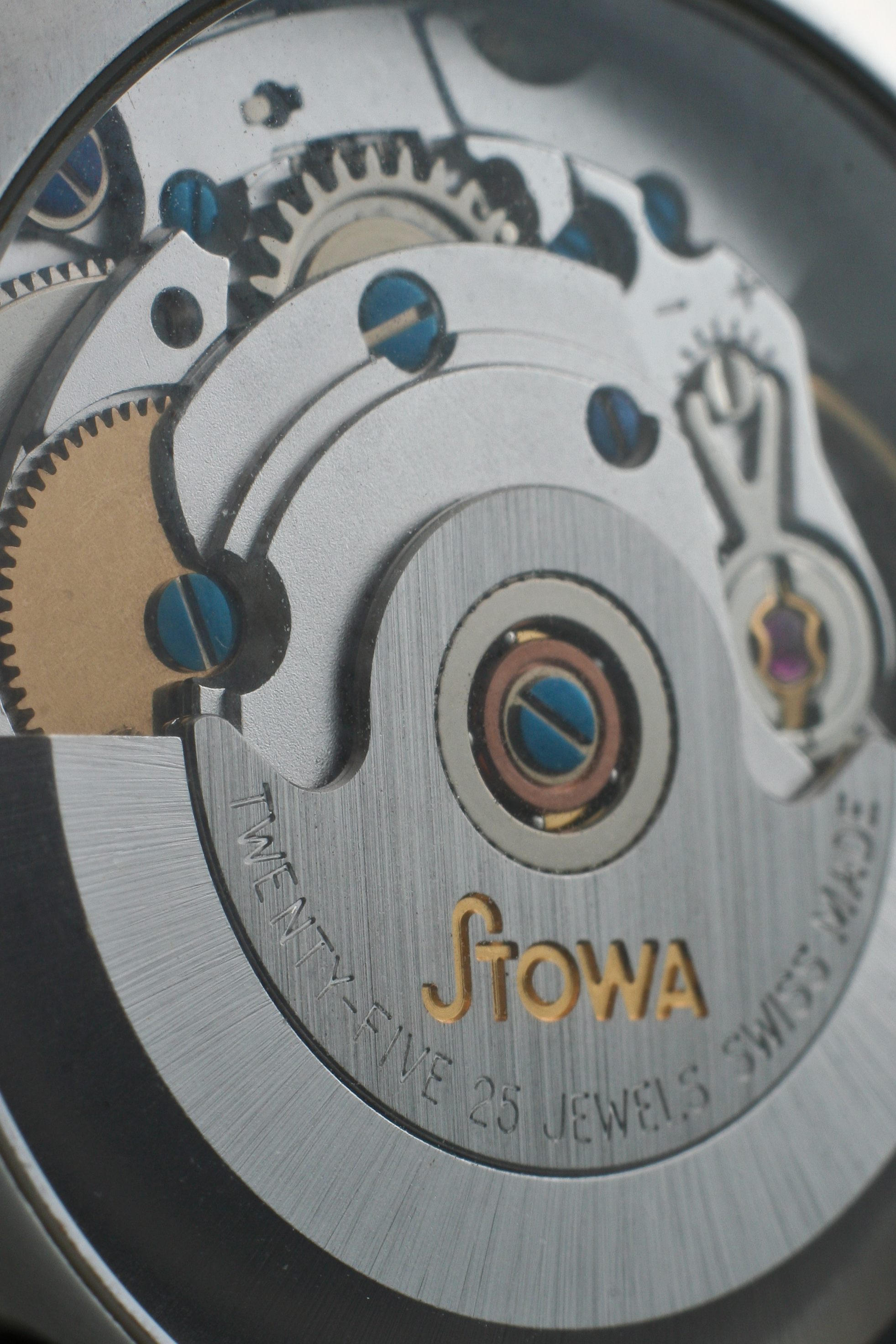
Figure 1. Close-up of the ETA 2824 in a Stowa Antea. The rotor carries STOWA, the brand of the finished watch. Photographed on 27 March 2009 by Guy Sie. Sources Stowa Antea ETA 2824 macro (Wikimedia Commons) and original Flickr photograph. Licensed CC BY-SA 2.0 Generic. Image unchanged.

Representative mechanical calibres#
ETA’s 2016 Mecaline catalogue lists the following three movements for different uses. The figures are the nominal specifications in that edition. 9
| Calibre | Catalogue features | Diameter and height |
|---|---|---|
| 2824-2 | Self-winding, centre seconds and date. 28,800 half-oscillations per hour, 25 jewels. | 25.60 mm and 4.60 mm |
| 2892A2 | Self-winding, centre seconds and date. 28,800 half-oscillations per hour, 21 jewels. | 25.60 mm and 3.60 mm |
| 7750 | Self-winding chronograph, day and date, cam-controlled operation. 28,800 half-oscillations per hour, 25 jewels. | 30.00 mm and 7.90 mm |
The 2824-2 and 2892A2 have the same diameter and different heights, illustrating the different requirements of a watch design. Alongside its ordinary time display, the 7750 has a chronograph for starting, stopping and resetting elapsed-time measurements. 9
The 7750 still carries the Valjoux name#
Valjoux developed the 7750 and introduced it at the Basel fair in 1973. Ebauches SA had commissioned a self-winding chronograph that could be made at lower cost and serviced more readily. Valjoux became an ETA factory in the reorganisation of 1 January 1985, and its name remained associated with the 7750. 10
In a cam-controlled chronograph, cams and levers change the state of the mechanism when the user presses a pusher. The 7750 adapts that arrangement to series production and the layout of its automatic winding system. Pasquier also reports that in 2020 ETA moved production from the 77xx Valjoux family to the A05 family. 10
Quartz and the industrialisation of Swatch#
Ebauches SA invested in the Swiss electronics watch research centre CEH and participated in work leading to the 1967 quartz prototypes and the industrial Beta 21 of 1970. In 1972 it presented the three-hand 9181 quartz movement, developed with Ebauches Electroniques Marin. 3
The thin Delirium of 1979 used the case as the structure supporting components. The 1983 Swatch relied on reducing the number of components and automating assembly. These projects designed the structure of a watch and its production process together. 3 8
Current quartz development also addresses the reliability of the display. ETA describes HeavyDrive as electronically detecting shocks and sending the motor a pulse in the opposite direction to prevent the hands from jumping. PreciDrive uses compensation for ambient temperature changes to improve accuracy. 11
Updating mechanical movements across company boundaries#
In its introduction to current mechanical technology, ETA says advances including changes to the barrel arbor and mainspring yield a typical 80-hour power reserve. 12
Work on magnetic resistance also draws on the group’s specialisations. ETA lists the Nivachron balance spring, made from a titanium-based alloy, among its technologies. Fellow group company Nivarox-FAR holds the trademark and related patents. 13
Why supply policy mattered to the wider industry#
For a watch company that uses another manufacturer’s movements, securing a continuing supply in the necessary quantities matters alongside quality. The Swiss Competition Commission, COMCO in French and WEKO in German, investigated ETA’s supply of mechanical movements. 14
An agreement approved in the decision of 21 October 2013 provided for a phased reduction in supply to ETA’s existing customers, with the supply obligation ending at the close of 2019. It also provided for equal treatment of customers and consideration of small and medium-sized companies. Assortments, the sets of regulating and escapement parts, were a separate supply issue from complete mechanical movements. 14 15
Following interim measures at the end of 2019, COMCO reached a decision in its review on 13 July 2020 and announced it on 15 July. It imposed neither a new supply obligation nor a restriction on supply, while maintaining its finding that ETA held a dominant market position. 15 16
Factories and skills today#
ETA’s site directory, checked on 4 November 2026, lists Grenchen, Moutier, Boncourt, Fontainemelon, Villeret, Sion, and Riazzino and Mendrisio in Ticino, among others. The different sites handle work including basic movements, components, exteriors, assembly and service. 1
The Swatch Group’s 2025 annual report says ETA is making its production equipment more flexible to accommodate small and special series alongside regular series. Industrial production technology also helps adapt equipment to differences in demand and specifications. 2
Supporting long-term use is part of the business. Customer services include spare parts, tools, repairs and technical information. The Customer Training Center offers training on specific movements tailored to a customer’s needs. Training people in manufacturing and service helps keep widely used movements in use for longer. 17 18
ETA brought together design and machining experience from many factories and combined common movements, client-specific specifications, assembly technology and service. Its history records how company consolidation and new technologies reshaped the division of labour in Swiss watchmaking. 3 4 10
Timeline#
| Date | Event |
|---|---|
| 1793 | The Fontainemelon workshop is founded. ETA uses this as the starting point in its official history. |
| 1856 | Girard and Schild establish the predecessor factory in Grenchen. |
| 1924 | The predecessor company uses the name Eta on its ébauches. |
| 1926 | A. Schild, FHF and A. Michel found Ebauches SA. |
| 1931 | Ebauches SA joins ASUAG. |
| 1932 | Eterna splits into Eterna SA for finished watches and Eta SA for ébauches. |
| 1967 | CEH presents Swiss quartz wristwatch prototypes. |
| 1970 | The industrial Beta 21 is introduced in Basel. |
| 1972 | Ebauches SA and EEM develop the three-hand 9181 quartz movement. |
| 1973 | The Valjoux 7750 is introduced in Basel. |
| From 1978 | Mergers and reorganisation within Ebauches SA. |
| 1979 | Delirium uses the case to support its components in a slim construction. |
| 1982 | ETA takes over operational oversight of Ebauches SA. |
| 1983 | ASUAG and SSIH merge. Swatch is introduced. |
| January 1985 | The Ebauches SA factories are consolidated as ETA manufacturing sites. |
| 1985 | The parent group takes the name SMH. |
| 1998 | SMH becomes the Swatch Group. |
| October 2013 | COMCO approves a phased reduction in supply of mechanical movements. |
| End of 2019 | The supply obligation specified in the 2013 agreement comes to an end. Interim measures are taken pending review. |
| July 2020 | COMCO decides against new supply obligations or restrictions and maintains its finding of a dominant market position. |
| 2020 | ETA’s company history records a move from making the 77xx Valjoux family to making the A05 family. |
Timeline based on 3 4 5 8 10 14 15 16. Current business and site information checked on 4 November 2026.
References#
1. ETA, “The Motorist of Time”, site directory, official company profile, accessed 4 November 2026.
2. Swatch Group, Annual Report 2025, pp. 15 and 72, official PDF, accessed 4 November 2026.
3. ETA, “History” / “Histoire”, English version and French version, accessed 4 November 2026.
4. German Vogt, “Ebauches”, Historisches Lexikon der Schweiz, revised 2 July 2009, German original, accessed 4 November 2026.
5. German Vogt, “Eta”, Dictionnaire historique de la Suisse, revised 26 August 2004, translated by Marie Ellenberger-Leuba, French version, accessed 4 November 2026.
6. Laurent Poupard, “Mécanismes d’horloge (2 mouvements de montre mécaniques A. Schild AS 960)”, dossier IM25005285, 2014, revised in 2015, history on p. 1, Bourgogne–Franche-Comté regional heritage survey PDF, accessed 4 November 2026.
7. Federation of the Swiss Watch Industry, “Our history”, section on 1926–1945, official industry history, accessed 4 November 2026.
8. Swatch Group, “Swatch Group History”, official history, accessed 4 November 2026.
9. ETA, Collection Mouvements mécaniques / Mecaline, 2016 edition, pp. 9, 17, 28 and 34–35, official catalogue PDF, accessed 4 November 2026.
10. Hélène Pasquier, “Valjoux 7750 – 50 ans d’histoire pour un mouvement d’exception”, Bulletin SSC, No. 96, December 2023, pp. 37–39, PDF published by the Swiss Society of Chronometry, accessed 4 November 2026. Author affiliated with ETA.
11. ETA, “Quartz knowhow”, HeavyDrive / PreciDrive, official technical description, accessed 4 November 2026.
12. ETA, “Improved power reserve”, official technical description, accessed 4 November 2026.
13. ETA, “Resistance to magnetism with Nivachron”, official technical description, accessed 4 November 2026.
14. WEKO, “WEKO genehmigt stufenweisen Abbau der Lieferungen von mechanischen Uhrwerken”, 25 October 2013, Swiss federal announcement, accessed 4 November 2026.
15. WEKO, “Swatch Group Lieferstopp / Ablauf Lieferverpflichtung”, decision of 13 July 2020, RPW/DPC 2021/2, pp. 306–395, especially pp. 308–309 and 394–395, published decision PDF, accessed 4 November 2026.
16. COMCO, “Décision de la COMCO concernant les mouvements ETA”, 15 July 2020, Swiss federal announcement, accessed 4 November 2026.
17. ETA, “Services”, Customer Service, official services page, accessed 4 November 2026.
18. ETA, “Customer Training Center”, official training page, accessed 4 November 2026.