This article was translated from Japanese using AI. Read the Japanese original
The Paris Clockmakers’ Trade Association (Chambre syndicale de l’Horlogerie de Paris) was a professional body formed by clock and watch manufacturers and merchants in the second half of the nineteenth century. It held skills competitions and decided in 1880 to establish the Paris School of Horology. At the 1900 Paris Universal Exhibition, it displayed old clock movements alongside makers’ benches and tools. The same association trained new craftspeople and showed how clocks had been made in the past. 1 2
Shared concerns in manufacturing and trade#
At a prize ceremony in 1886, the association’s president, Auguste-Hilaire Rodanet, dated its founding to about fourteen years earlier. He said French horological businesses had come together to examine common problems of production and trade in response to advances in manufacturing abroad. Vocational training was an early concern, and the association held a horological skills competition each year. According to Rodanet in 1886, employers, craftspeople and apprentices living in France could enter regardless of nationality. 1
The proceedings of the 1889 International Congress of Chronometry describe how regional factories supplied clock movements to Paris workshops. Factories in Saint-Nicolas-d’Aliermont and Montbéliard supplied ébauches, or unfinished movements. Paris workshops made the escapements that controlled the advance of the train, finished the movements and put them in cases. The same proceedings record a trend for regional factories to finish more of the work and ship movements ready for casing. With machine production of parts spreading in pocket watches as well, the congress discussed changes in manufacturing alongside vocational education. 3
The list of officers for the horological history exhibition at the 1900 fair includes Rodanet as president, Paul Garnier, who dealt in electric clocks, and Alphonse Moynet, who dealt in horological tools and parts, as the association’s vice-presidents, and Charles Diette as treasurer of the association and school. The collector Gérard Bacqueville was responsible for the association and school’s museum and library. People involved in manufacturing, tool supply, education and collecting all took part in the exhibition. 2
From competition to a school of horology#
At skills competitions, judges examined the pieces submitted and awarded prizes to outstanding craftspeople and apprentices. Rodanet was put in charge of the association in February 1880. At the general meeting on 12 July that year, members approved a school to provide systematic training. The Société de l’École d’horlogerie de Paris was formed to run it, and Rodanet said it raised about 50,000 francs that year. Practical workshops opened on 1 January 1881 and the formal inauguration took place on 6 March. The first address was 99 rue du Faubourg-du-Temple. 1 4
A presidential decree of 12 July 1883 recognised the school society as an organisation of public benefit, approved its statutes and required it to report annually to the Minister of Commerce. The school began receiving subsidies from the state and the City of Paris. As enrolment increased, it built new premises at 30 rue Manin near the Buttes-Chaumont. The foundation stone was laid on 24 April 1887 and the new building was formally inaugurated on 21 November 1888. 1 4
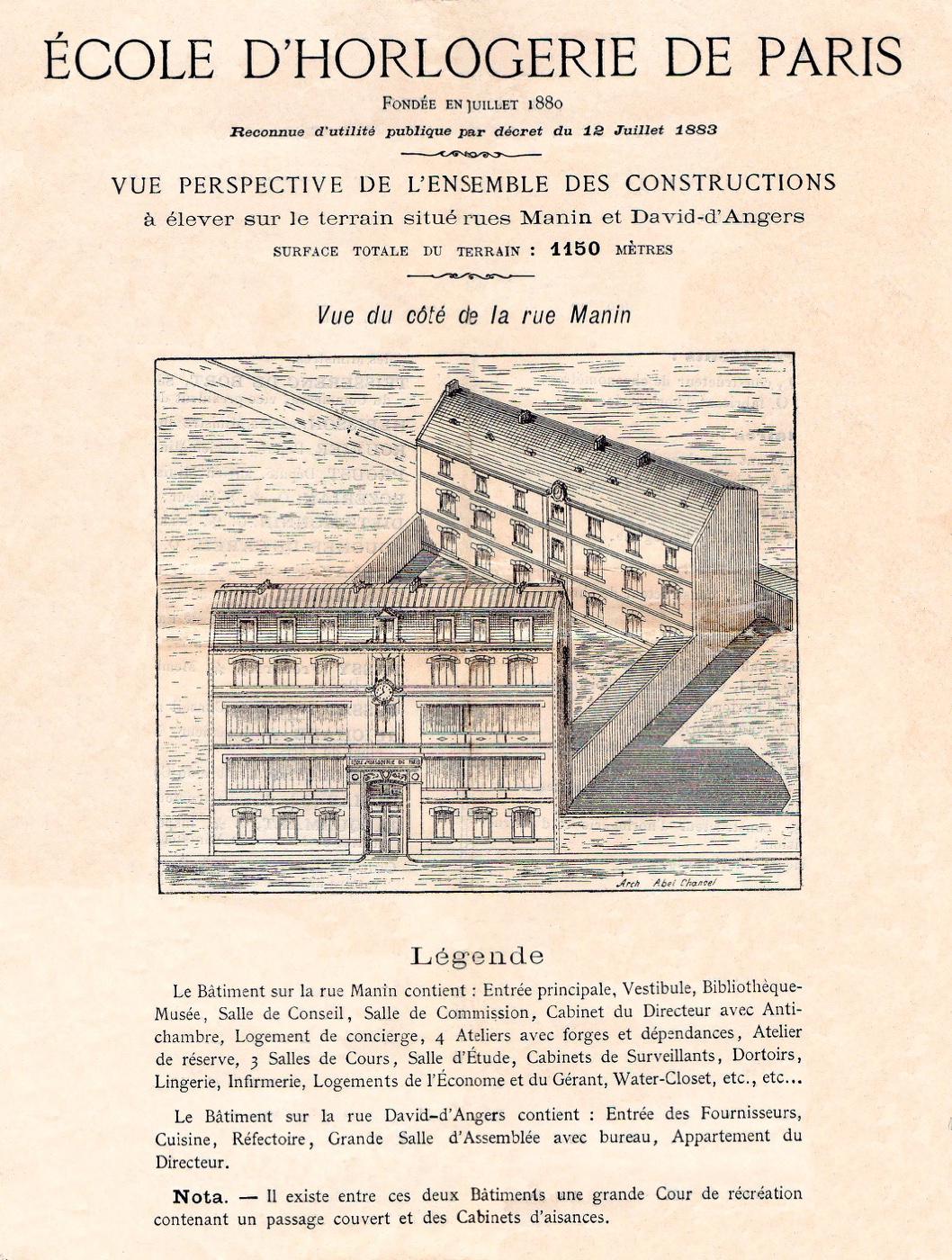
Proposed design for the Paris School of Horology seen from rue Manin. The drawing is signed by the architect Abel Chancel. Image by Elsa.ARB, Wikimedia Commons. Licence CC BY-SA 4.0. Resized and recompressed as a JPEG.

The periodical La Science illustrée reports that the new building had a library and museum on the ground floor, with drafting rooms and workshops upstairs. Practical work included preparing and finishing pocket-watch and mantel-clock movements, escapements, fitting jewels to support pivots, repair and rate adjustment, and work on chronometers. Classroom subjects included mathematics, mechanics, physics and drawing, as well as French and bookkeeping. The official bulletin of the 1889 exhibition reported that Rodanet presented President Sadi Carnot with a precision astronomical pendulum clock made by students. Participants in the International Congress of Chronometry also visited the rue Manin school that September. 3 4 5
Clocks and tools at the 1900 exhibition#
The official catalogue of the 1900 Universal Exhibition lists the association as exhibitor no. 36 in class 96, Horology, with makers’ work and drawings, books on horology and horologists’ tools. Mathieu Planchon’s report on the historical exhibition at the same fair discusses uncased clock movements exhibited by the association. Plate LVII, for example, shows an iron movement that transmits mainspring power through a conical fusee and gut line beside a weight-driven movement. Planchon says he had previously donated both to the association. Their display made it possible to compare ways of transmitting power normally hidden inside the case. 2 6
Planchon also presented a decimal regulator he attributed to Pierre-Louis Berthoud in 1793. It displays both Revolutionary decimal time and conventional time. A descendant, A.-L. Berthoud, reportedly donated the clock and the bench and tools Berthoud had used during his lifetime. The association’s exhibits included Ferdinand Berthoud’s longitude timekeepers and chronometers by Breguet father and son, which the report used to trace the development of precision timekeeping at sea. 2
The Archives de Paris lists the school at 30 rue Manin under the name “École d’horlogerie et de la mécanique de précision de la Ville de Paris”. The practical curriculum, fair catalogues and plates, and clocks and tools shown at the exhibition document the association’s work in teaching horological techniques and presenting their history through objects. 2 4 7
Sending pendulum beats by telephone#
Checking the rate of a precision clock requires comparison with a time standard. In 1903, Émile Guyou, who worked at the Montsouris Observatory, proposed sending Paris mean time to clockmakers by telephone. According to Guy Boistel’s study of Guyou’s correspondence, the association negotiated with the Ministry of Public Instruction to have a telephone line installed at the observatory. 8
In 1905, L’Illustration reported that at the association’s request, the observatory demonstrated a way to send the sound of a pendulum clock directly over the telephone line. The sender counted the first few beats aloud and the receiver counted seconds from the continuing sound. On 25 May that year, the chronometers aboard the naval vessel Escopette in Brest were reportedly adjusted against the Montsouris pendulum clock. According to Boistel, the telephone time project was discontinued in 1906 as plans advanced to transmit time wirelessly from the Eiffel Tower. 8 9
Timeline#
| Period | Event |
|---|---|
| Early 1870s | Horological businesses form an association to discuss common problems of production and trade. The date comes from Rodanet’s retrospective account in 1886. 1 |
| February and July 1880 | Rodanet is put in charge of the association. The general meeting of 12 July approves the school and its governing society is formed. 1 |
| January and March 1881 | Practical classes begin at 99 rue du Faubourg-du-Temple. The school is inaugurated on 6 March. 1 4 |
| July 1883 | A presidential decree recognises the school society as an organisation of public benefit. 1 4 |
| April 1887 | The foundation stone of the new school on rue Manin is laid. 1 4 |
| November 1888 | The new school building is formally inaugurated. 4 |
| 1889 | A precision astronomical pendulum clock made by students is presented to President Carnot. International Congress of Chronometry participants visit the school on 10 September. 3 5 |
| 1900 | The association shows work, drawings, books and tools in the horology class at the Paris exhibition and displays items from its collection in the historical exhibition. 2 6 |
| 1903–1906 | The association takes part in the Montsouris telephone time project. A trial of setting marine chronometers takes place in Brest in May 1905. 8 9 |
| Present | The Archives de Paris index lists the school records for 30 rue Manin under call number 3366W. 7 |
References#
- A.-H. Rodanet, L’Horlogerie astronomique et civile, 1887, pp. 132–134, 183–184 and 204. Speeches of 27 June 1886 and 24 April 1887, and presidential decree of 12 July 1883 reproduced at the end. Public copy of the Gallica volume. Accessed 20 November 2026.
2. Mathieu Planchon, Musée rétrospectif de la classe 96. Horlogerie. Rapport, report on the 1900 Paris exhibition, list of officers, preface, pp. 61–64 and 76–84, plates LVII, LXX, LXX bis and LXXIII–LXXIV. Text at CNAM. Accessed 20 November 2026.
3. Exposition universelle, Congrès international de chronométrie, proceedings of the 1889 Paris exhibition congress, list of officers, visit reports and pp. 38–40, “Notes sur l’horlogerie à l’exposition”. Text at CNAM. Accessed 20 November 2026.
4. La Science illustrée, “Inauguration de l’École d’horlogerie de Paris”, on the November 1888 opening, p. 33 of the annual volume PDF. Scan. Accessed 20 November 2026.
5. Bulletin officiel de l’Exposition universelle de 1889, vol. 1, report on Rodanet’s presentation of a precision astronomical pendulum clock to President Carnot. Text at CNAM. Accessed 20 November 2026.
6. Exposition universelle internationale de 1900, Catalogue général officiel, group 15, class 96, p. 11, French exhibitor no. 36. Digitised official catalogue. Accessed 20 November 2026.
7. Archives de Paris, Index par adresse des écoles et établissements d’enseignement, p. 29, École d’horlogerie et de la mécanique de précision de la Ville de Paris (3366W). Paris archives index by address. Accessed 20 November 2026.
8. Guy Boistel, L’Observatoire de la Marine et du Bureau des longitudes au parc Montsouris, 1875–1914, 2010, pp. 133–135, “Un service de l’heure (ou horloge parlante) pour les horlogers parisiens”. IMCCE edition. Accessed 20 November 2026.
9. L’Illustration, “La transmission précise de l’heure par téléphone”, 24 June 1905, no. 3252, p. 419. Project Gutenberg text. Accessed 20 November 2026.