This article was translated from Japanese using AI. Read the Japanese original
The Royal Irish Academy (RIA, Acadamh Ríoga na hÉireann in Irish) is a Dublin-based learned society supporting research in the sciences and humanities. Its role in the history of horology lies in recording the work of clockmakers and astronomers in papers that later readers could examine. Its 1788 volume contains a description of three pendulums made by the Dublin clockmaker John Crosthwaite.1 2
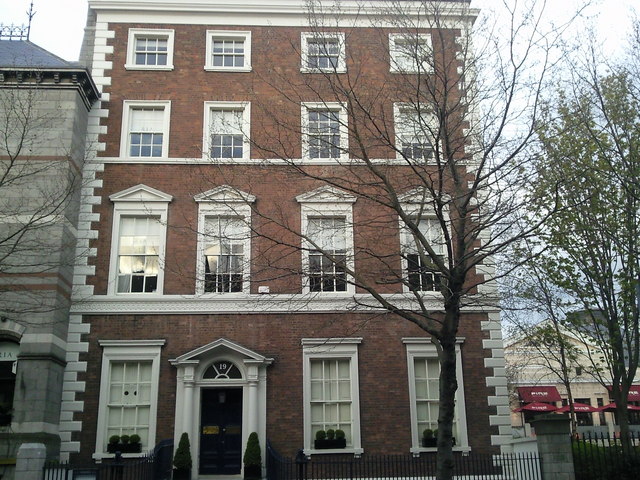
Figure 1. Exterior of Academy House, April 20, 2010. Image title: Royal Irish Academy, Dawson St, Dublin. Photograph by C O’Flanagan. Source: Wikimedia Commons, originally from Geograph. Licence: CC BY-SA 2.0. Unmodified.

Founding and structure#
The Academy was founded in May 1785 and incorporated by royal charter from George III in January 1786. Its first president was James Caulfeild, Earl of Charlemont.3
Its remit extended beyond science. The president’s statement of March 16, 1922, divides the Academy’s work into three broad areas: science, history and literature, and archaeology. Its scientific work included mathematics, chemistry, experimental physics, botany, zoology and geology. Timekeeping mechanisms were studied and published in this wider setting.4
The front matter of volume 16 of the Transactions, published in 1830, documents the organisation in the nineteenth century. It lists the president, John Brinkley, the vice-presidents, the Council, and committees on science and antiquities. Brinkley was an astronomer, showing one link between the Academy’s operation across disciplines and the study of astronomy.5
The Academy acquired a new building in 1851 and moved to Academy House, 19 Dawson Street, in 1852. This was still the address listed by its publishing division on November 11, 2026.3 6
From talks to a lasting technical record#
What the Transactions preserved#
According to its publishing division, the Academy began publishing the Transactions in 1787, recording the proceedings and papers of members. Printing material presented at meetings let researchers who were absent, and readers in later generations, consult the accounts.6
The difference between presentation and publication matters for horological history. Crosthwaite’s pendulum paper appeared in volume 2, pp. 7–11, in 1788, but the heading gives November 1, 1787, as the date it was read. The text also says that one pendulum had already been in use for eighteen years.2
The opening of volume 16 in 1830 includes a notice making the authors of papers responsible for their opinions, statements of fact and reasoning.5
Temperature compensation, materials and the surroundings#
Crosthwaite’s first pendulum used two rods made at the same time from the same steel and finished in the same condition. The arrangement sought to cancel the expansion of one rod with the expansion of the other, an approach distinct from compensation by different expansion rates in different metals. He was concerned both with the amount of expansion and with exposing the two rods to the air in the same way so they responded alike to changes in temperature.2
The paper also describes where the pendulum was installed. For its first ten years it was mounted on a partition wall and affected by a nearby door opening and closing. Afterwards, vibrations from coaches travelling along the road still caused trouble. The account considers the supporting wall, surrounding vibrations and exchange of heat with the air as part of the performance of a precision clock.2
Separating the suspension and the drive#
In the second pendulum, a flat diamond surface supports a conical tip of hardened steel, with three screws to level it. The pendulum rod is made of dried, oiled and painted wood and is supported from a wall independently of the clock. According to the paper, it continued swinging for 27 hours before drive from the clock was applied.2
In the third arrangement, the escape wheel has pins in place of ordinary teeth, acting directly on a receiving piece on the pendulum rod. The aim was to reduce the number of intermediate parts transmitting energy to the pendulum and to align the point of application with the centre of the rod. Crosthwaite lists jewelled receiving surfaces, finished steel pins, a fixed point of support and uniform driving force as ideal conditions. He used brass pins in the actual clock and proposed steel pins as an improvement.2
Crosthwaite also says he saw a clock in Britain that worked on a similar principle. The paper shows what the maker was trying to solve and where he saw scope for improvement. The Academy’s publication preserves material, thermal, frictional, support and driving considerations in one technical account.2
For more on the maker, see John Crosthwaite. For observing installations and the operation of their clocks, see Dunsink Observatory.
The library, research and publishing#
The Academy preserves knowledge in ways that extend beyond publishing papers. The 1922 statement records the gift of the Book of Ballymote in 1785 and the acquisition and cataloguing of manuscripts during the nineteenth century. It also names research in mathematics and physics by Hamilton, Lloyd, Brinkley, MacCullagh and others.4
Irish Script on Screen (ISOS), run by the Dublin Institute for Advanced Studies, offers one example of access today. Its description of the Academy’s manuscript collection includes liturgy, genealogy, law, medicine, literature and annals. Providing digital images makes the materials easier to consult while preserving the originals and allowing research at a distance.7
As described by the publishing division on November 11, 2026, the Academy publishes six academic journals covering earth science, biology and the environment, mathematics, international affairs, history, archaeology and literature, and Irish language studies. Alongside research monographs, its Prism imprint publishes books for general readers. Long-running publications such as the Irish Historic Towns Atlas and Documents on Irish Foreign Policy continue the work of editing and publishing beyond an individual meeting or paper.6
The RIA’s place in horological history comes from this continuing record. The public preservation of a clockmaker’s description of components and operating conditions allows readers to compare it with surviving clocks and accounts of other observations.2 5
Timeline#
| Date | Event |
|---|---|
| May 1785 | The Academy is founded. The Earl of Charlemont is its first president.3 |
| 1785 | The Academy receives the Book of Ballymote.4 |
| January 1786 | The Academy is incorporated by royal charter.3 |
| 1787 | Publication of the Transactions begins.6 |
| November 1, 1787 | Crosthwaite’s paper on three pendulums is read.2 |
| 1788 | The paper appears in volume 2, pp. 7–11.2 |
| 1830 | Volume 16 lists Brinkley and other officers and prints the notice concerning authors’ responsibility.5 |
| 1851–1852 | The Academy acquires a new building and moves to Academy House the following year.3 |
| March 16, 1922 | The president reports on scholarship, manuscripts and publishing at the annual meeting.4 |
| 2001 | The ISOS collection description explains the Academy’s participation in publishing manuscript images.7 |
| Checked November 2026 | The official publishing division lists six journals, research books and books for the general reader.6 |
References#
- Royal Irish Academy, About, official publishing division. Activities and address. Accessed November 11, 2026.
2. Attributed to John Crosthwaite, “An Account and Description of Three Pendulums Invented and Constructed by John Crosthwaite, Watch and Clock Maker, Dublin”, The Transactions of the Royal Irish Academy, vol. 2, 1788, pp. 7–11. The heading gives the date read as November 1, 1787. Accessed November 11, 2026.
3. J. J. O’Connor, E. F. Robertson and others, The Royal Irish Academy, MacTutor, University of St Andrews, updated 2004. Founding, charter, first president and relocation. Accessed November 11, 2026.
4. Royal Irish Academy, A Statement Made by the President at the Annual Meeting, March 16, 1922, especially pp. 1–3 and 9–11. Digitised copy at the University of California, Berkeley. Accessed November 11, 2026.
5. Royal Irish Academy, Transactions, vol. 16, part 1, front matter, 1830. Title page, notice concerning authors’ responsibility, lists of officers and committees. Accessed November 11, 2026.
6. Royal Irish Academy, About, publishing activity. The start of publication in 1787, six current journals, Prism and research series. Accessed November 11, 2026.
7. Siobhán Fitzpatrick, Royal Irish Academy, Irish Script on Screen, collection description dated 2001. Manuscript holdings and the purpose of publishing images. Accessed November 11, 2026.