This article was translated from Japanese using AI. Read the Japanese original
The brands on the dial and the group behind them#
The Swatch Group Ltd is a Swiss group that owns watch and jewellery brands, manufacturers of movements, components and electronic parts, and sales and servicing networks. Omega, Longines, Tissot and Breguet are among its brands. The companies that make the mechanisms inside the watches, including ETA and Nivarox-FAR, belong to the same group. The group’s role encompasses both the individual brands customers see and the industrial base they share. 1
The parent company’s registered office is in Neuchâtel and its administrative headquarters are in Biel/Bienne. The two predecessor groups merged and the first Swatch went on sale in 1983. The parent company took its present name in 1998. 1 2
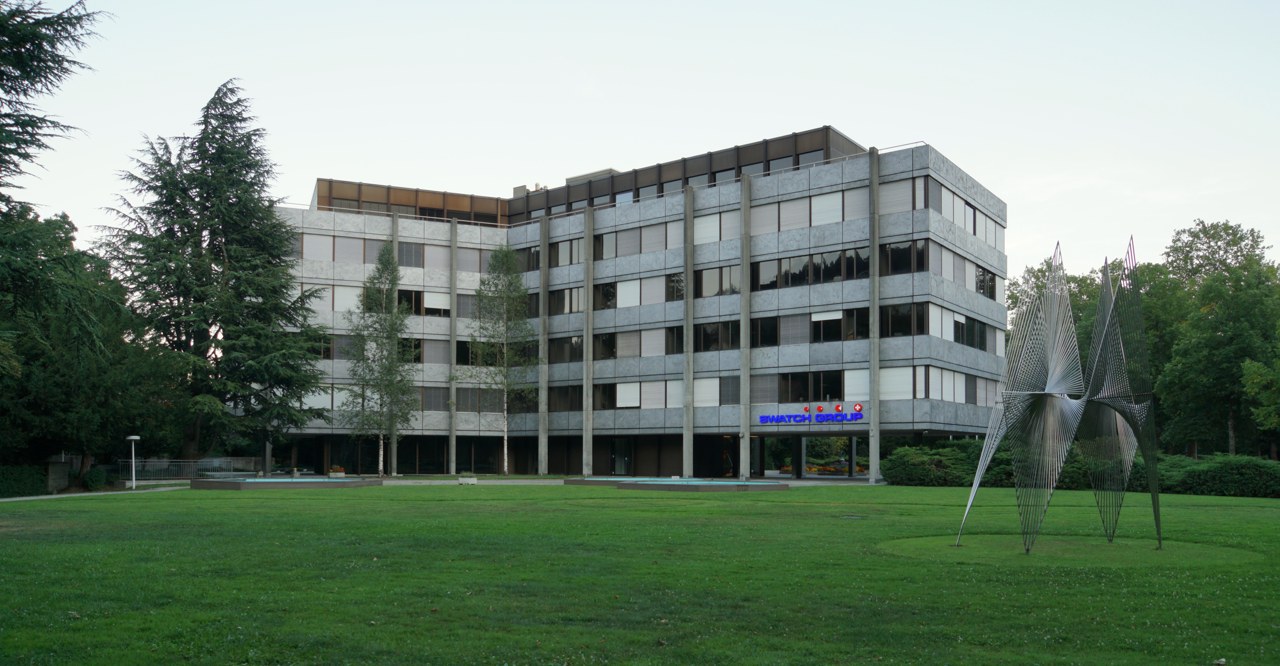
Figure 1. The group’s administrative headquarters in the former Omega headquarters, photographed in 2015. Photograph by TimotheusB, own work. Source Wikimedia Commons. Licence CC BY 4.0. Resized and recompressed as a JPEG, with no cropping or colour adjustment.

Two lines of descent, finished watches and components#
One predecessor, SSIH (Société suisse pour l’industrie horlogère), was founded in 1930 around the combination of Omega and Tissot. The other, ASUAG, was founded in 1931 as a body for restructuring the watch industry. Its main role was to bring manufacturers of movements and components together. ASUAG later also added finished-watch companies. 2 3
Competition from quartz watches explains only part of the crisis of the 1970s. Business historian Pierre-Yves Donzé also examines ASUAG’s rapid diversification and reliance on financing, SSIH’s declining competitiveness in low-priced mechanical watches, and support from the banks. Alongside the shift to electronic technology, the groups had to reorganise factories, products, financing and management. 3
ASUAG and SSIH merged in 1983. Consultant Nicolas G. Hayek helped draw up the recovery plan, then continued the restructuring through an investor group’s equity participation and his management of the business. The merger, share acquisition and assumption of executive responsibility are distinct events in the transition from a bank-led recovery to a different management structure. 2 3
The sources differ in how they date the name change and the appointment. The official history puts the name change to SMH (Société suisse de Microélectronique et d’Horlogerie) and Hayek’s appointment as CEO in 1985. Donzé treats 1983–1986 as the transition period for implementing the merger and dates Hayek’s management from 1986. 2 3
Mass production of Swatch and accounts of the recovery#
The Swatch that went on sale in 1983 was a quartz watch made with plastic. The company history says it had 51 components and was assembled on an automated production line. The project aimed to mass-produce affordable watches in Switzerland, with design, colour and the appeal of collecting as part of the offer. In 1985, Swatch Ltd was set up inside SMH, combining production by ETA with product planning and sales by the brand. 2
Donzé focuses on rationalising production, locating manufacturing internationally, positioning brands by price segment and taking a role in distribution. In his account of the recovery, the success of the Swatch is one part of a broader reorganisation. 3
A broad range of brands and vertical integration#
From the 1990s the group expanded its range to include high-end mechanical watches and jewellery. Blancpain and Frédéric Piguet joined in 1992, Breguet in 1999, and Jaquet Droz, Glashütte Original and Union Glashütte in 2000. The group acquired Harry Winston’s jewellery and watch business in 2013. These deals brought existing brands and manufacturing capabilities into the group. 2
The organisation chart in the year-end 2025 annual report lists several price segments, from luxury brands such as Breguet and Omega through Longines and Rado, Tissot and Hamilton, to Swatch and Flik Flak. 1
Vertical integration means that a single group handles multiple steps from materials and components to finished products, sales and servicing. The Swatch Group integrated these functions by bringing specialist companies together. The following are examples. 1 4
| Area | Representative companies or units | Role in watchmaking |
|---|---|---|
| Movements | ETA | Mechanisms inside watches and the capacity to manufacture and assemble them |
| Regulation and escapements | Nivarox-FAR | Balance springs, oscillators, escapements and other parts that govern the rate |
| External and display components | Comadur, Universo, Meco and others | Specialists producing materials, hands, operating components and other parts |
| Electronic systems | EM Microelectronic, Renata, Micro Crystal | Electronic circuits, batteries and quartz technologies |
| Sales | Tourbillon, Hour Passion and others | Retail networks that bring the group’s brands to customers |
| Research and shared services | Asulab, research and development teams, customer service | Support for development, intellectual property, quality and repairs |
In a mechanical watch the mainspring supplies power to the gears. The escapement releases the train in small steps at the intervals set by the oscillator, giving the watch a steady rate. In addition to regulating and escapement parts, Nivarox-FAR works with alloys for balance springs and with silicon components. Its role illustrates how the brands’ designs rely on manufacturing techniques for tiny components hidden inside the watch. 4
External supply and competition policy#
The shared production base also affects companies outside the group. ETA has supplied mechanical movements to external watch companies, so its supply policy had effects across the industry. In 2013, the Swiss Competition Commission (WEKO) approved an agreement for ETA to reduce deliveries to existing customers in stages. It also set out terms for equal treatment of customers and for avoiding hardship for small and medium-sized enterprises. Mechanical movements and regulating components were treated separately. The commission said that the requirement to supply regulating components would continue at that point. 5
In July 2020, the commission imposed no new supply duties or restrictions. It found that ETA remained dominant in the market for mechanical Swiss made movements, leaving it subject to oversight under competition law. 6
Leadership, training and scale#
The group’s official leadership list as checked on 13 November 2026 gives Nayla Hayek as Chair of the Board of Directors and Nick Hayek as President of the Executive Group Management Board. The 2025 annual report gives the combined holdings of the Hayek Pool and associated institutions and individuals as 44.5% of all voting rights at year-end. 1 7
Maintaining manufacturing capacity requires skills in assembly, adjustment and repair as well as equipment. The group trains watchmakers through vocational programmes and the Nicolas G. Hayek Watchmaking Schools. For example, its official description places the Miami school within the local customer-service operation and lists the 1,800-hour WOSTEP Customer Service Watchmaker programme. 8
According to the unaudited report for the first half of 2026, sales were CHF 3.121 billion, operating profit CHF 52 million and net profit CHF 16 million. The group had 31,331 employees at the end of June. Sales rose by 2.0% year on year at actual exchange rates and by 8.5% at constant exchange rates. 9
The group’s strength is its ability to pair brands at different price points with manufacturing and services spanning components through to repairs. This breadth also raises questions about capacity utilisation and retaining jobs when demand weakens, and about how to manage supply to outside customers. The group’s place in watchmaking history reflects both the success of the Swatch and the way it reorganised scattered industrial assets into a group linked to global markets. 3 9
Timeline#
| Year | Event |
|---|---|
| 1930 | SSIH is founded around Omega and Tissot. |
| 1931 | ASUAG is founded and becomes a basis for industrial restructuring in movements and components, among other areas. |
| 1983 | ASUAG and SSIH merge. The first Swatch goes on sale. |
| 1985–1986 | The name changes to SMH and management passes to Hayek. The official history and the research date these developments differently, as described above. |
| 1992 | Blancpain and Frédéric Piguet are acquired. |
| 1998 | The parent company changes its name to The Swatch Group Ltd. |
| 1999 | Breguet is acquired. |
| 2000 | Jaquet Droz, Glashütte Original and Union Glashütte join the group. |
| 2003 | Nick Hayek becomes CEO and President of the Executive Group Management Board. |
| 2010 | Nicolas G. Hayek dies. Nayla Hayek becomes Chair of the Board of Directors. |
| 2013 | The group acquires Harry Winston’s jewellery and watch business. WEKO approves a staged reduction in ETA’s deliveries. |
| July 2020 | WEKO announces that it will impose no new supply duties or restrictions on ETA. |
| July 2026 | The group publishes its 2026 half-year report. |
The timeline draws on the official history, annual report, independent research and WEKO announcements. 1 2 3 5 6 9
References#
- The Swatch Group Ltd, Annual Report 2025, 2026, pp. 5–10, 20 and 44, on the group structure, officers, addresses and voting rights.
2. Swatch Group, Swatch Group History, official history.
3. Pierre-Yves Donzé, The Comeback of the Swiss Watch Industry on the World Market: A Business History of the Swatch Group (1983–2010), Osaka University Discussion Paper 11-14, 2011, pp. 1–8 and elsewhere.
4. Swatch Group, Nivarox-FAR, manufacturing activities.
5. WEKO, WEKO genehmigt stufenweisen Abbau der Lieferungen von mechanischen Uhrwerken, 25 October 2013.
6. WEKO, WEKO-Entscheid zu ETA-Uhrwerken, 15 July 2020, p. 1.
7. Swatch Group, The Boards, leadership as listed on the date checked.
8. Swatch Group, Nicolas G. Hayek Watchmaking Schools, Miami section.
9. The Swatch Group Ltd, Half-Year Report 2026, 21 July 2026, pp. 1–4, 10.
Sources accessed or checked on 13 November 2026.