This article was translated from Japanese using AI. Read the Japanese original
The Synchronome Co. Ltd. was a London clock company that supplied electric master and secondary clocks. It put into practice a system in which a single pendulum clock kept time and sent signals by wire to several dials, serving applications from public time display to precision timekeeping for research. Frank Hope-Jones’s business began operating in 1895 and incorporated in 1912. 1
Origins and premises#
Hope-Jones and George Bennett Bowell developed electric clocks and obtained a patent in 1895 that included the Synchronome switch. According to Dollar Museum’s history, they organised the Synchronome Syndicate Company in 1897 and moved to London, after which Bowell left. Hope-Jones continued the business. The company incorporated in 1912 and was based at 32–34 Clerkenwell Road. 1
Trading records document its early names. According to the guide to the invoice book published by the University of Queensland Physics Museum, the invoice of 26 March 1902 was issued in the name of Synchronome Syndicate Ltd., while invoices from October that year onward used The Synchronome Company. 2
The master clock keeps time and the secondary clocks display it#
A master-clock system separates the device that measures time from those that display it in different places. In the Synchronome system, a gravity arm falls to impulse the pendulum, and an electromagnet lifts the arm back to its starting position. In the mechanism preserved by the Institution of Mechanical Engineers (IMechE), this action takes place every 30 seconds, and the same circuit could drive multiple receiving clocks. The transmitting clock installed when the institution’s headquarters at One Birdcage Walk opened in 1899 governed the displays throughout the building. 3
This division of work lets clocks in different places show the same time without a separate precision pendulum or regulator for each dial. The displayed times can agree even when the master clock differs from the time standard.
A public installation in Dollar, Scotland, illustrates the arrangement. In 1912, master clock No. 348 in the town hall drove the four dials of the William Spence memorial clock near the bridge by electrical pulses. The equipment that kept time could be maintained indoors while the time was displayed outside. 1
Manufacture of free-pendulum clocks#
Synchronome’s best-known research instrument was William Hamilton Shortt’s free-pendulum clock. First realised in 1921, it separated the pendulum that provided the time reference from a subsidiary clock that handled tasks such as driving the display. An electrical connection linked the two. The aim was to free the reference pendulum as far as possible from the work of driving gears. According to The Clockworks, Synchronome manufactured Shortt’s free-pendulum clocks apart from experimental clock No. 0. Its Clerkenwell offices were also used for early experiments. 4
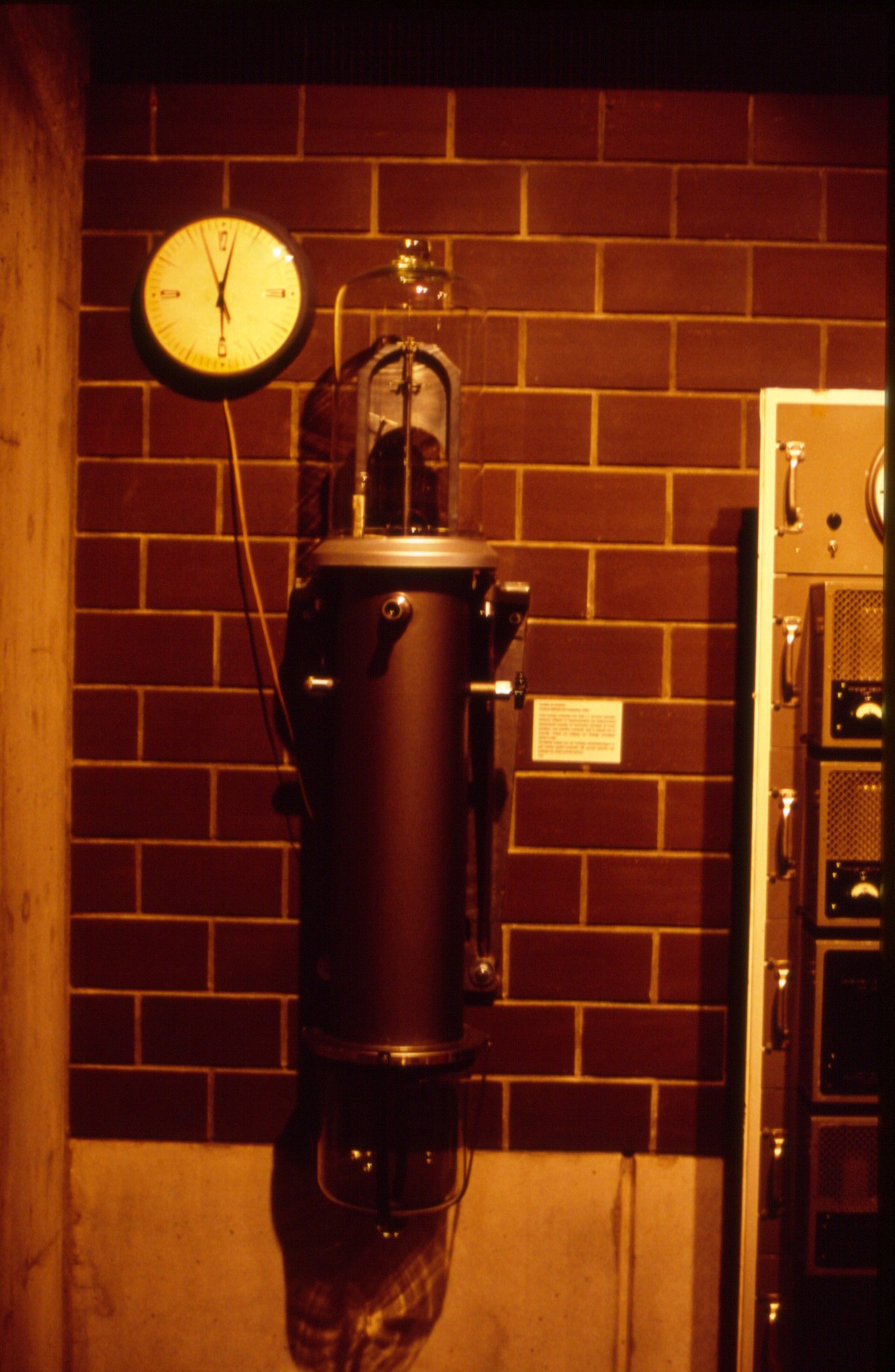
Figure 1. Tank containing the reference pendulum of a Shortt–Synchronome clock. Photographed at the International Museum of Horology, La Chaux-de-Fonds. By Rama, 27 September 2006. File name MIH-film31jpg.jpg. Source Wikimedia Commons. Licence CC BY-SA 2.0 France. Reproduced unchanged.

Shortt designed the clock, while Synchronome provided manufacturing and a place to develop it. The plate on The Clockworks’ No. 47 records Shortt’s design in collaboration with the company and gives its London address. According to the collection record, this clock was sent to the Sternberg Astronomical Institute in Moscow in the 1930s. 4
In 1929 the US National Bureau of Standards (NBS, now NIST) also bought a Shortt clock from Synchronome in London. NIST records that the clock took over as the time standard from a Riefler clock and was later replaced by quartz oscillators. It exemplifies the adoption of Synchronome’s precision pendulum clocks by a national metrology institute. 5
Overseas supply and the Brisbane company#
Early records document supplies to Australia. A March 1902 invoice lists a self-winding pendulum master clock for electrical control, one 12-inch dial and five dial mechanisms that advanced their hands in steps. Invoices from 1903–1904 also list bracket clocks and mechanisms and hands for large dials. The company supplied components for assembling multiple displays as well as complete clocks. 2
According to Museums Victoria, Albert George Jackson established the Synchronome Electrical Co in Brisbane in 1904. It supplied clocks using the system developed in Britain. The museum attributes the 1938 master clock and three secondary clocks in its collection to the Brisbane company. 6
Its place in horological history#
Synchronome’s work was distinguished by making clocks operate as a system. Public master-clock installations kept dials in agreement, while Shortt’s clocks reduced the load on the pendulum for observations. Both divided the work of keeping and displaying time and connected the two electrically. The company’s work spanned ordinary master-clock systems and Shortt’s precision instruments, with related businesses overseas. 346
Timeline#
| Year | Event |
|---|---|
| 1895 | Hope-Jones and Bowell receive a patent for an electric clock and the Synchronome business begins. 1 |
| 1897 | They organise the Synchronome Syndicate Company and move to London. 1 |
| 1899 | A transmitting clock is installed when the IMechE headquarters opens. 3 |
| 1902 | Surviving invoices record master clocks and dial mechanisms for Australia. 2 |
| 1904 | Jackson establishes a separate business in Brisbane. 6 |
| 1912 | The British business incorporates. A master clock is installed for the public clock in Dollar. 1 |
| 1921 | Shortt’s free-pendulum clock is realised. 4 |
| 1929 | NBS buys a Shortt clock from Synchronome. 5 |
References#
- Dollar Museum, Synchronome, company history and description of clocks in the collection. Accessed 8 November 2026.
- University of Queensland Physics Museum, SYNCHRONOME INVOICE BOOK, pp. 1–3, invoices and commentary. Accessed 8 November 2026.
- Institution of Mechanical Engineers, Hope-Jones synchronome remontoire, IME/13/7/40. Accessed 8 November 2026.
- The Clockworks, William Hamilton Shortt’s ‘Free pendulum’ clock, 1921, plate, provenance and detailed description. Accessed 8 November 2026.
- National Institute of Standards and Technology, Second: The Past, “A new timekeeper enters the scene.” Accessed 8 November 2026.
- Museums Victoria, Electric Clock - Synchronome Electric Clock Co, Brisbane, 1938, ST 20780. Accessed 8 November 2026.