Alfred Niaudet-Breguet#
This article was translated from Japanese using AI. Read the Japanese original
Alfred Niaudet-Breguet (Alfred Niaudet, 1835–11 October 1883) was an engineer at the Breguet workshop in Paris. In 1866 he reported on a clock that used a tuning fork in place of a pendulum to regulate the gear train and a hand to count the vibrations. He also worked on the workshop’s electrical instruments. In 1877 he received a telephone from Alexander Graham Bell to demonstrate in France. 1 2 7 15
Joining the Breguet workshop#
The French archival authority record gives his name as Niaudet-Bréguet. The 1866 Academy of Sciences report uses Niaudet-Breguet, while the 1883 obituary in La Nature calls him Alfred Niaudet. His mother was Mathilde Lassieur, whose younger sister Eugénie Caroline was married to the clockmaker Louis-Clément Breguet. His maternal grandfather, Jonas Louis Lassieur, was also a clockmaker and had ties to the Breguet workshop. 1 3 4 8
According to art historian Michelle Foa, Niaudet, his mother and his sisters moved in with the Breguet family on the Île de la Cité while he was still a child. Edgar Degas, whom Niaudet met at the Lycée Louis-le-Grand, was a frequent visitor and painted Niaudet’s portrait around 1877. A pocket-watch chain is visible on his waistcoat. Historian of scientific instruments Paolo Brenni dates Niaudet’s entry into the workshop to 1854. At the time, the workshop made clocks and watches as well as telegraph instruments and electrical railway signalling equipment. 1 5
Counting the vibrations of a continuously running fork#
Transferring energy between the gear train and the tuning fork#
A tuning fork produces a fixed pitch when struck, but left alone its amplitude dwindles and it eventually stops vibrating. Niaudet’s idea was to connect a tuning fork of the kind used to measure short intervals to a clock’s gear train to keep it vibrating. In his report to the Academy of Sciences on 10 December 1866, he cited Duhamel as a predecessor in the use of tuning forks to measure short intervals. 2
Through the escapement, the tuning fork controls the advance of the gear train, and the train gives the fork small impulses in return. Georges Sire, reporting on horology at the 1867 Paris Universal Exposition, wrote that the exhibited mantel clock used an anchor escapement. Each swing of the fork in either direction released one escape-wheel tooth, which then pushed the anchor. A dial and a hand connected to a train arbor made it possible to count the intervals set by the fork. The train supplies power and the fork determines when it is released, with both acting through the same escapement. 2 6
The original report’s counting convention matters when interpreting the rates. By a “single vibration,” Niaudet meant one swing in one direction. The first fork made roughly 100 single vibrations per second, or about 50 complete cycles per second (about 50 Hz). He next tried a fork making about 200 single vibrations per second and reported that it worked without modification to the device. He also proposed slowing a fork by symmetrically attaching equal weights to its two prongs. 2
Optical comparison and limits at higher frequencies#
Using Lissajous’s optical method, Niaudet compared the fork connected to the clock with an independent fork set vibrating by hand. He said that their oscillations continued to match once brought into agreement, even when he doubled and tripled the clock’s driving weight. This was a comparison of the prototype under different levels of driving power. In addition to measuring small fractions of time, the original report proposed driving recording instruments uniformly and synchronising two high-speed trains for telegraphy. 2
Running the escapement faster placed greater demands on it. According to Sire, a trial with a fork making 512 single vibrations per second (256 Hz) required considerable power to keep advancing the teeth against the inertia of the escape wheel and caused heavy wear in the escapement. Sire also noted that the exhibited fork was secured to a sliding mount, which made it possible to adjust the depth of engagement with the escapement. His observation that temperature affected the depth shows that the point of contact that transmitted the oscillations to the train also needed adjustment. 6
The surviving Breguet No. 1150#
The Musée international d’horlogerie (MIH) in La Chaux-de-Fonds holds Breguet No. 1150 as a mantel clock made in Paris in 1868 (IV-337). Its nickel-plated brass case is glazed on four sides and the ring dial has a small seconds hand at the top. The movement has two barrels and a 250 mm steel tuning fork with one prong in contact with the escapement. The museum specifies 100 Hz for this clock, or 100 complete cycles per second. 9
The MIH traces the movement to French patent no. 73414, in Louis-Clément Breguet’s name. In the original 1866 report, Niaudet described the prototypes and optical comparisons in the first person, and Sire discussed the exhibit under the name Niaudet-Breguet. In his 1882 book, acoustical instrument maker Rudolph Koenig recalled that clocks of the type Niaudet had reported on were exhibited at the Paris Universal Exposition in 1867 and the Vienna Universal Exposition in 1873. 2 6 9 10
From a hand that shows the time to a pen that records it#
In 1874 Niaudet described Étienne-Jules Marey’s short-interval recorder in La Nature. He explained in turn Lissajous’s circuit for driving a tuning fork with an electromagnet, Mercadier’s dry contact using platinum, and the recording electromagnet Marey added. The recording electromagnet worked in the same circuit as the fork. A fine pen attached to its moving piece left marks at hundredth-of-a-second intervals on a soot-blackened rotating surface. Recording another phenomenon on the same surface made it possible to compare the two traces and read off the elapsed time. 11
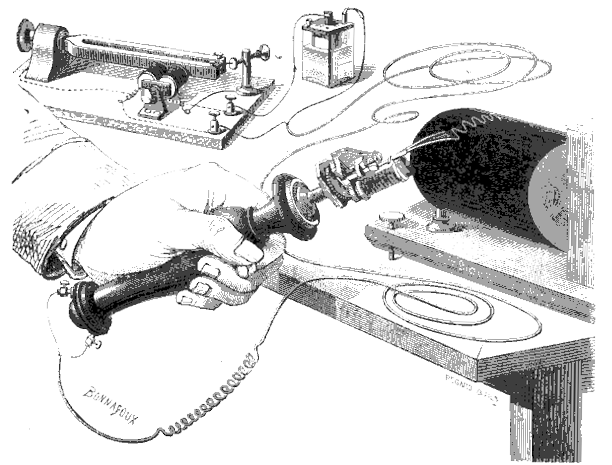
Figure 1. Marey’s short-interval recorder. Illustration from Niaudet-Breguet’s 1874 account, signed Bonnafoux at lower left. Source and rights information: Wikimedia Commons file description. Public domain. Unmodified.

The method of using a train to sustain a tuning fork and count its vibrations was also used in instruments for measuring frequency. In Koenig’s comparator, a fork making 128 single vibrations per second drove the gear train, and the hand on a small dial with 128 divisions completed one turn per second. An adjusting screw on the prong allowed the fork’s period to be varied. By comparing the hand’s gain or loss with a chronometer of known rate, an observer could measure the fork’s frequency and study the effects of temperature under different conditions. Among later examples, Case Western Reserve University preserves a wind-up tuning-fork counter made by Max Kohl. 10 12
Demonstrating the telephone and working in the electrical industry#
According to his obituary, Niaudet organised telegraph operations for the Army of the Rhine during the Franco-Prussian War of 1870. After the war he helped introduce new communications equipment. 8
In a letter to Gardiner Greene Hubbard on 1 November 1877, Bell wrote that he had given Niaudet a telephone to exhibit in France. Niaudet presented Bell’s telephone to the French Physical Society on 2 November. La Nature reported that attendees tried holding a conversation over a line from the meeting hall to the basement and listened to a music box over a second line to the floor above. Communications historian Jesús Sánchez Miñana identifies Niaudet and the Breguet workshop as early participants in the spread of the telephone in France. 7 13 16
The 1883 obituary describes Niaudet as a member of the French Physical Society from its founding. He served as an officer of the Société Générale des Téléphones and as chairman of the Compagnie Internationale des Téléphones, among other positions. In addition to papers, he wrote books on batteries and generators. The catalogue of the electricity retrospective at the 1900 Paris Universal Exposition listed his book on direct-current machines, including the Gramme type. His 1866 report had already proposed applying the tuning fork used to regulate clocks to recording and communications equipment. 2 8 14
Chronology#
| Year | Event |
|---|---|
| 1835 | Alfred Niaudet is born. 3 |
| 1854 | According to Brenni, he begins working at the Breguet workshop in Paris. 1 |
| 1866 | On 10 December he reports on a mechanical tuning-fork clock at the Academy of Sciences. 2 |
| 1867 | A tuning-fork mantel clock appears in the machinery exhibition at the Paris Universal Exposition. Brenni also dates the transfer of the clock and watch business to Edward Brown to this year. 1 6 |
| 1868 | Breguet No. 1150 is made in Paris. It is now held by the MIH. 9 |
| 1870 | According to the La Nature obituary, Niaudet organises telegraph operations for the Army of the Rhine. 8 |
| 1873 | According to Koenig, a tuning-fork clock is also shown at the Vienna Universal Exposition. 10 |
| 1874 | Niaudet describes Marey’s short-interval recorder in La Nature. 11 |
| 1877 | Bell supplies a telephone for demonstration in France. Niaudet presents it at the French Physical Society on 2 November. 7 16 |
| 1882 | Koenig describes a comparator using a tuning-fork clock in his book and mentions Niaudet’s report and the exposition exhibits. 10 |
| 1883 | Niaudet dies on 11 October. An obituary appears in the 27 October issue of La Nature. 8 15 |
| 1900 | The catalogue of the electricity retrospective at the Paris Universal Exposition lists his book on direct-current machines. 14 |
References#
- Paolo Brenni, “19th Century French Scientific Instrument Makers, XII: Louis Clément François Breguet and Antoine Louis Breguet”, Bulletin of the Scientific Instrument Society, no. 50, 1996, pp. 19–24.
2. Niaudet-Breguet, “Application du diapason à l’horlogerie,” Comptes rendus de l’Académie des sciences, vol. 63, 10 December 1866, pp. 991–992. Original volume.
3. FranceArchives, “Niaudet-Bréguet, Alfred (1835–1883)”, personal authority record.
4. Cahiers du Centre de généalogie protestante, no. 120, Breguet family genealogy, pp. 188–189.
5. Michelle Foa, “The Making of Degas: Duranty, Technology, and the Meaning of Materials in Later Nineteenth-Century Paris”, nonsite.org, no. 27, 11 February 2019, fig. 5 and notes 14–20.
6. Georges Sire, L’horlogerie à l’Exposition universelle de 1867 à Paris, 1870 offprint, pp. 79–80. CNUM, 8K396.
7. Alexander Graham Bell, letter to Gardiner Greene Hubbard, 1 November 1877, Library of Congress, magbell.07900418.
8. “Nécrologie — Alfred Niaudet”, La Nature, no. 543, 27 October 1883, p. 350. CNUM, 4KY28.21.
9. Musée international d’horlogerie, “Pendule à diapason”, 1868, IV-337, no. 1150.
10. Rudolph Koenig, Quelques expériences d’acoustique, 1882, pp. 173–175, fig. 47.
11. Alfred Niaudet-Bréguet, “Chronographe du Dr Marey”, La Nature, 9 May 1874, pp. 353–354.
12. Case Western Reserve University, Department of Physics, “Tuning Fork Clock”, tuning-fork counter by Max Kohl.
13. Jesús Sánchez Miñana, “Bell’s Travels to Paris and the Introduction of His Telephone into France (1877–78)”, The Circulation of Science and Technology: Proceedings of the 4th International Conference of the ESHS, published 2012, pp. 233–235 and notes 2–8.
14. Musée rétrospectif du groupe V : électricité, report on the retrospective at the 1900 Paris Universal Exposition, entry 172. CNUM, 8XAE511.
15. Société philomathique de Paris, Bulletin de la Société philomathique de Paris, list of members, p. XXI (Niaudet entry).
16. “Société française de physique — Première expérience du téléphone à Paris”, La Nature, no. 232, 10 November 1877, pp. 383–384 (meeting of 2 November). CNUM, 4KY28.9.
All sources accessed on 21 November 2026.